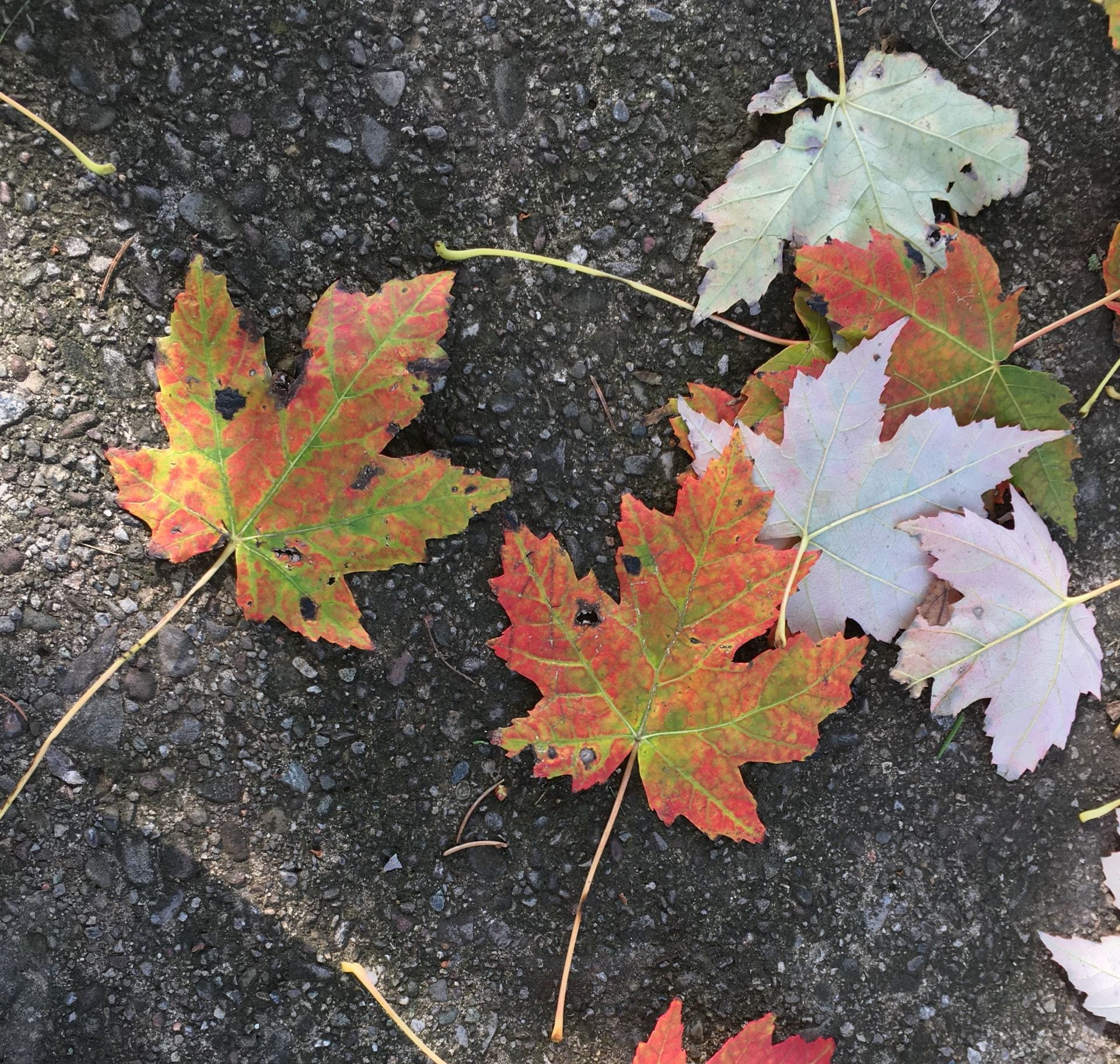
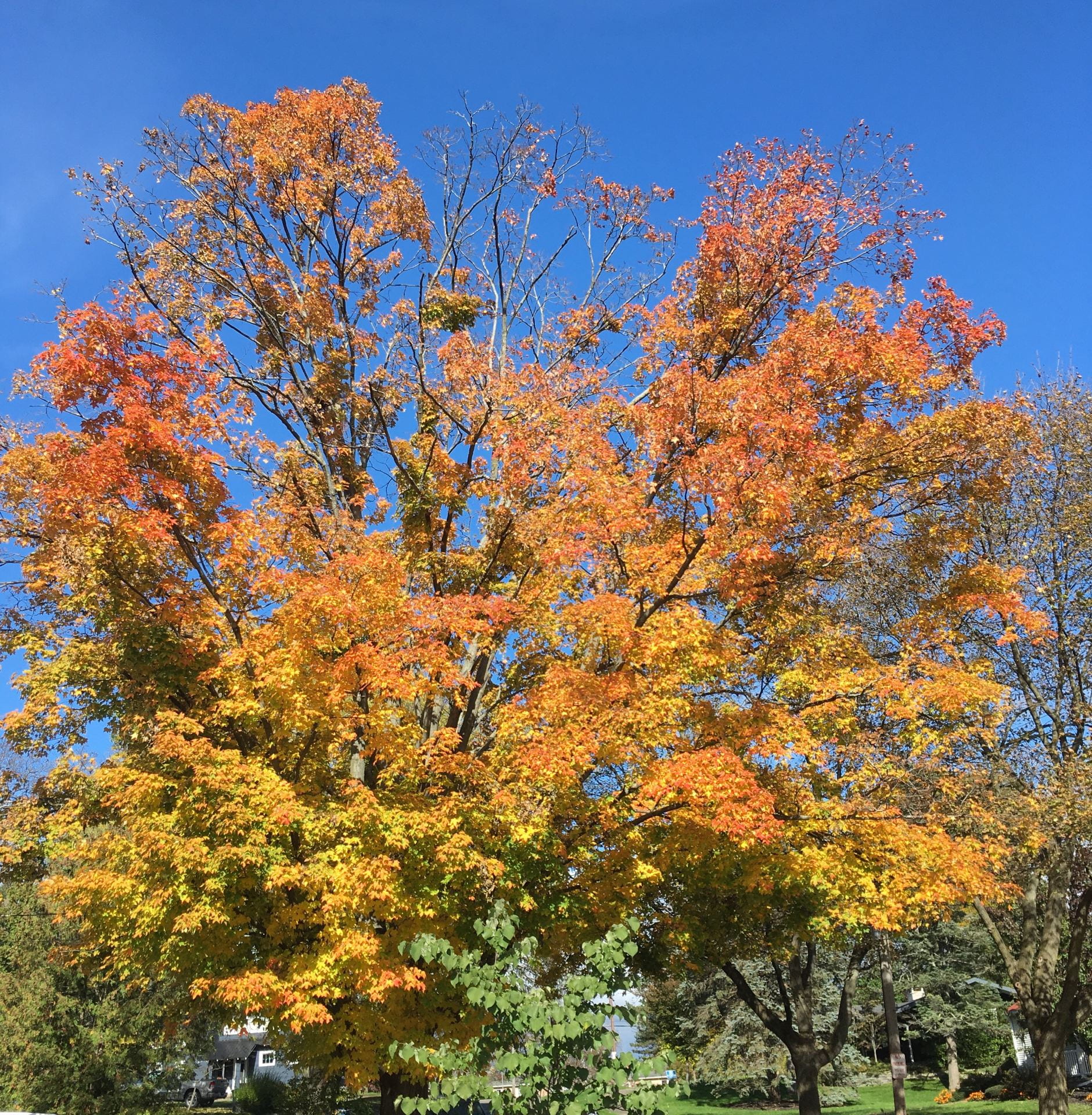
Fall leaves are beautiful…but fall garden clean-up isn’t always fun. Maybe skip some of that clean-up this year.
If you have been procrastinating on your fall garden clean-up (like me), I’ve got good news for you! You may want to just erase some of those tasks from your to-do list altogether. And you can do it guilt-free!
As you may recall from my post this spring, a messy garden provides good shelter for friendly insects like pollinators and natural enemies of pests over the winter. Whether it’s leaves on the ground or dead plant stems, it’s not a bad idea to leave at least some debris in your yard and garden. The Xerces Society provides a nice summary of the benefits fallen leaves offer to insects and other creatures. You can read an eloquent description of all the benefits of a messy yard here.
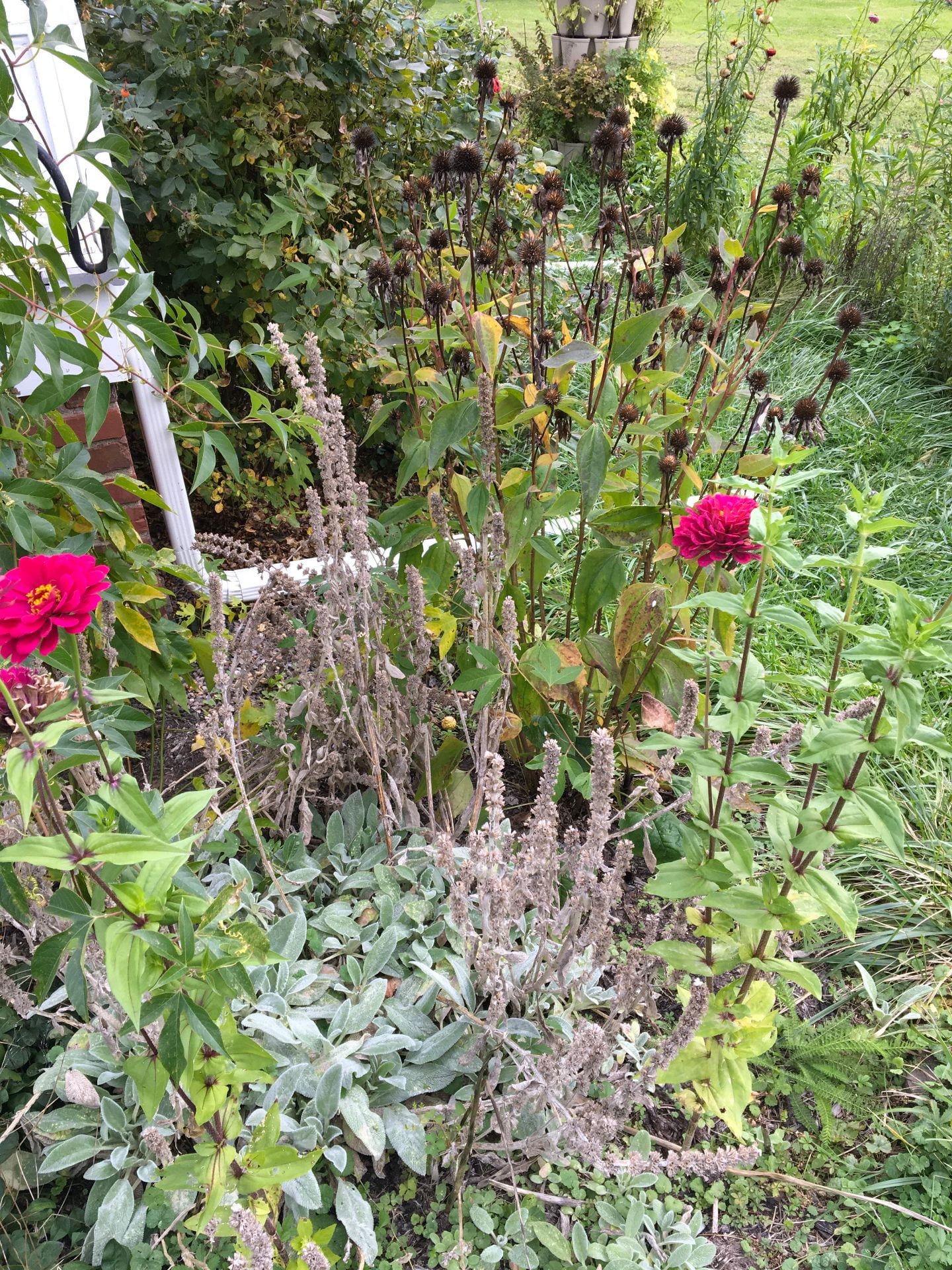
As these plants continue to senesce, I will leave the stems in the garden over the winter.
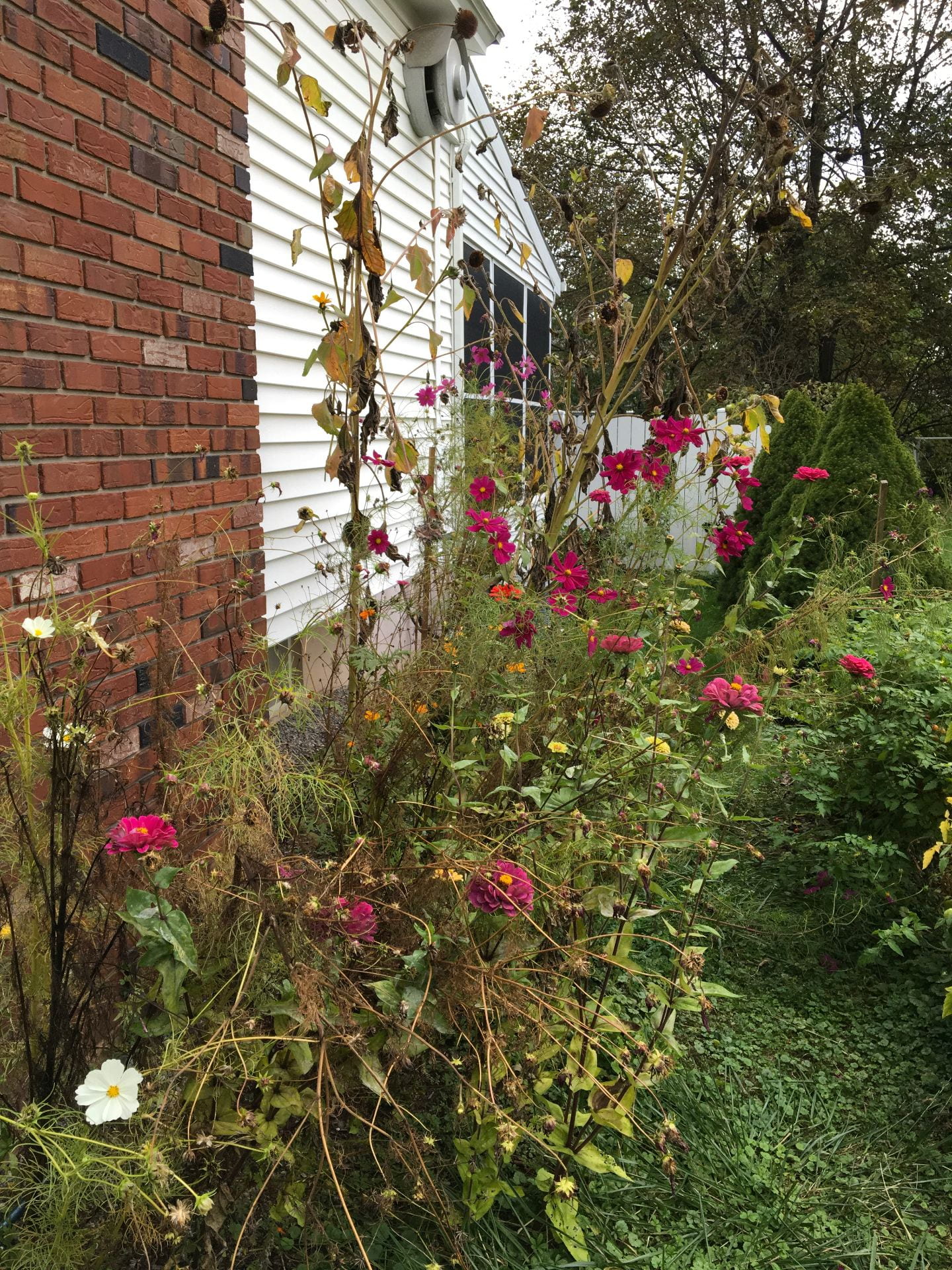
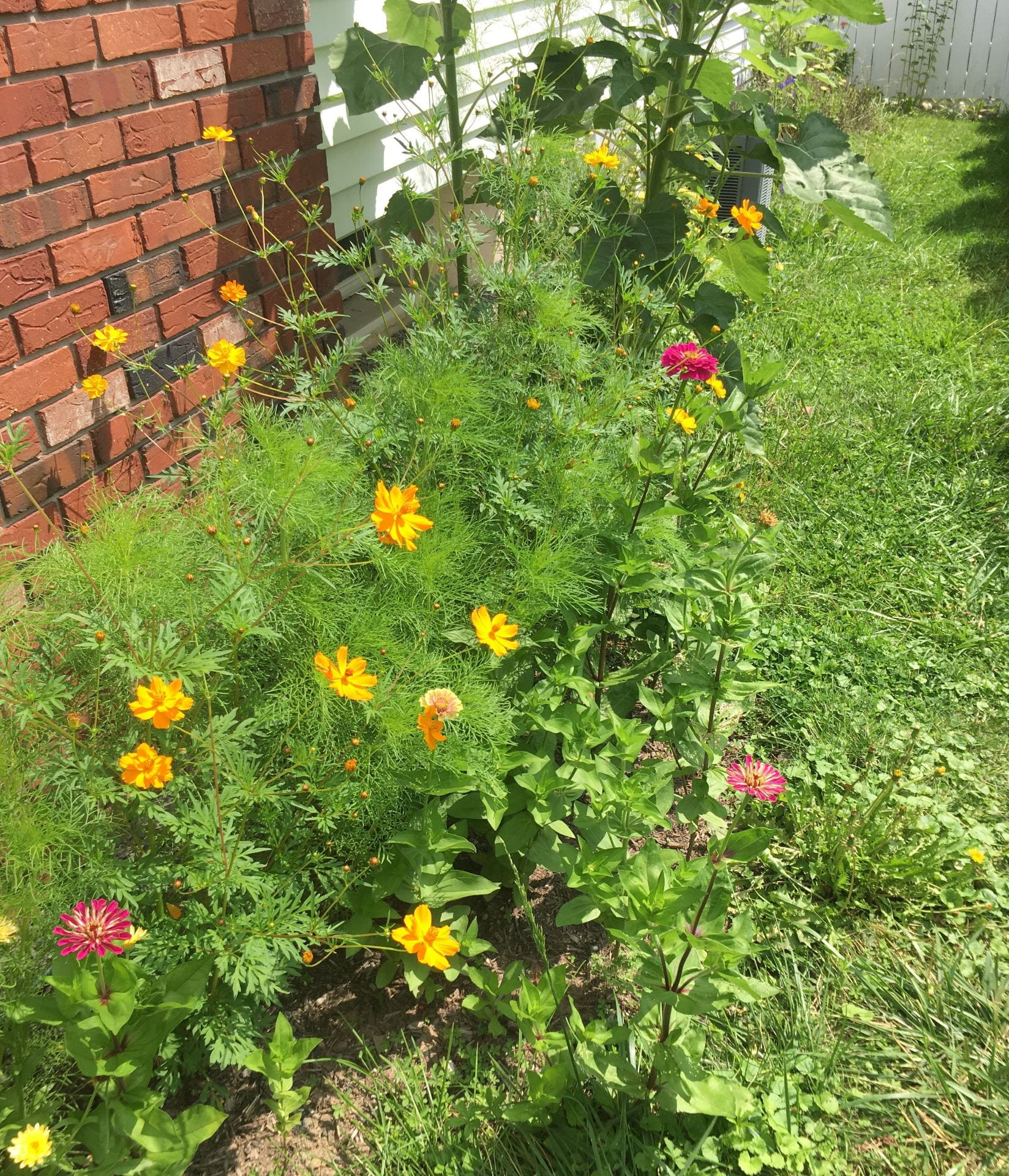
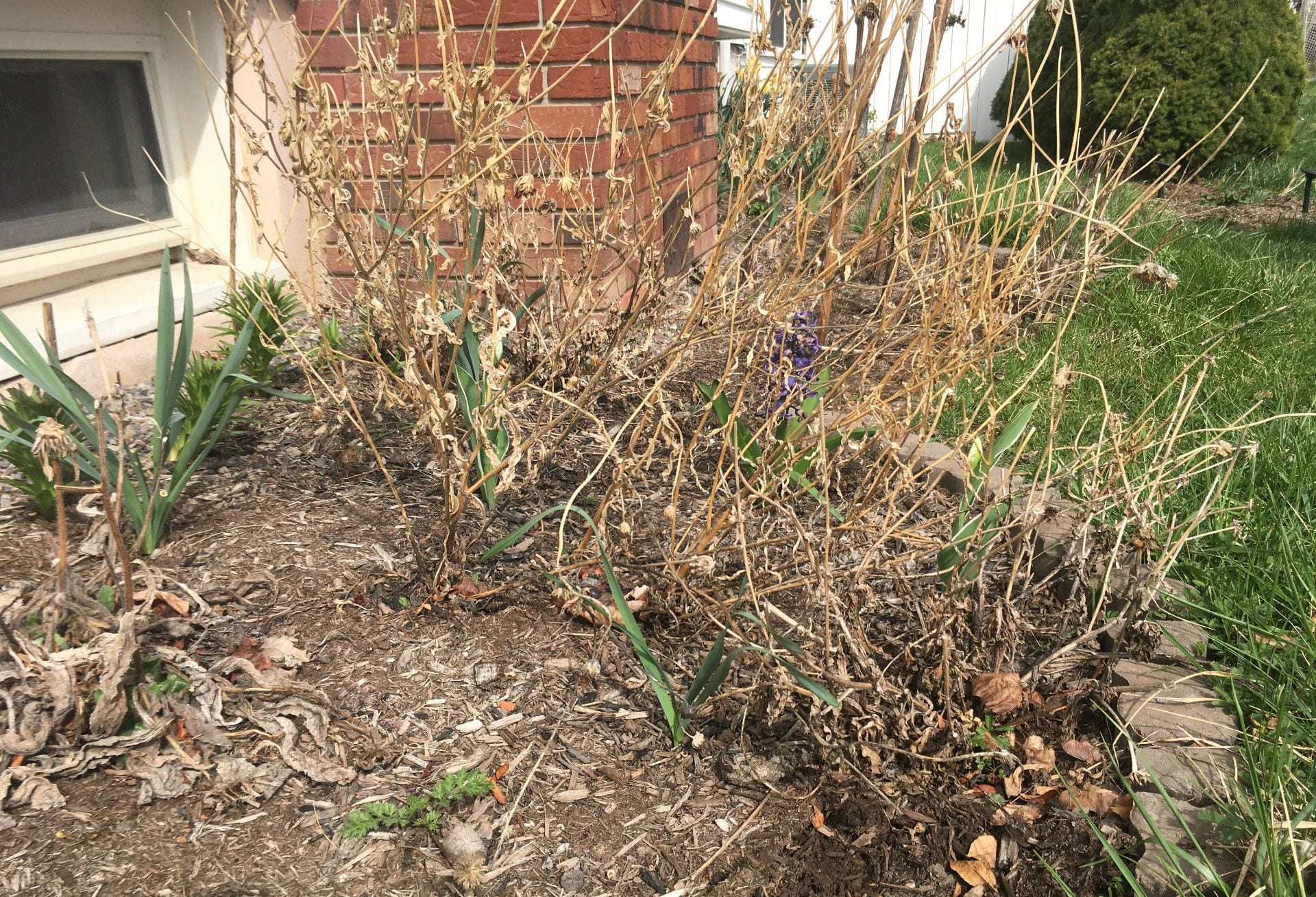
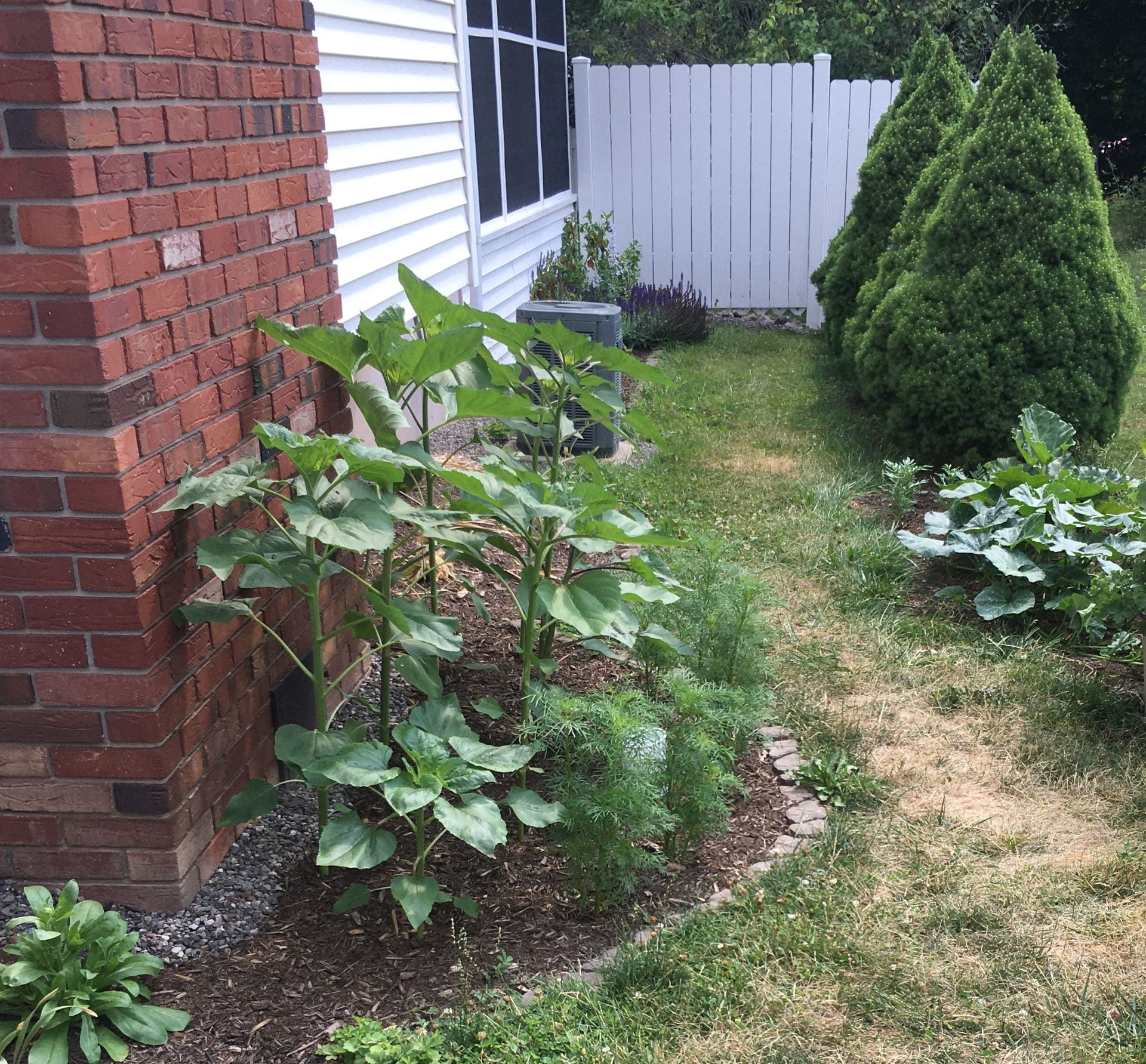
Just to prove I’m putting my money where my mouth is, here are some pictures from my own yard. I’m thinking about cutting down the sunflower stalks and propping them up next to my compost bin in the back yard, just to make things a little tidier in the front yard.
These sunflowers, cosmos, and zinnia plants are no longer looking so nice. But I will leave many of them in the garden until spring.
I’m going to still take out (and send to my local municipal compost facility) my vegetable plants (tomatoes and peppers). Leaving dead stems from healthy plants in your garden is one thing, but this year’s vegetable plants can harbor next year’s vegetable diseases and insect pests if left over the winter. Disposing of diseased or insect-infested plants away from your garden is just good IPM.
A few more caveats…
First, you should know that ticks complicate the simple advice to “leave the leaves”. If you’ve had problems with ticks in your yard (learn how to monitor for ticks here), be strategic about where you leave things messy, and where you clean them up. For example, consider cleaning up areas where your family and pets spend more time. You should also be careful about where you pile leaves. My co-worker Joellen explains why here. And definitely use other IPM strategies to protect yourself from ticks, regardless of your yard clean-up plans.
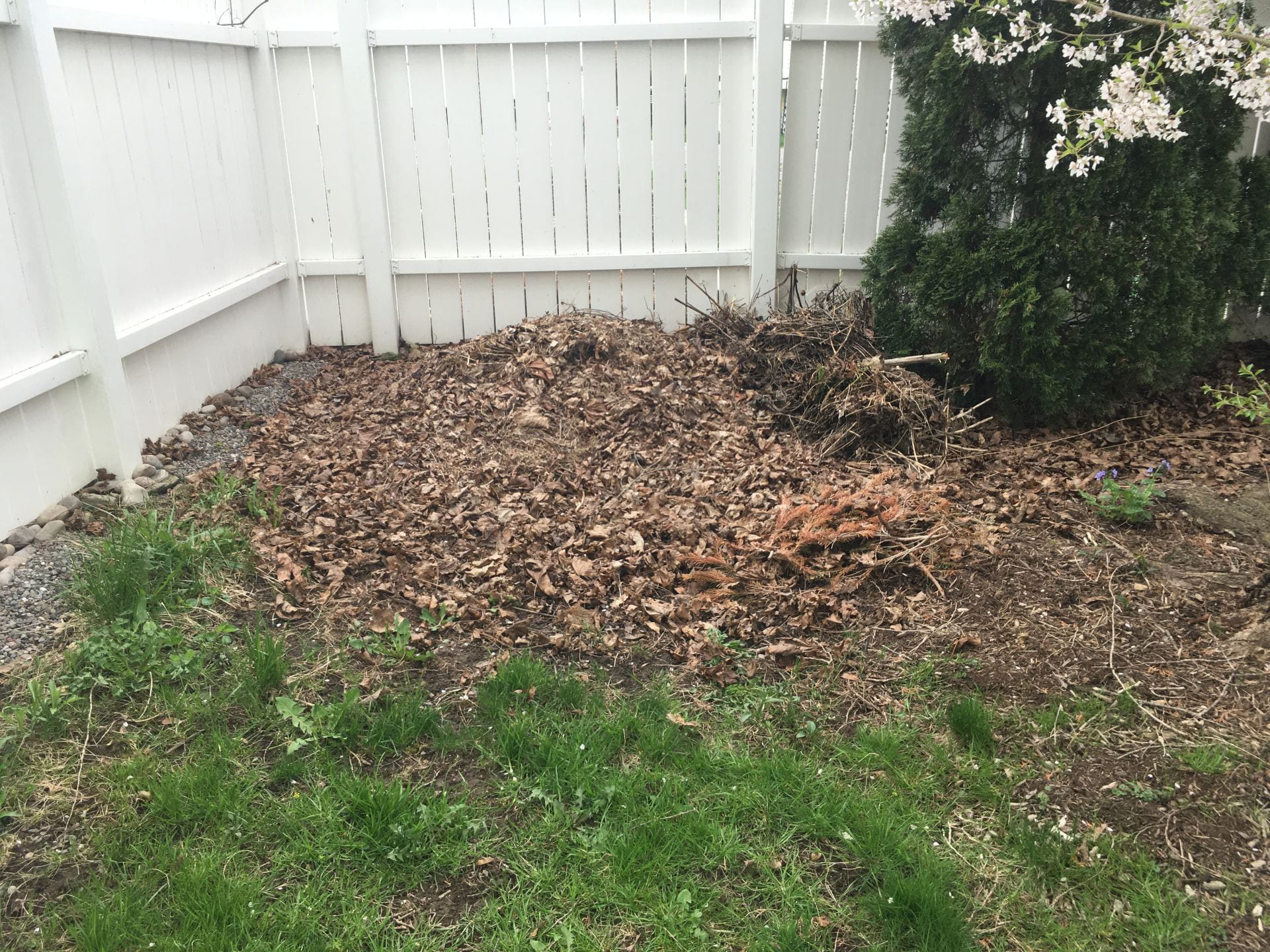
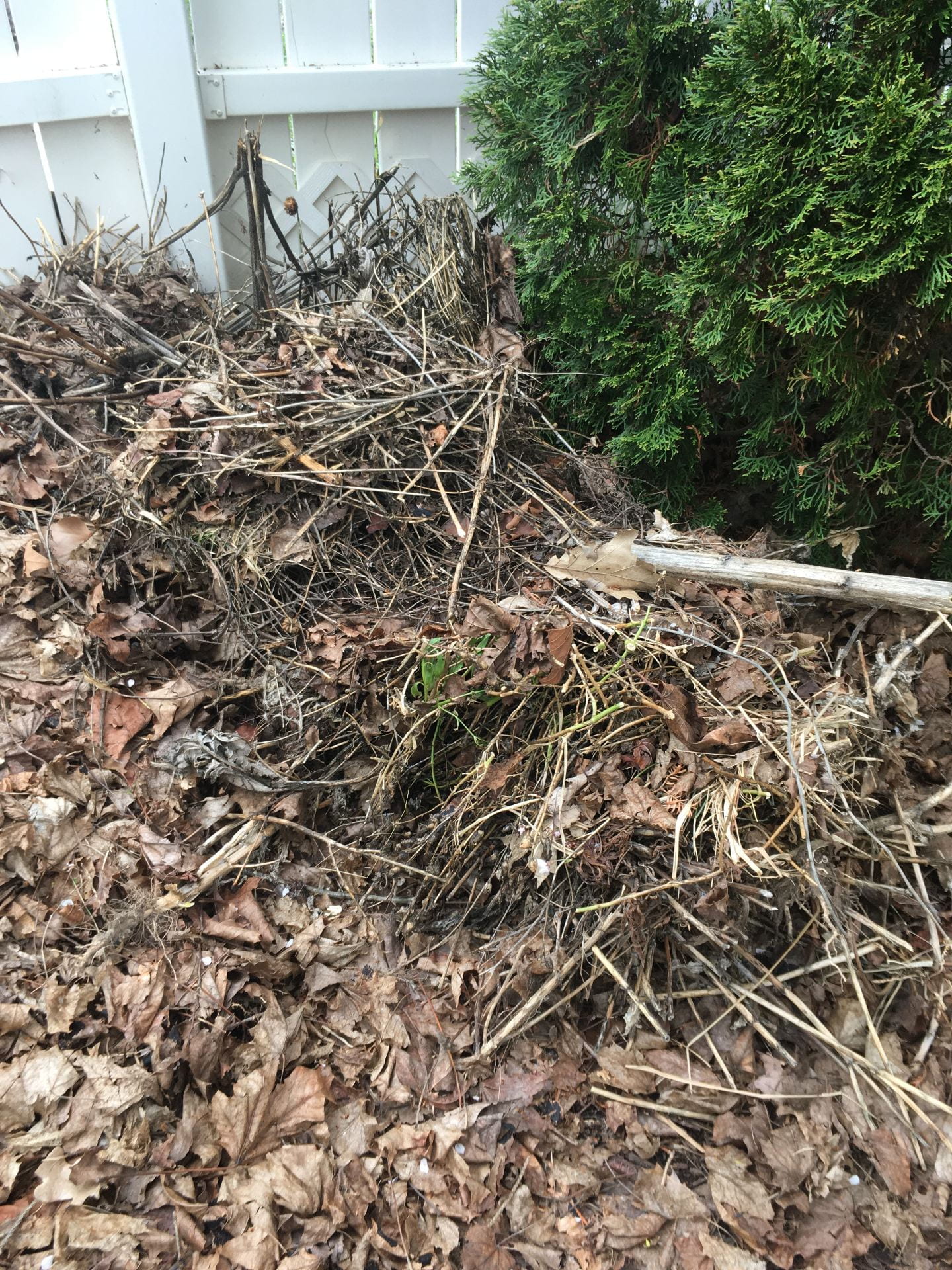
This was the leaf (and other plant debris) pile in my backyard this spring. Piles like this can shelter lots of invertebrates…including ticks.
Second, if you’ve got a garden bed in the front yard that you just can’t stand to leave messy through the winter, it’s ok to clean it up and not feel guilty. Maybe pick another part of your yard that you can leave a bit messy instead. Don’t let the perfect become the enemy of the good.
Happy Fall!
This post was written by Amara Dunn, Biocontrol Specialist with the NYSIPM program. All images are hers, unless otherwise noted.
This work is supported by:
New York State Department of Agriculture and Markets
New York State Department of Environmental Conservation
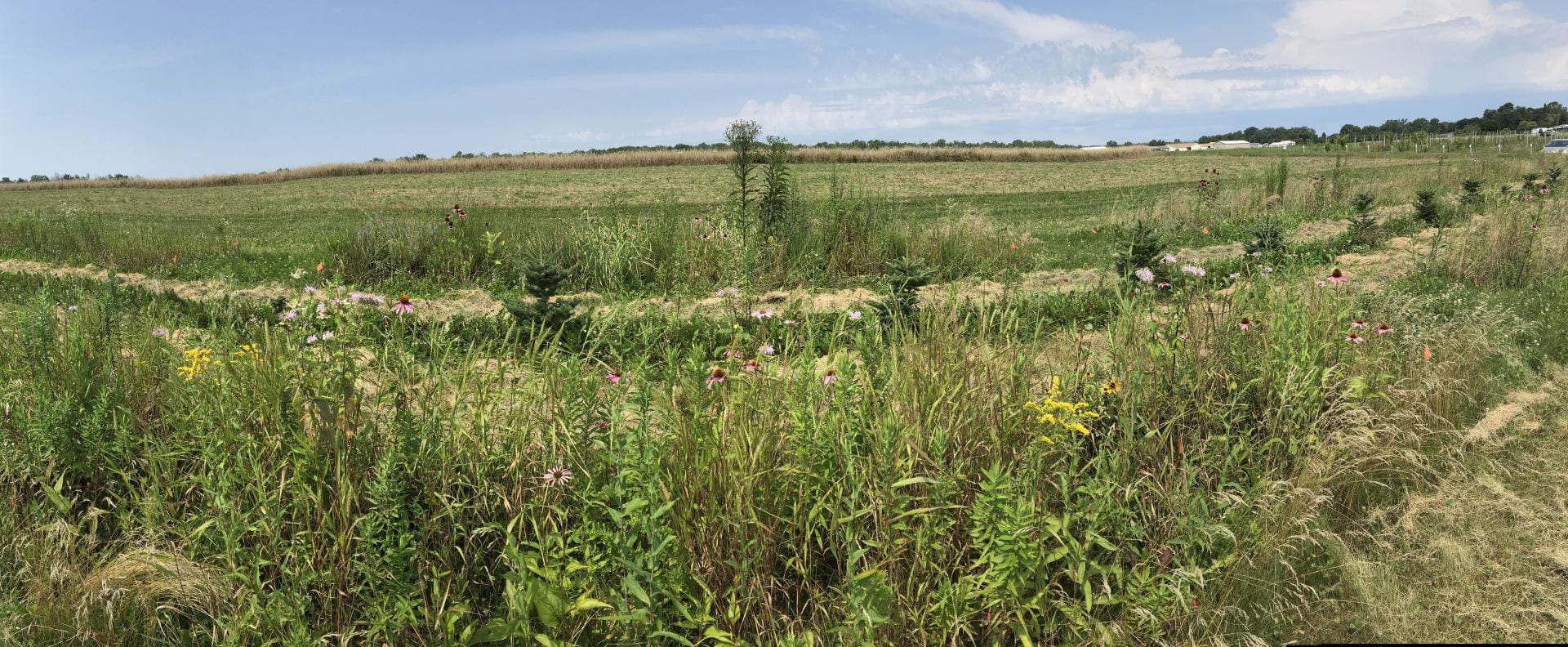
It’s hard to believe it, but we are in our fourth year of a project establishing perennial wildflowers and grasses to support populations of pollinators and natural enemies of pests. You can read more about this ongoing project in past blog posts, but in just a few weeks, you can also come visit these plots in person (if you live near Geneva, NY)!
Our Habitat for Beneficial Insects Open House is taking place on Thursday, August 19, 2021. We’re inviting members of the public, home gardeners, and beneficial insect enthusiasts to stop in between 1:30 and 3:30 PM to:
see how the wildflower plots are looking
learn about the methods we’ve used to establish them
practice recognizing some of the beneficial insects we’ve attracted
In order to offer an experience that is accessible and as safe as possible for all attendees, we are requesting that everyone wear a mask unless you maintain at least 6 feet of distance between yourself and people you do not live with, regardless of your COVID vaccination status. There will be plenty of space at the field to spread out, and we will have microphones available so that you will still be able to hear even if you are standing further from a speaker than usual. We will have masks available if you do not have one. (But if you have a favorite insect or wildflower themed mask, we want to see them!) These recommendations follow Cornell’s current guidance and if that guidance changes, we will let you know.
To get there, put this address into your GPS:
1097 County Rd. 4
Geneva, NY 14456
Then look for these signs to find our field and park:
New York State Department of Agriculture and Markets
Crop Protection and Pest Management -Extension Implementation Program Area grant no. 2017-70006-27142/project accession no. 1014000, from the USDA National Institute of Food and Agriculture.
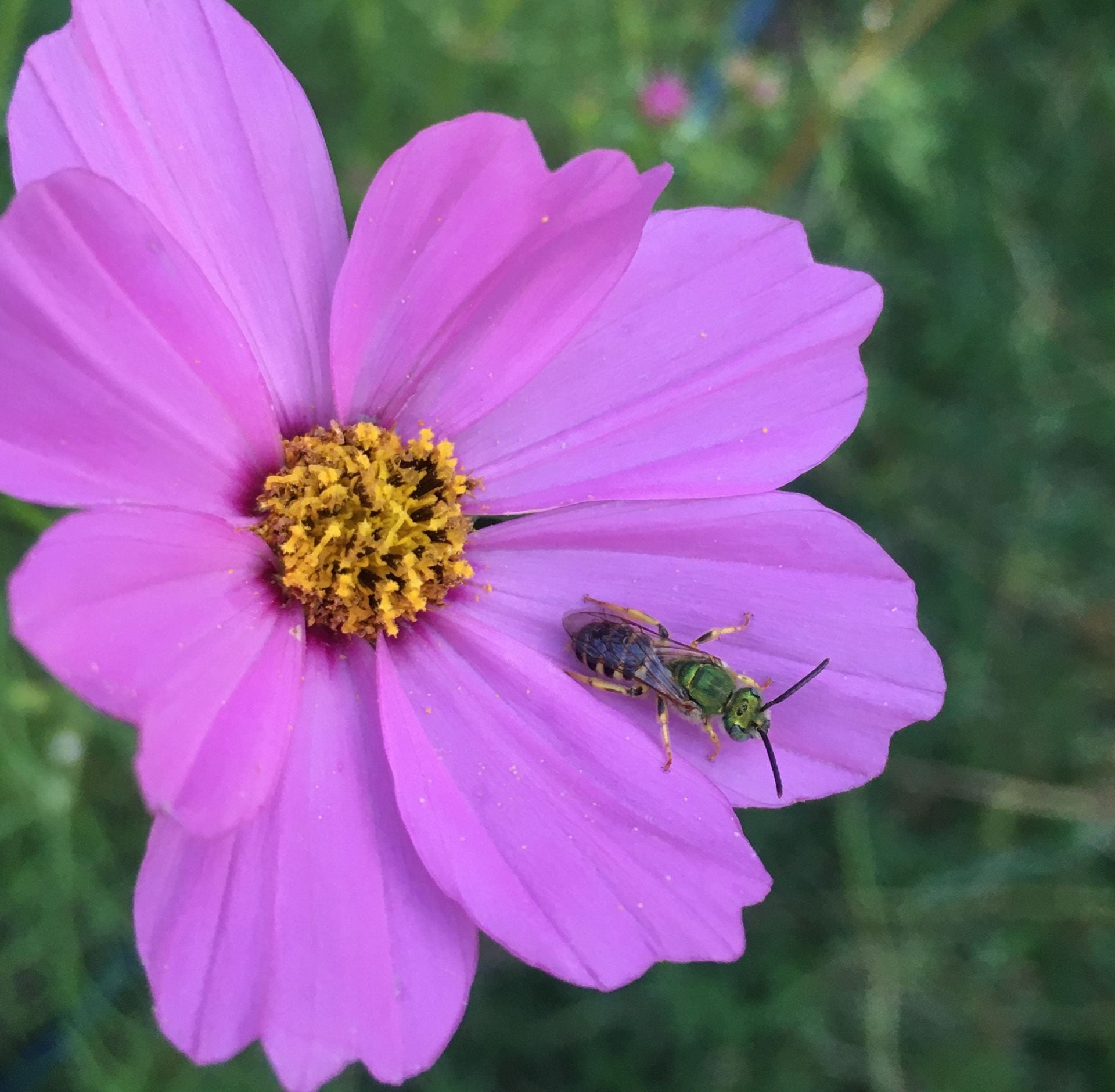
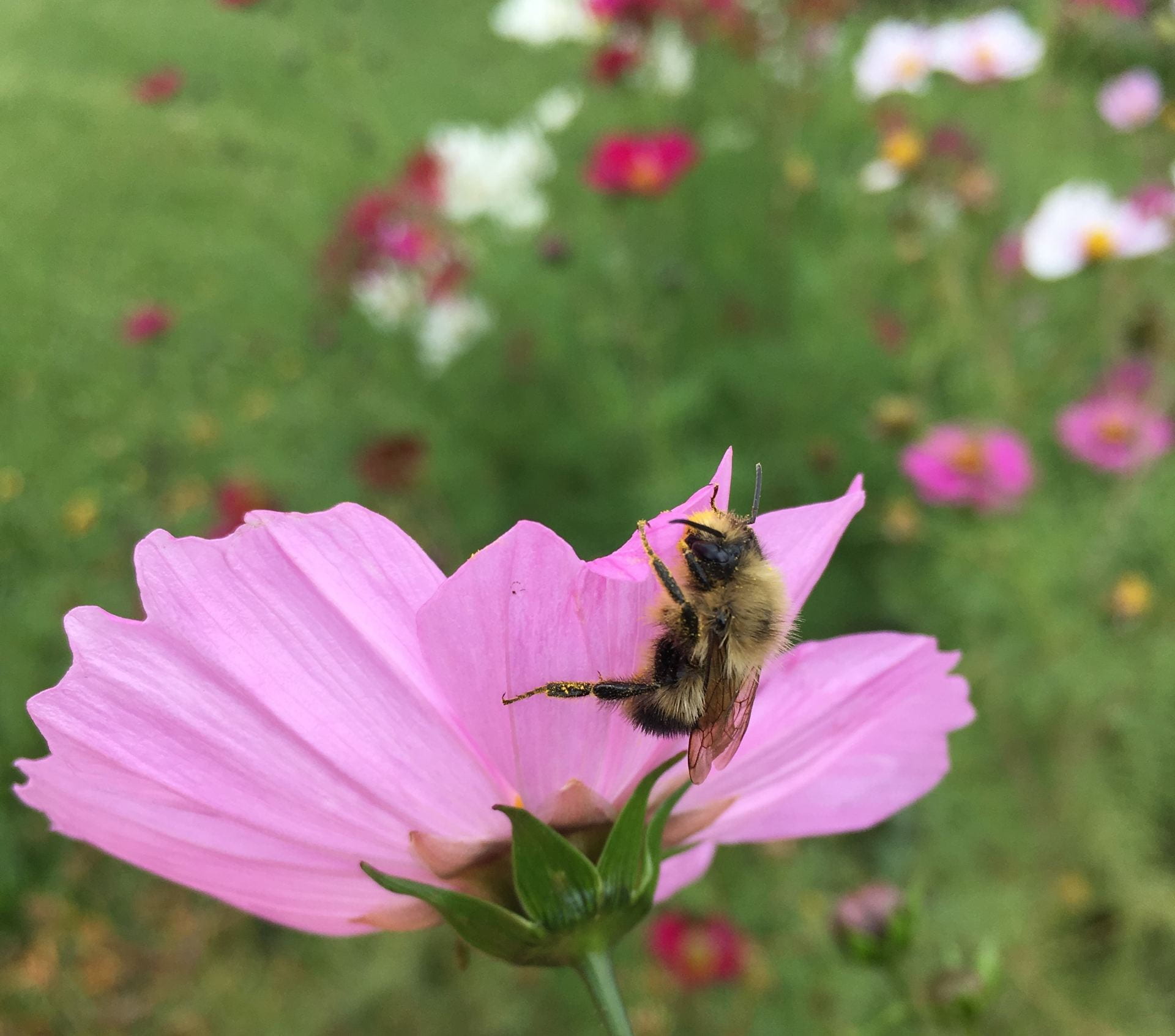
Zinnias and cosmos are great food sources for all kinds of insects.
As we start August in New York, I hope that your gardens and fields are full of abundant blooms, vegetables, fruits, or all of the above. They may also be humming, buzzing, or making other noises as a result of resident insects. If you find an unfamiliar insect, you might be wondering: Is it a friend or a foe? Here are some friendly insects – natural enemies of pests – you might encounter.
Lady beetles
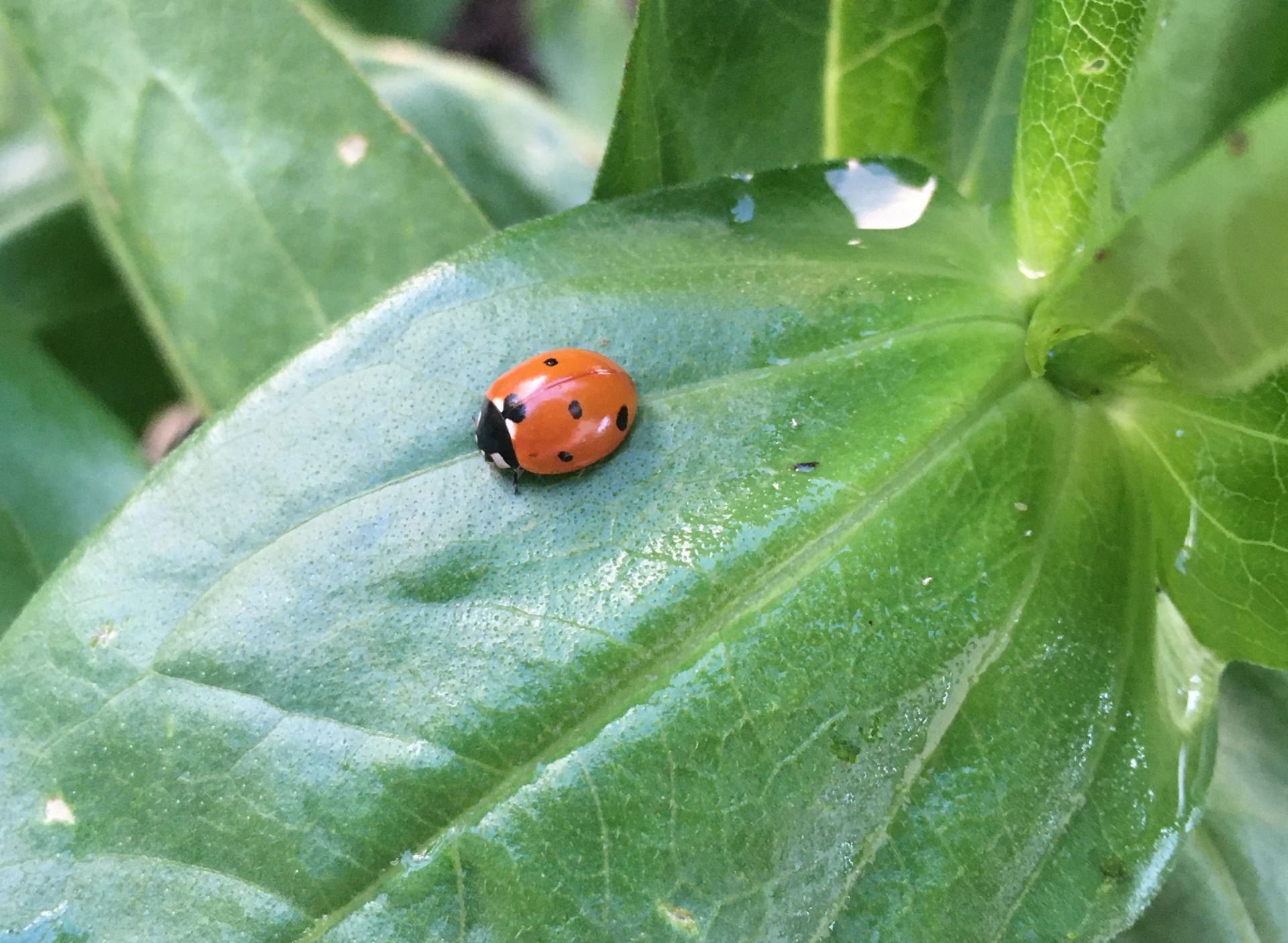
This sevenspotted lady beetle is pretty easy to recognize.
Adult lady beetles are some of the most easily recognized natural enemies. For example, most would know that this sevenspotted lady beetle is a friend. But lady beetles come in many different stripes – err – spots. Here’s another lady beetle that might not be as familiar, but is an equally good predator.
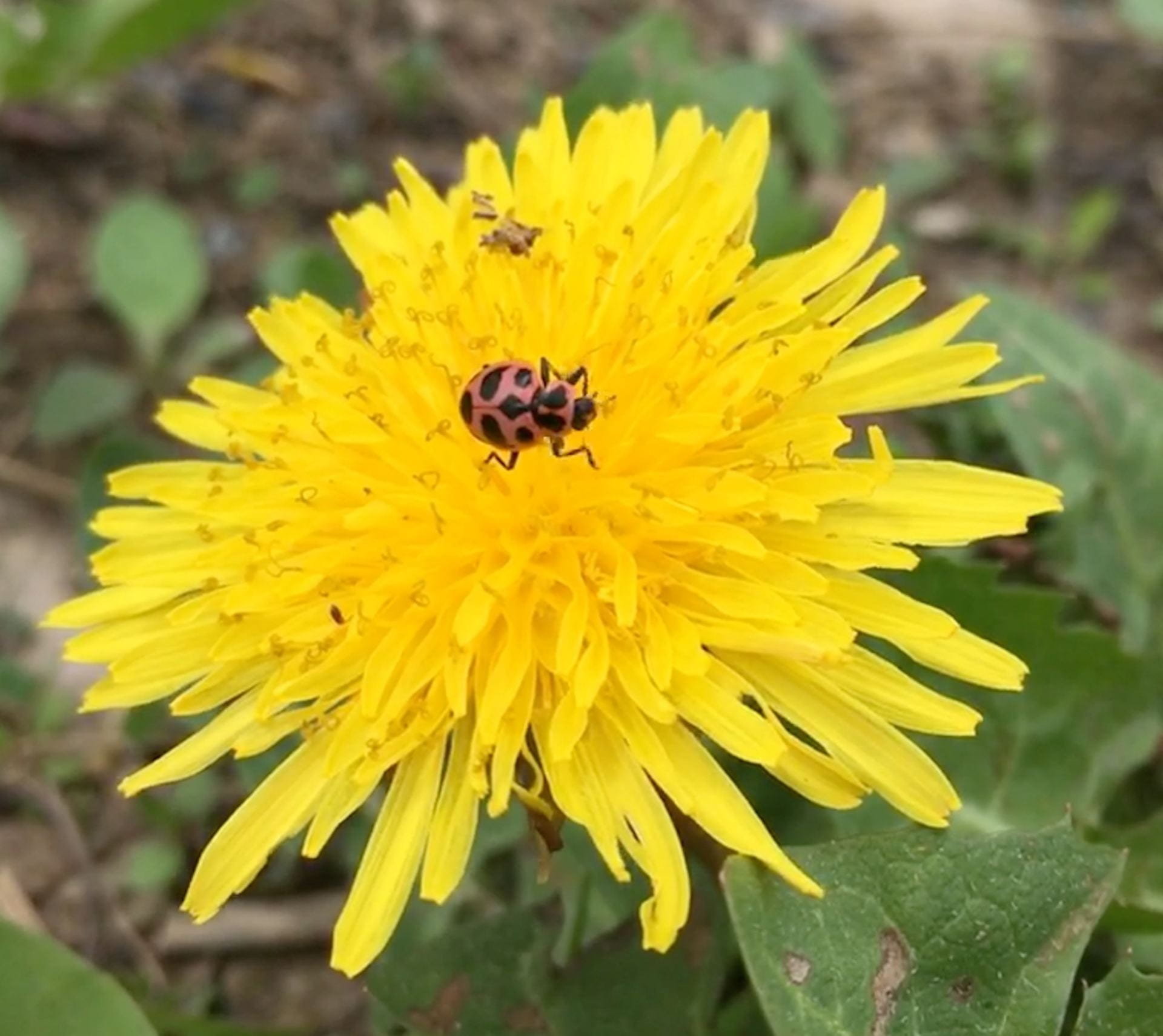
You might be less familiar with the pink spotted lady beetle, but it’s a friendly insect you should get to know.
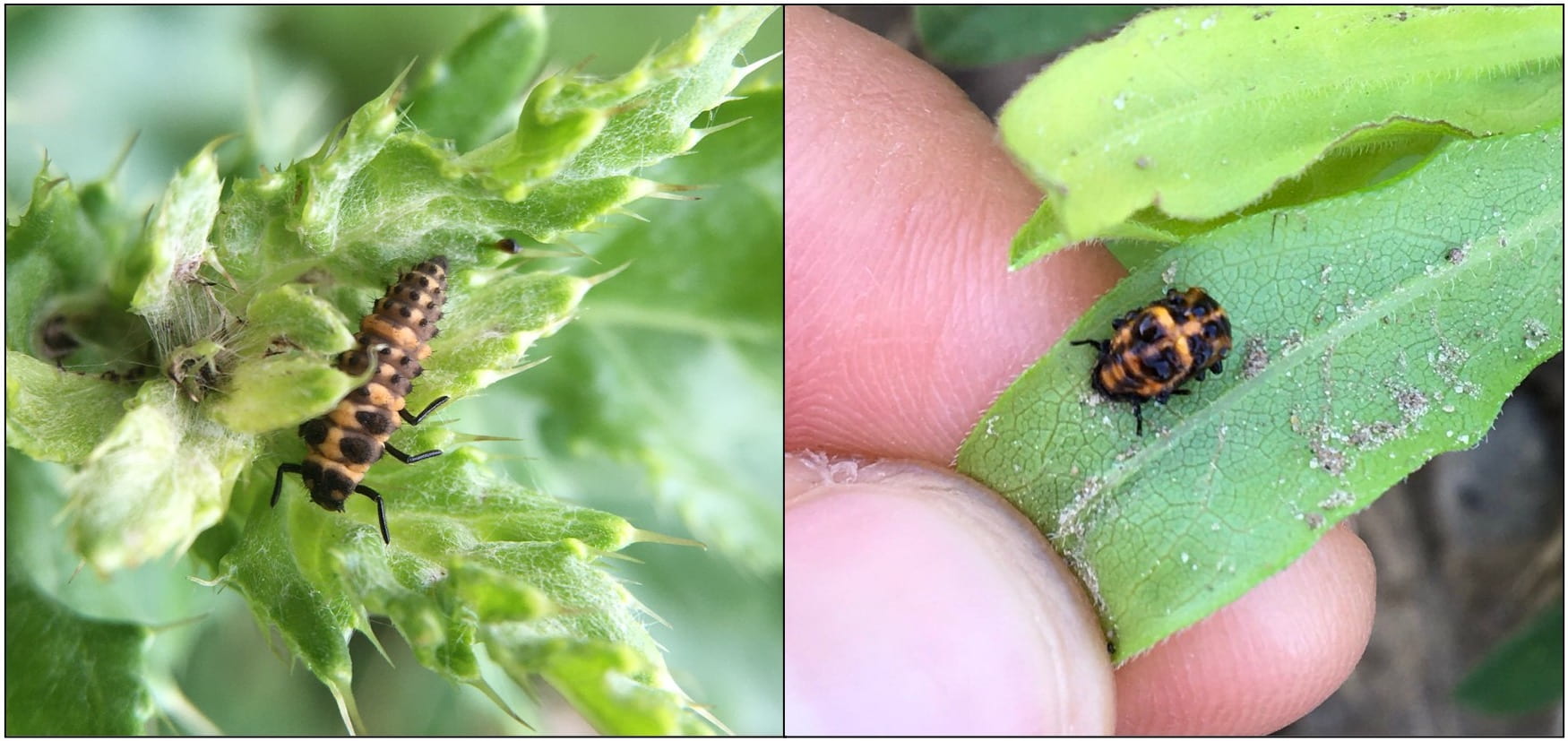
Immature lady beetles look very different from adults. But the larvae are voracious predators, and leaving the pupae undisturbed means you’ll soon have more adult lady beetles around. In addition to aphids, lady beetles will eat whiteflies, thrips, mites, and eggs of other insects.
An immature (larval) lady beetle on the left is a great predator. The pupal (resting) stage of the lady beetle on the right will soon turn into an adult.
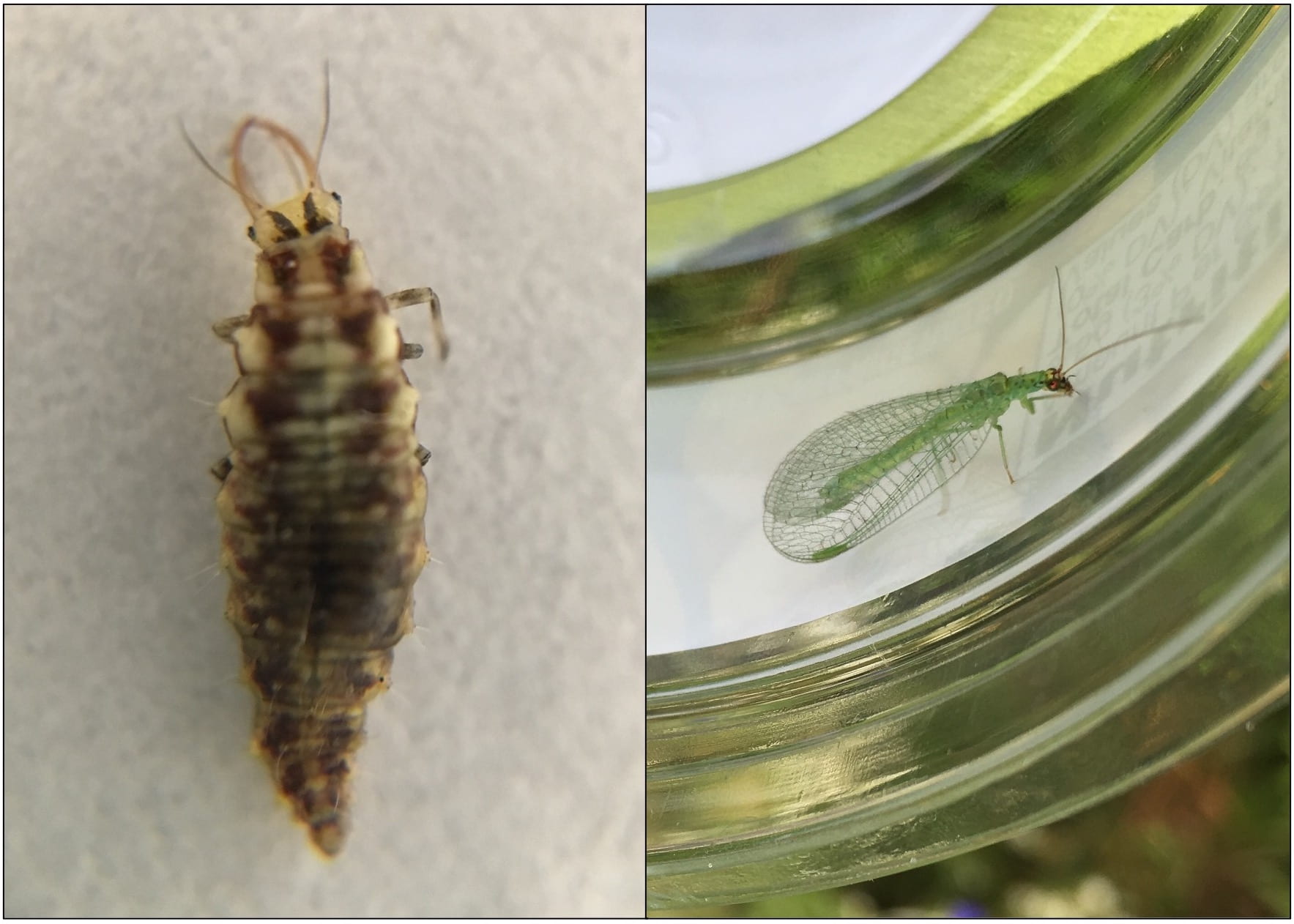
Similarly, while you may be more familiar with the adult lacewings (which can be green, as well as brown), in some lacewing species it’s only the larvae with their formidable jaws that are munching on pests (generally the same ones that lady beetles eat). Adult lacewings will eat pollen and nectar (and some species also eat other insects).
Larval lacewings (left; this one is magnified) look much different than adult lacewings (right).
Minute pirate bugs
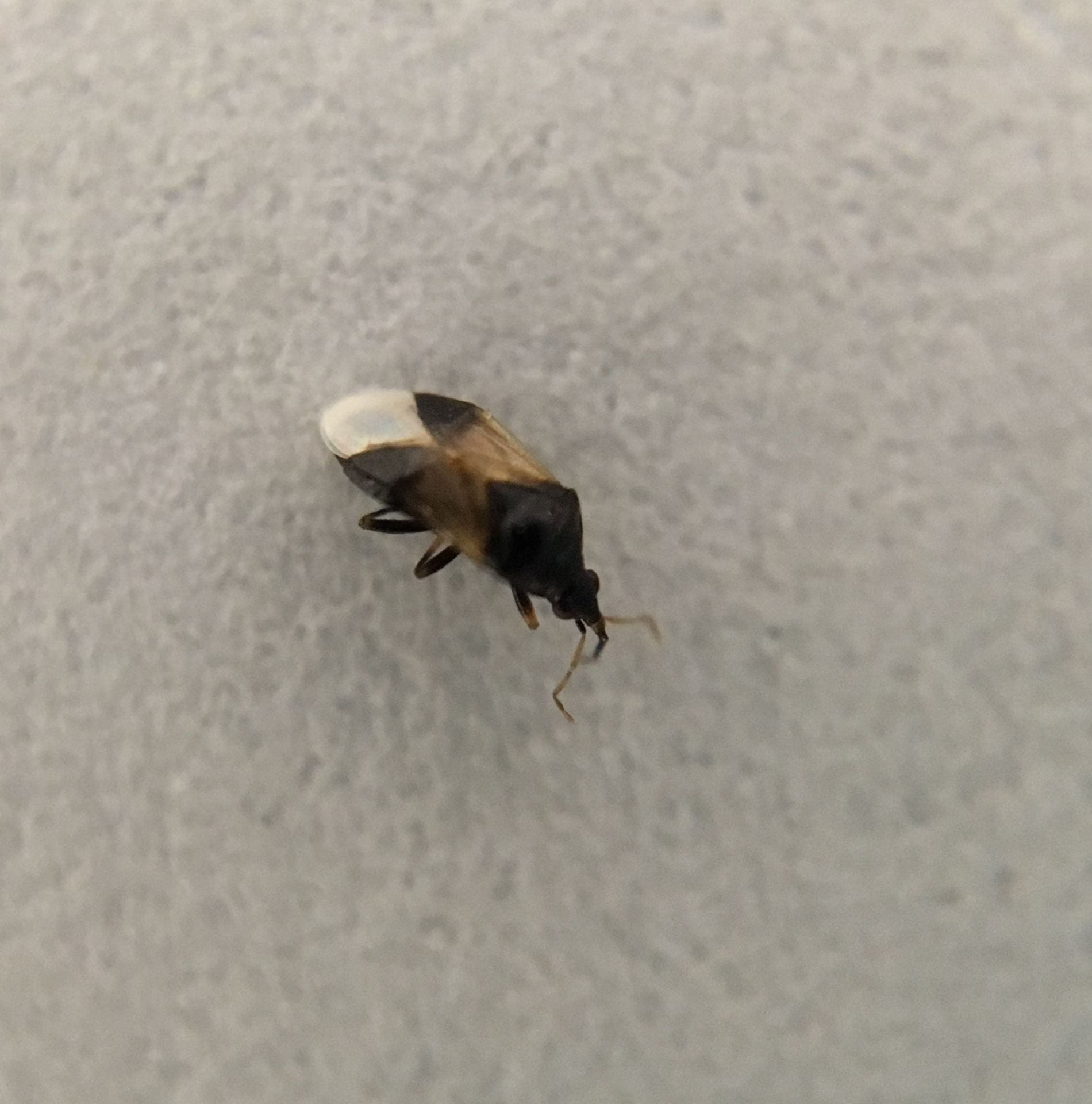
This picture of a minute pirate bug is magnified. They are no more than a quarter of an inch long.
This friendly bug (and it is a true bug!) can be hard to spot because it’s so tiny; truly minute. If you get a chance to look at this (< ¼”) insect with a hand lens, you’ll notice a white diamond shape towards its rear, with a black diamond shape behind its head. At least that’s what the adults look like. Here’s one searching for thrips on a sign at a corn maze. The immature (or nymph) minute pirate bugs are orange and look not much like the adults. In keeping with their size, minute pirate bugs eat small pests like aphids, mites, thrips, and insect eggs. They also eat pollen and nectar, which is probably why I often bring a few inside with me when I cut flowers from my garden. Those same mouthparts that are great at eating pests can also give you a small (but startling) pinch. But it doesn’t hurt much, and if you leave them undisturbed, both you and the pirate bugs will be happier.
Hover flies
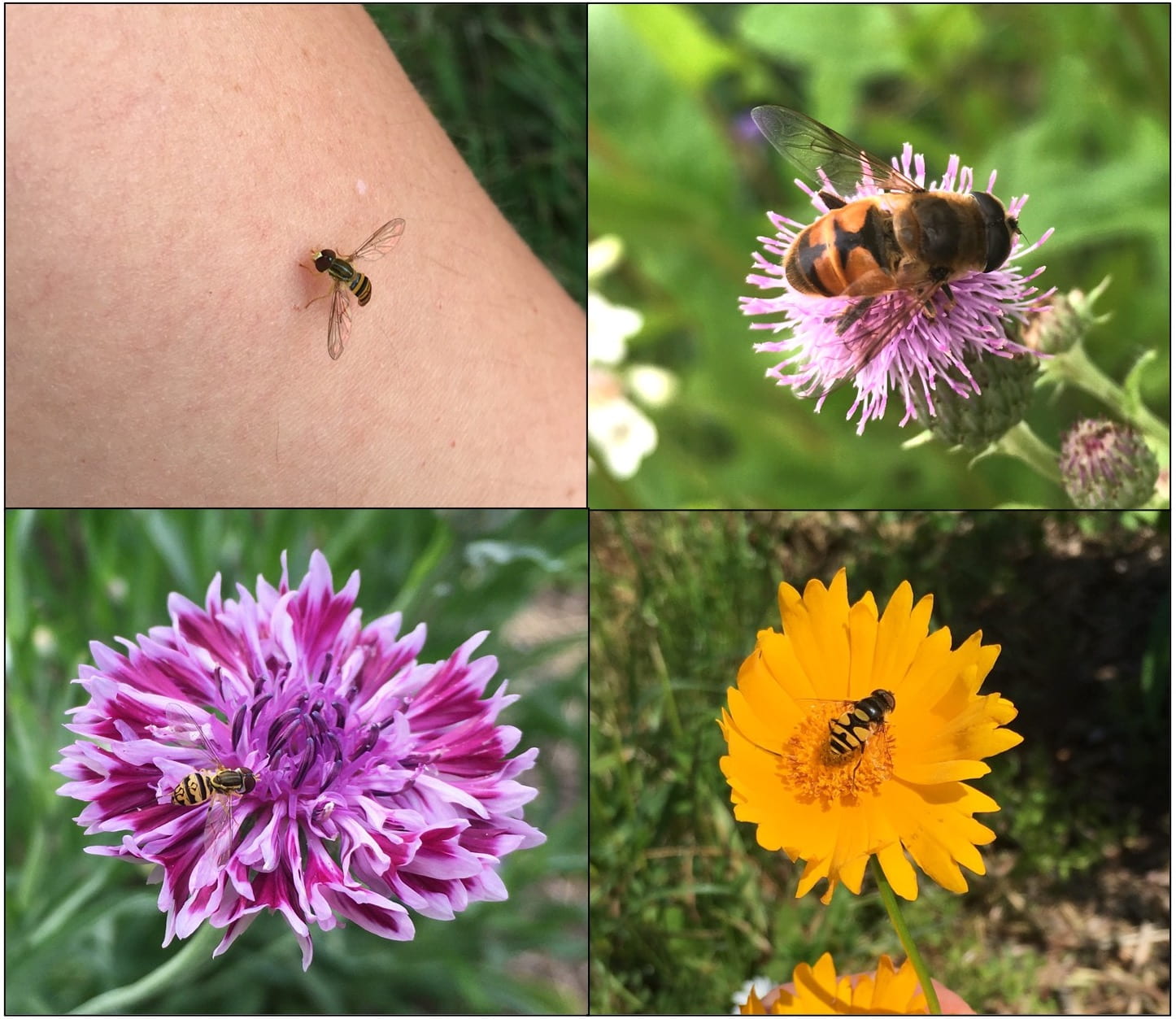
Adult hover flies come in different sizes, shapes, and stripe patterns, but they are great pollinators and good friends to have in the garden or field.
Sometimes hover flies (also called syrphid flies) are incorrectly called sweat bees. Sweat bees are true bees. While many hover flies are black and yellow striped, and some look quite a lot like bees, they are flies. True to their name, hover flies are often spotted hovering around flowers. Here are two tips for distinguishing hover flies from bees:
Hover flies have big eyes that take up most of their head; bee eyes are usually smaller and oval-shaped
Hover flies have only two wings; bees have four
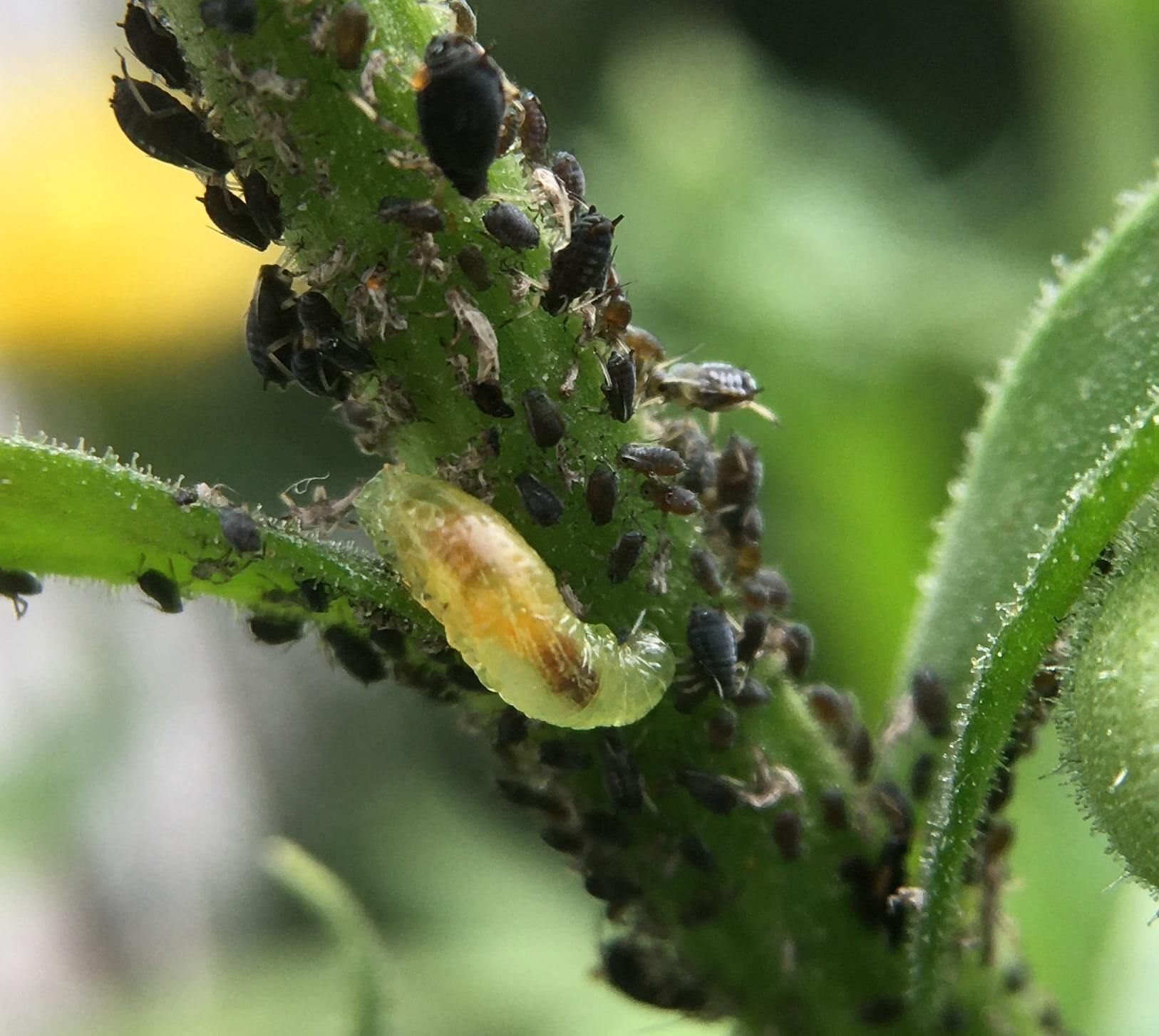
Immature (larval) hover flies are the ones that are eating pests on your plants. They look like small worms, and may come in slightly different sizes or shapes. But they love to eat aphids, whiteflies, and scales.
I’m not 100% sure if this is a hover fly larva, or another predatory fly larva. But this will give you some idea of what you’re looking for.
(Predatory) stink bugs
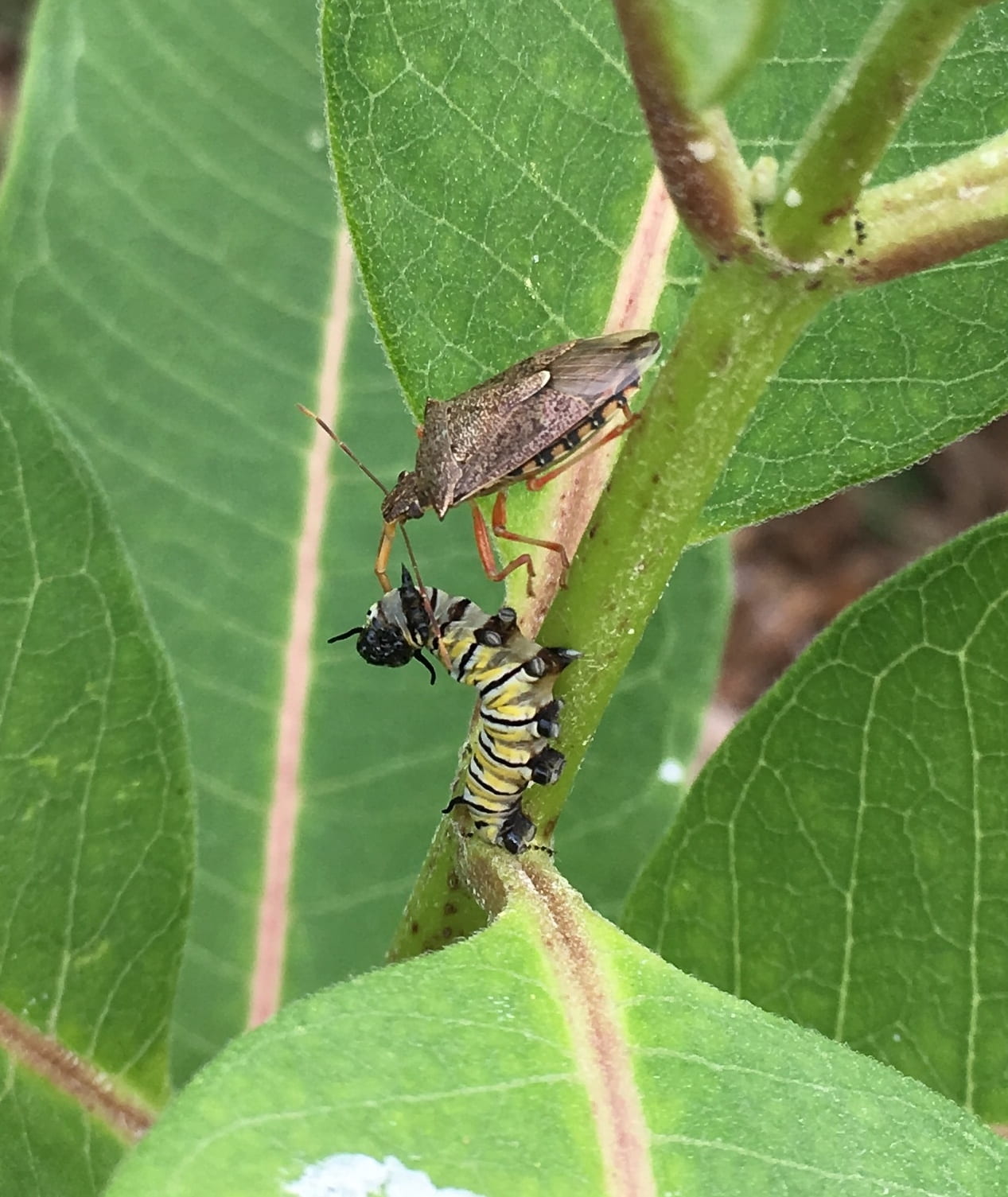
Carnivorous (as opposed to plant-eating) stink bugs are generalist predators, so you may sometimes find them eating other beneficial insects.
None of us are happy to find stink bugs (usually brown marmorated stink bugs, to be specific) invading our homes, but there are many more stink bug species, and some of them are excellent predators. I know, the one above happens to be eating a monarch caterpillar, but they will eat pest caterpillars and other insects, too. The advantage of generalist predators is that they will eat all kinds of pests. The disadvantage is that they may also eat some insects that aren’t pests. This is just part of a balanced ecosystem in your garden or field.
It can be difficult to distinguish a predatory stink bug from a pest stink bug, without looking closely at its proboscis (straw-like mouthparts used for sucking either plant or bug juices), but Virginia Cooperative Extension has a nice field guide available here, which can help. Or you could spend some time observing the stink bug to see if it’s eating a plant or another insect.
Spiders
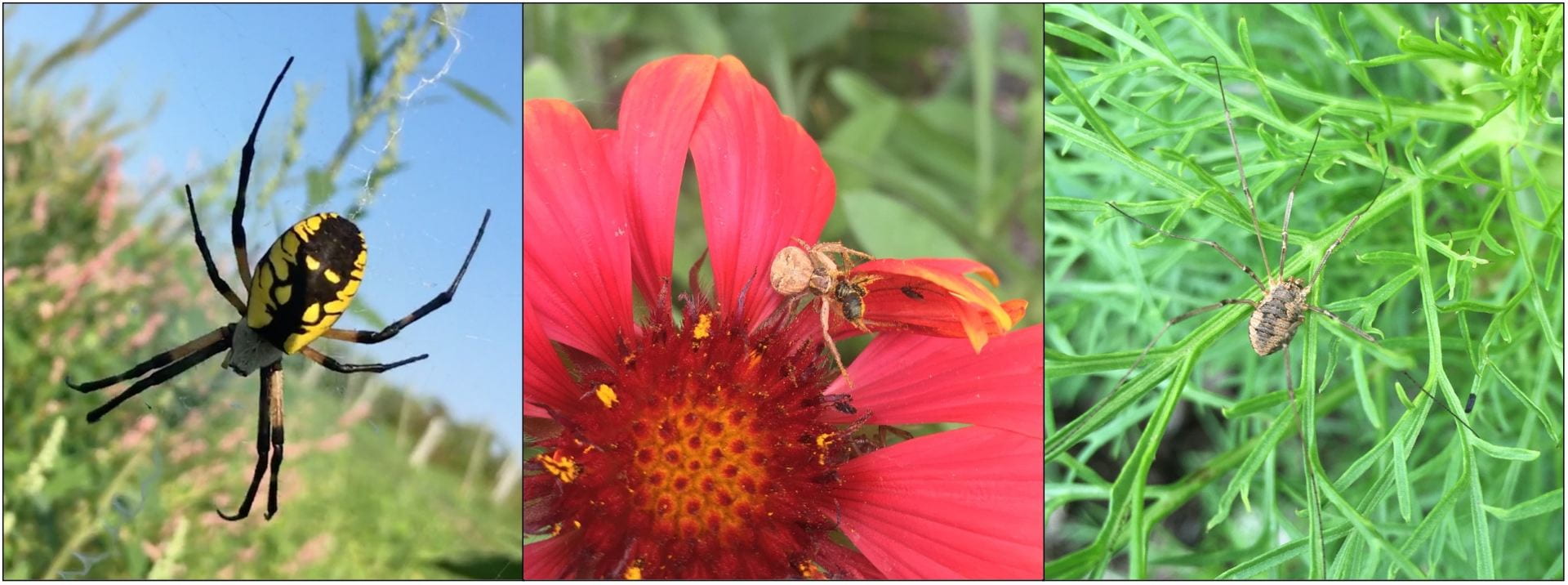
These are just a few of the eight-legged friends you might find in your garden of fields.
Spiders (examples on the left and middle in the above picture) and harvestmen (example on the right) may make some people feel uncomfortable, but both are generalist predators, and therefore good to have around. The spiders you are likely to find in New York are nearly all non-venomous, so welcome them without fear. More info about common spiders of NY can be found here.
Wasps
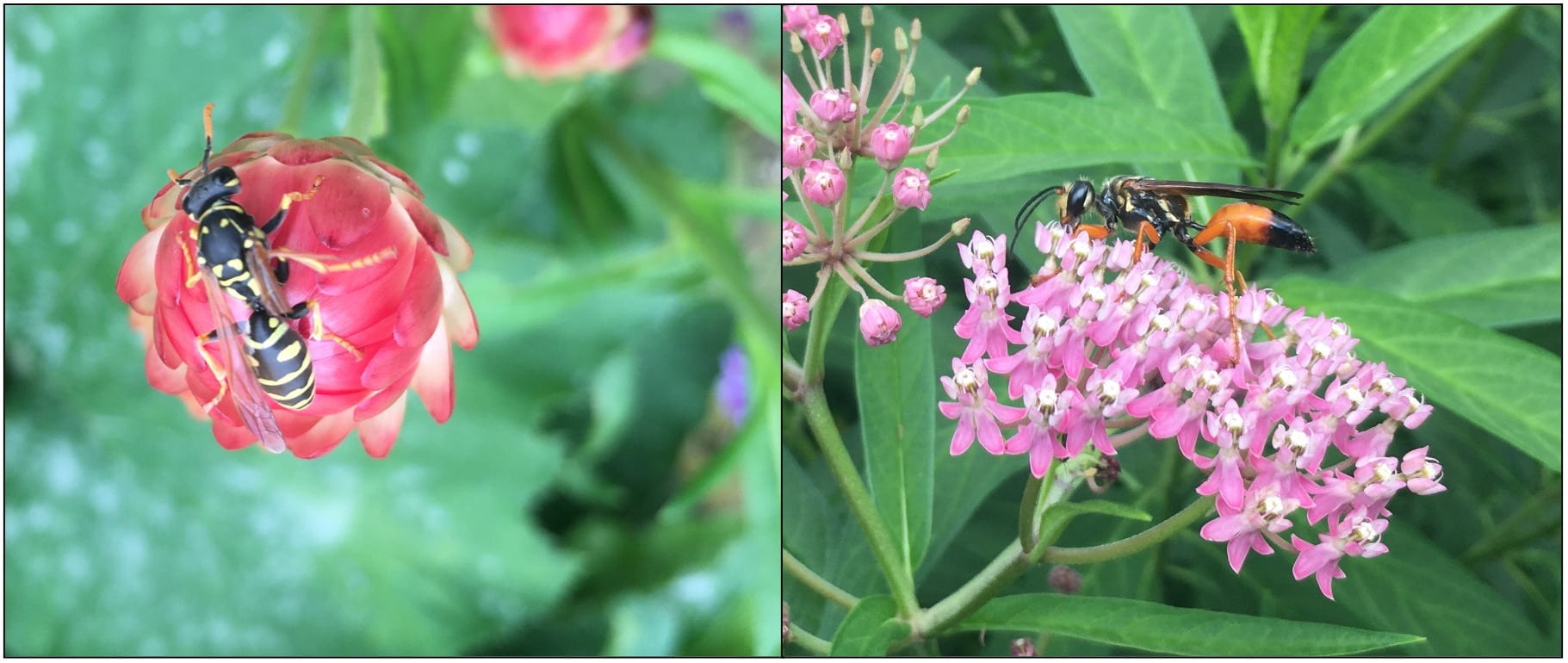
Just two of many wasps you might find visiting flowers in your garden or field.
If you are growing a diversity of flowers that produce lots of pollen and nectar, you may also see a diversity of wasp visitors. Most are unlikely to sting you, and even wasps like yellow jackets or hornets that may sting you are likely also looking for caterpillars and other insects to eat. Many wasps (including tiny ones you won’t notice and larger ones that you will) can also kill pests by laying their eggs in or on them. These are called parasitoid wasps. So if wasps aren’t hurting anyone, leave them alone. Of course, if stinging wasps are building a nest on or near a structure where they are likely to be disturbed by people, action may be required. Learn how to use IPM for stinging wasps here.
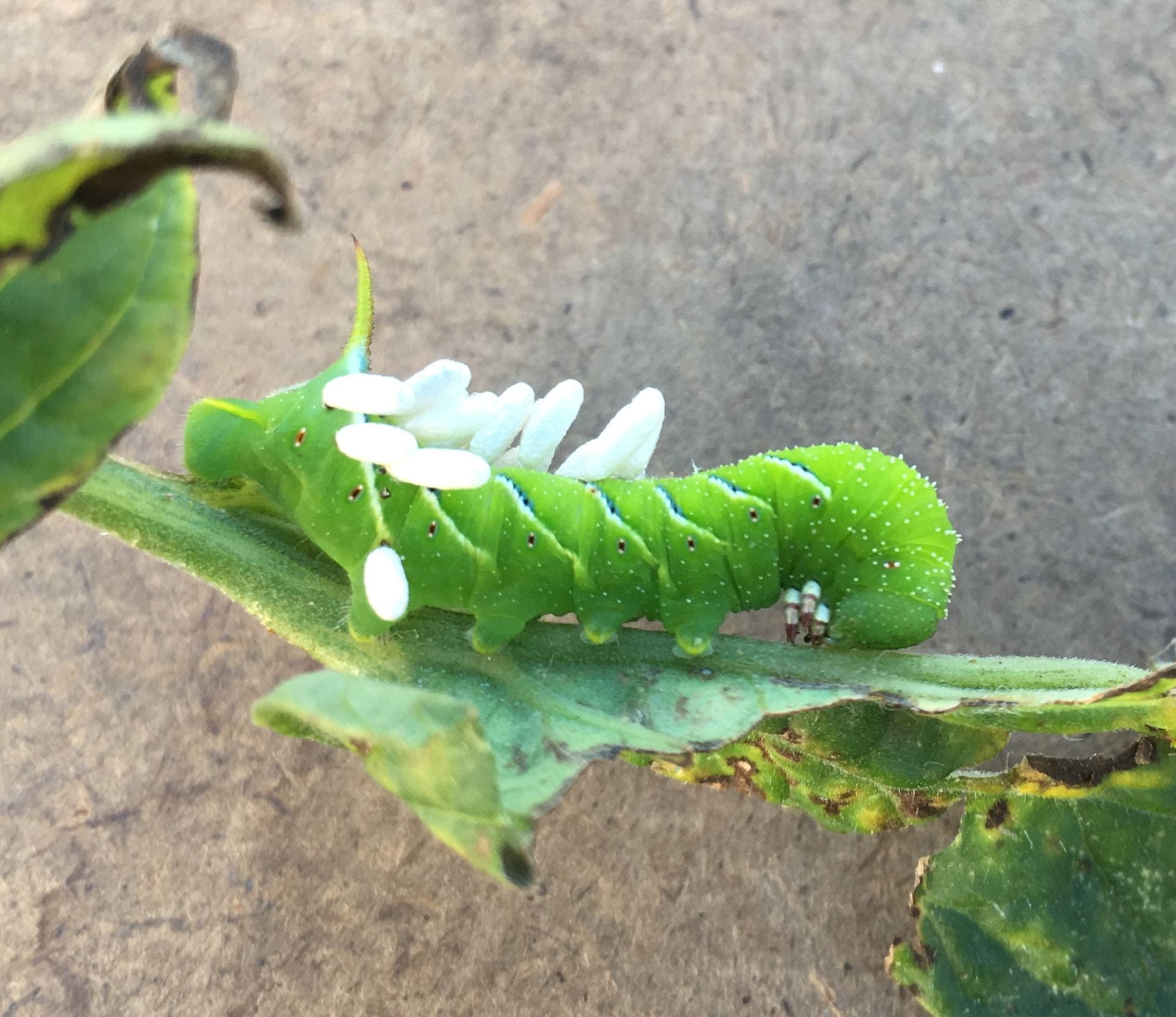
This hornworm was parasitized by a wasp, and its tomato-munching days are numbered. New wasps will emerge from the white sacks on its back.
Other flies
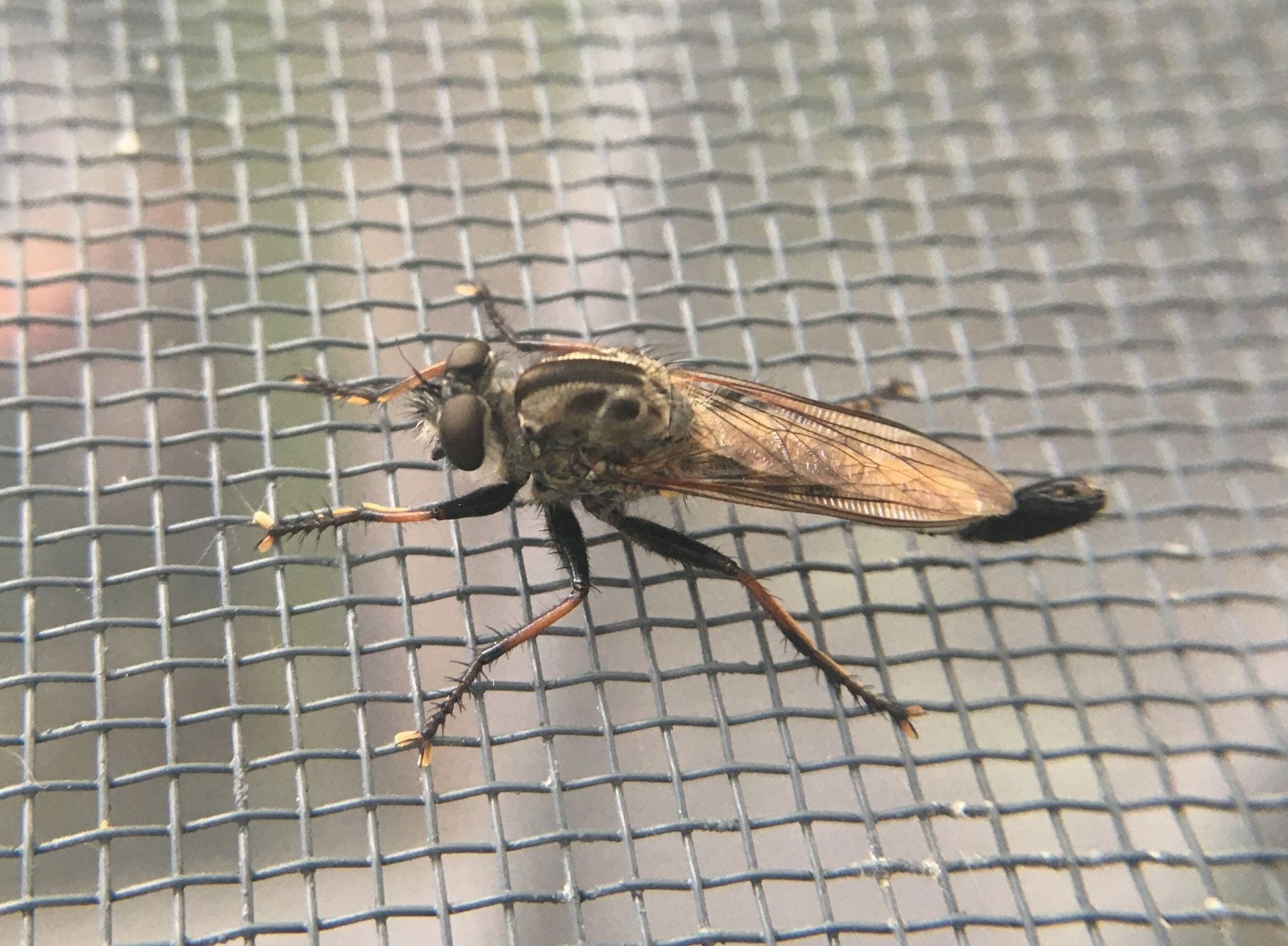
Robber flies may not look very pretty, but they are good predators to have around.
Besides hover flies, there are a whole lot more flies visiting gardens and fields, and many will either eat or parasitize pests. The robber fly pictured above is especially large and is a great predator. Of course, there are plenty of flies you don’t want around. For more info on IPM for flies around your home, you can look here. You can find resources for managing livestock flies here.
And there’s more!
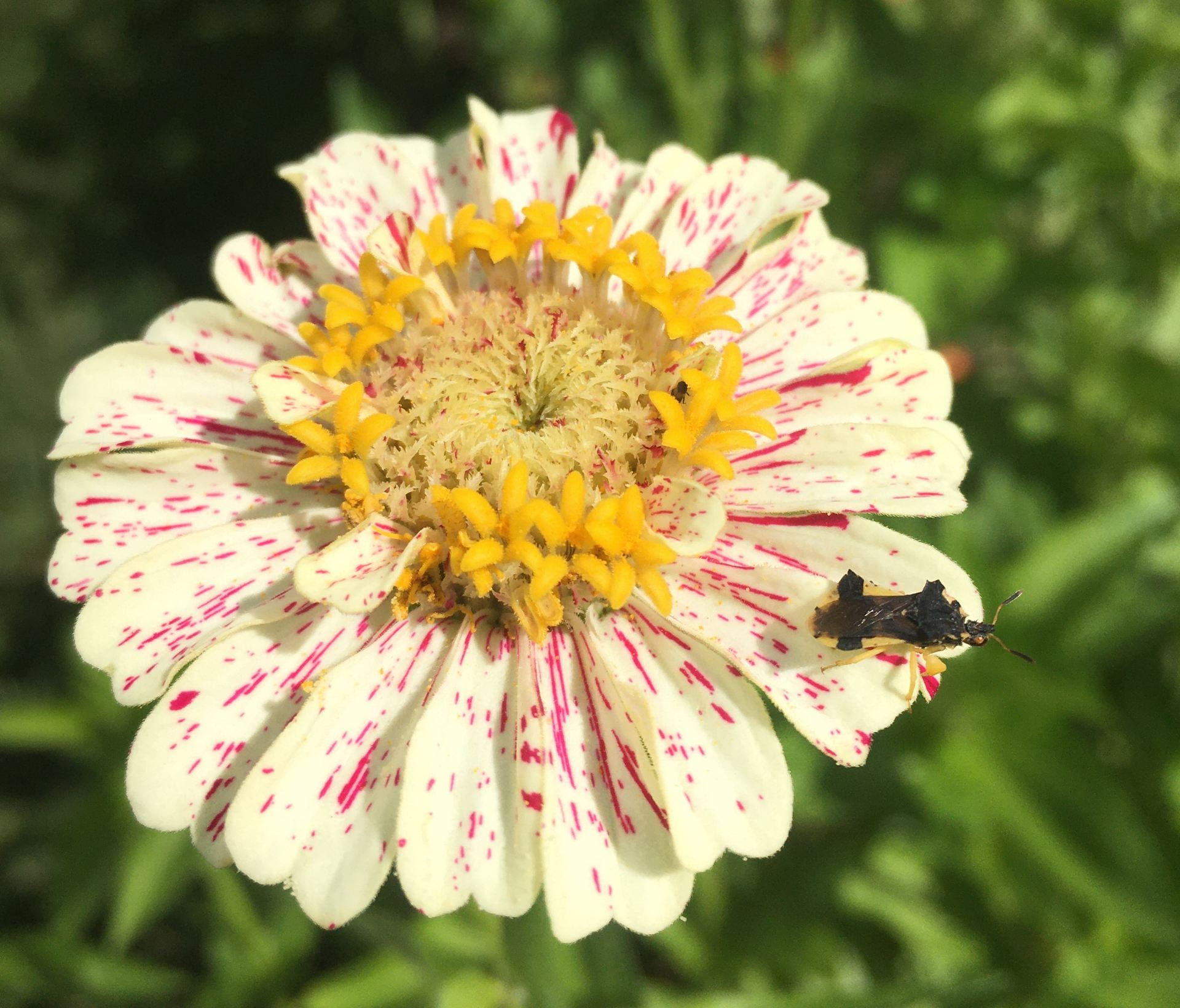
This is by no means an exhaustive list of insect natural enemies. For example, there are a variety of other true bugs, including big-eyed bugs, damsel bugs, assassin bugs, and ambush bugs that will eat pests in your garden or field. The ambush bugs are the easiest to recognize.
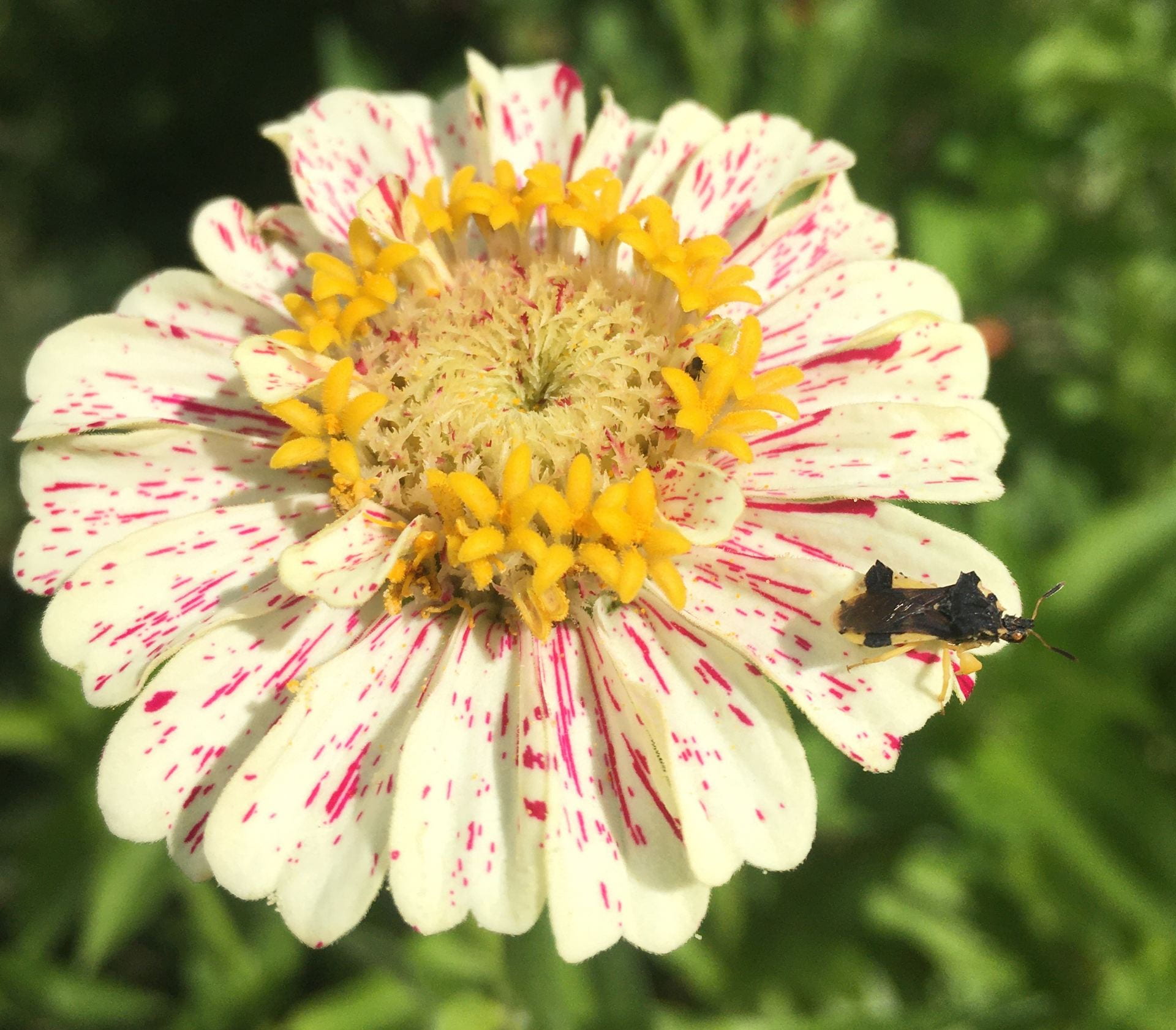
This ambush bug isn’t too hard for you or I to spot on this zinnia. Hopefully its prey won’t see it so easily.
And, this list doesn’t touch on most of the ground-dwelling natural enemies (although some spiders are predominantly found on the ground. I’ll cover those in another post.
This post was written by Amara Dunn, Biocontrol Specialist with the NYSIPM program. All images are hers, unless otherwise noted.
This work is supported by:
New York State Department of Agriculture and Markets
New York State Department of Environmental Conservation
Don’t clean up your garden too early this spring! Pollinators and natural enemies of pests need to stay cozy a bit longer.
The days are getting longer and (sometimes) warmer, trees are beginning to leaf out, spring bulbs are blooming, and lots of people are anxious to clean up their gardens. But you may have heard that cleaning up your garden too early is bad for pollinators and other beneficial insects like natural enemies of pests. Is this true? How long do you need to wait?
What’s the concern with early garden clean-up?
There are two aspects of garden clean-up that pose a risk to beneficial insects in your garden: cutting out dead stems and clearing away leaves or other debris on the ground. Some species of wild bees nest in dead stems, so cutting down and disposing of these stems before the bees emerge for the spring is problematic. Dead leaves and other plant debris on the ground provide shelter for natural enemies like lady beetles, fireflies, and ground beetles. Pristinely-raked garden beds remove this shelter. You can read more about the benefits of messiness in thisThinkIPM blog post.
When should I clean up my garden?
First, please don’t clean your garden up in the fall. With the exception of removing and disposing of diseased or insect-infested plants (especially annuals), let your garden rest in the fall.
Ok, so you’ve waited until spring. But when? It’s complicated. You are trying to protect a diverse group of wild bee species, who are nesting in diverse settings (including both the ground and dead plant stems), in addition to many different species of beetles, spiders, and other arthropod natural enemies of pests. It should come as no surprise that all of these different arthropods emerge from their winter homes at different times. For example, around here (NY) bumble bees, carpenter bees, mason bees, and mining bees emerge earlier (early April) than sweat bees (May). Even within two species of mason bee, researchers found that the temperature during the winter, the sex of the bees, and their size all significantly impacted when they would emerge in the spring (varying by up to 40 days). Winter temperatures also impact when alfalfa leafcutting bees and other bees emerge.
Sweat bees nest in the ground, and emerge a bit later in the spring than some other bee species.
So what should I do?
First, don’t let the complexity of the situation paralyze you. Can you leave just a part of your garden “messy” year round, while you clean up the flower bed right next to the street? Do it. Don’t let the perfect become the enemy of the good. You might also consider making or purchasing a sign that lets your neighbors know why you are keeping your garden a bit untidy. It could spark some interesting conversations, and maybe you’ll start a new trend!
Second – and related to the first suggestion – remember that diversity is a strength. No single way of gardening is good for all beneficial insects. For example, mulch provides shelter for beetles (many of which are predators), but ground nesting bees need bare ground. Different parts of your yard or garden can support different beneficial insects.
Third, the Xerces Society offers some guidelines for timing garden clean-up by watching the weather and what’s happening to other plants around you. However, this advice is specifically for protecting bees, and doesn’t address the needs of natural enemies of pests.
In the northeast, don’t start garden clean-up until your taxes are submitted. But realize that even waiting until mid to late April is still too early for some bee species.
The cool season grasses we usually have growing in our lawns generally require the soil to be about 50° F in order to start growing. Wait to clean up your gardens until you need to mow your lawn regularly. But always remember to mow high.
Wait until apple and pear trees finish blooming. In the northeast U.S., apricots, peaches, plums, and cherries will bloom early (when many ground-nesting bees are emerging), but apples and pears won’t finish blooming until mid-May.
To be extra safe, wait until you are ready to plant tomatoes (when night temperatures are consistently above 50° F). At least in my part of NY, this may not be until late May.
Fourth, if you feel like you absolutely can’t wait to do some garden clean-up, change how you dispose of the debris you remove. Cut back last-year’s dead stems and pile them loosely in a corner of your yard (rather than bagging them and taking or sending them to a compost facility). Insects that have yet to emerge from the stems can still do so. Once you’re well into summer, feel free to compost this debris. But remember that your landscaping choices can also create spaces for ticks to hang out.
I did clean up some garden beds in my front yard a bit on the early side this spring. But I piled the stems I cut in a back corner of my backyard.
Happy gardening!
This post was written by Amara Dunn, Biocontrol Specialist with the NYSIPM program. All images are hers, unless otherwise noted.
The prospect of growing cut flowers is so very appealing during February in upstate NY!
I don’t know about you, but this time of year I start daydreaming of all the plants I can’t wait to grow in my garden once it gets warm. The virtual and hard copy seed catalogs that fill my mailbox and my inbox are full of so many beautiful pictures and inviting suggestions. How to choose?
Well, if one of your goals for your 2021 garden is to provide good habitat for beneficial insects that eat pest insects (natural enemies of pests), here’s some advice…
Look for pollen and nectar producers
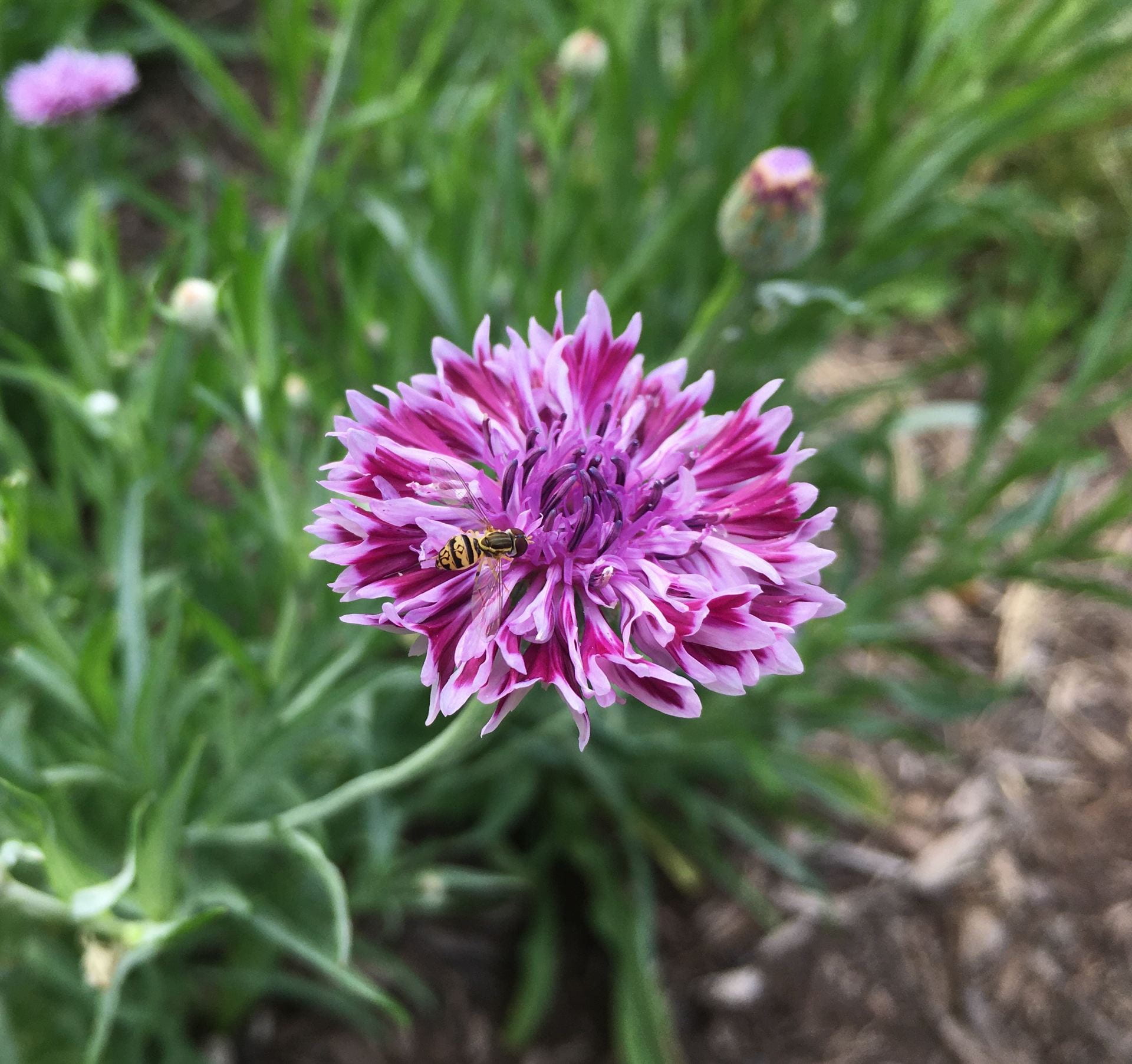
Flowers that provide plenty of pollen and nectar make great habitat for natural enemies. This is because some natural enemies also eat pollen or nectar (or both). For example, this adult hover fly feeds on the pollen and nectar produced by this bachelor’s button.
An appreciation for bachelor’s button flowers is something I share with this hover fly.
Flowers that produce pollen and nectar also attract other insects that natural enemies feed on (including lots of neutral insects, so the net effect is positive). This ambush bug is hanging out on a zinnia waiting for other insects to wander by and become lunch.
This ambush bug doesn’t seem too well camouflaged to me, but hopefully its prey didn’t notice it.
How do you know if a plant will produce flowers rich in pollen and nectar? Well, plants marketed as being good for pollinators are often a good bet, since bees, butterflies, and other pollinators also feed on pollen and nectar. Be aware that sometimes – but not always – “fancy” cultivars (with double blossoms or exotic colors) do not provide the same pollen and nectar resources as the “plain” cultivars or simply native species. You can read a bit more about this in my post from last spring.
Flower shape matters
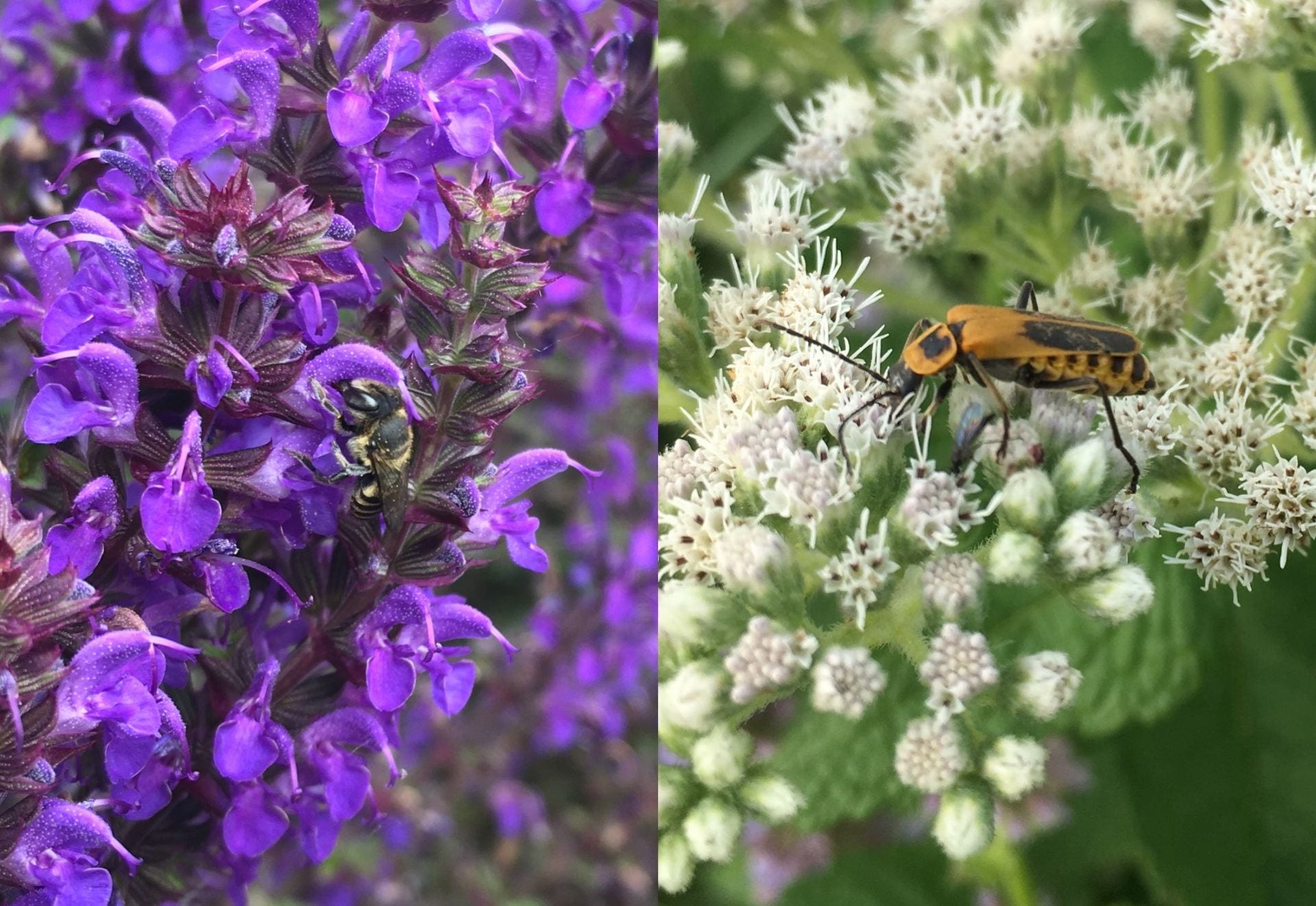
While some bees have long tongues that help them reach into deep, tube-shaped flowers, lots of natural enemies (like flies, small wasps, and beetles) prefer small, shallow, and open flowers. The pollen and nectar are easier to access, and these flower shapes also give them a nice spot to land or sit.
The bee on the left has no problem reaching into these tubular flowers. The soldier beetle on the right is happy on the small boneset flowers.
Plan for season-long blooms
Natural enemies need food (whether it’s pollen and nectar or other insects) from early in the spring until late in the fall. If you only have blooms in July and August, the natural enemies will be very hungry, and will find another spot to hang out. Of course, continuous blooms have aesthetic value, too.
While annuals tend to bloom for a longer period of time during the growing season (especially if you pick off dead blooms), it can be hard to find annuals that bloom early (at least in NY).
Golden alexanders is an early-blooming perennial. I took this picture in the middle of May.
Including some early-blooming perennials will feed your natural enemies before your annuals take off. This site lets you search for plants by a variety of characteristics, including when they bloom.
Put away those pesticides!
Or at least pause and assess whether you really need them and what impact they might have on natural enemies and other non-pests before you use them. Of course, you must always read and follow the label on any pesticide, no matter where you plan to use it. The label is the law!
Plants that don’t bloom are still useful
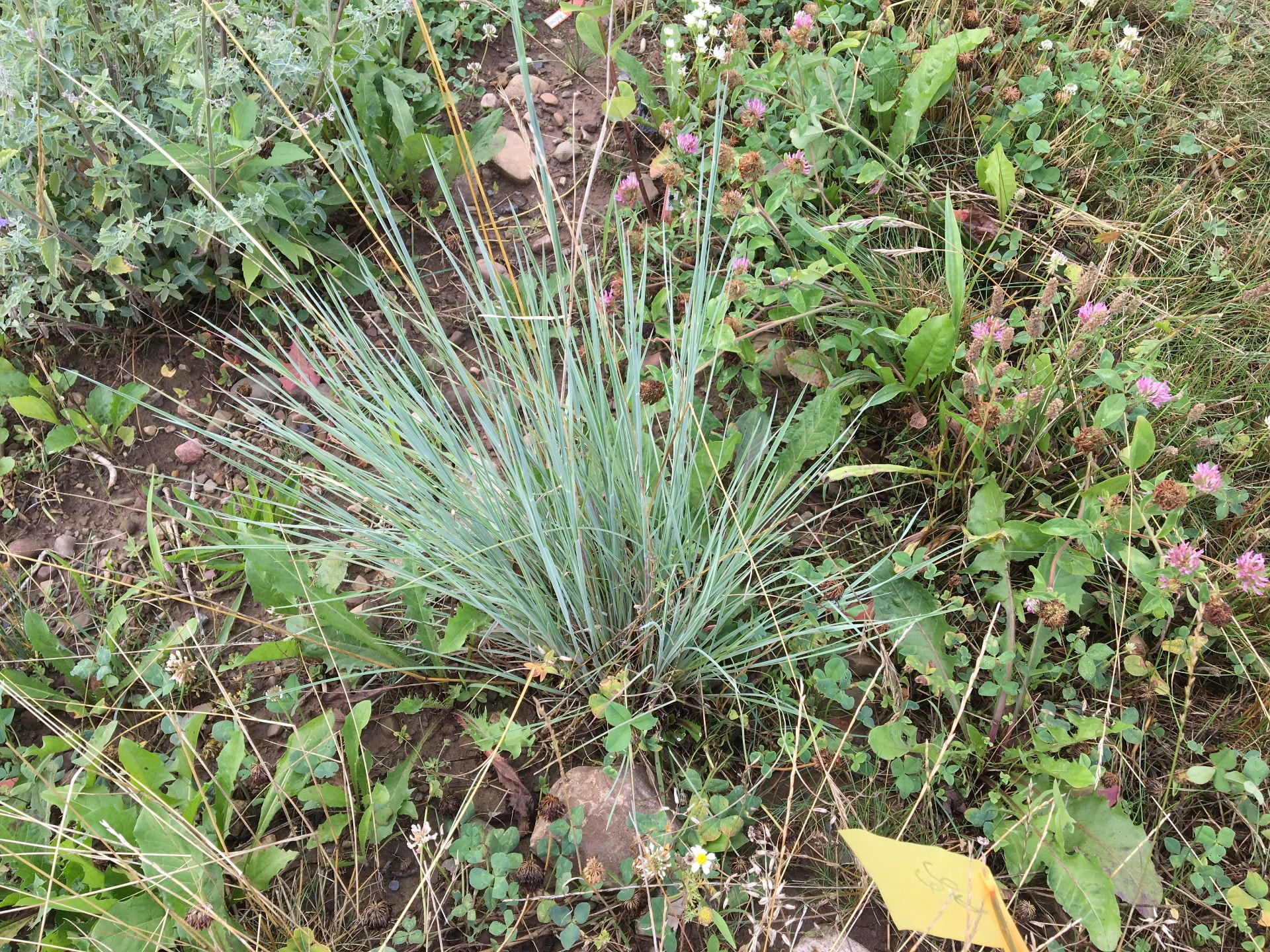
For example, bunching grasses not only provide some visual contrast to blooming plants, but they make great shelter for predatory beetles, spiders, and other insects.
Grass that grows in clumps like this little bluestem provides shelter for ground-dwelling natural enemies.
If you love spreadsheets like me…
While looking for pollinator-friendly plants is an easy way to choose plants that will probably support natural enemies, sometimes I am asked “yes, but if I want to attract this specific natural enemy, what should I plant?” So I reviewed university research and extension resources from around the United States to see which plants have been documented to support specific natural enemies. Here’s the link to that spreadsheet. If you want the “cliffs notes”, here are the plant families that had the largest number of species documented as supporting natural enemies:
Aster (same as the daisy or composite family)
Carrot (same as the parsley family)
Mint
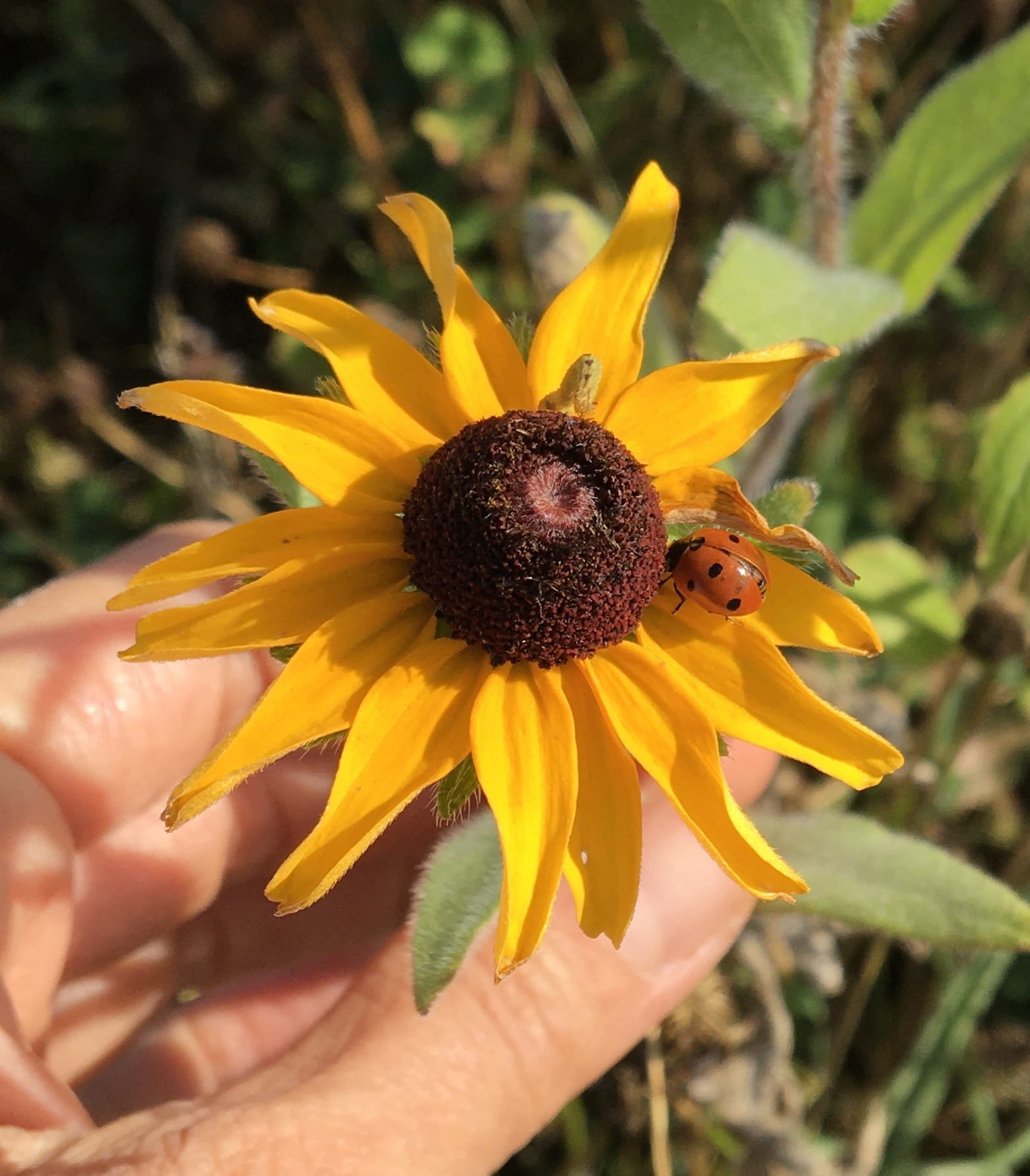
Lots of members of the aster (daisy, composite) family produce plenty of easily-accessible pollen to feed natural enemies like this lady beetle.
Got a pest and you’re wondering which natural enemies will eat it? There’s a chart for that, too!
So, what will you be growing in 2021? I already placed my first seed order (hint: it included a few different kinds of both zinnias and sunflowers), but I can’t promise I won’t place a second one.
This post was written by Amara Dunn, Biocontrol Specialist with the NYSIPM program. All images are hers, unless otherwise noted.
Trips to our beneficial insect habitat and Christmas tree research plots this year were very solitary, but it was good to get outside.
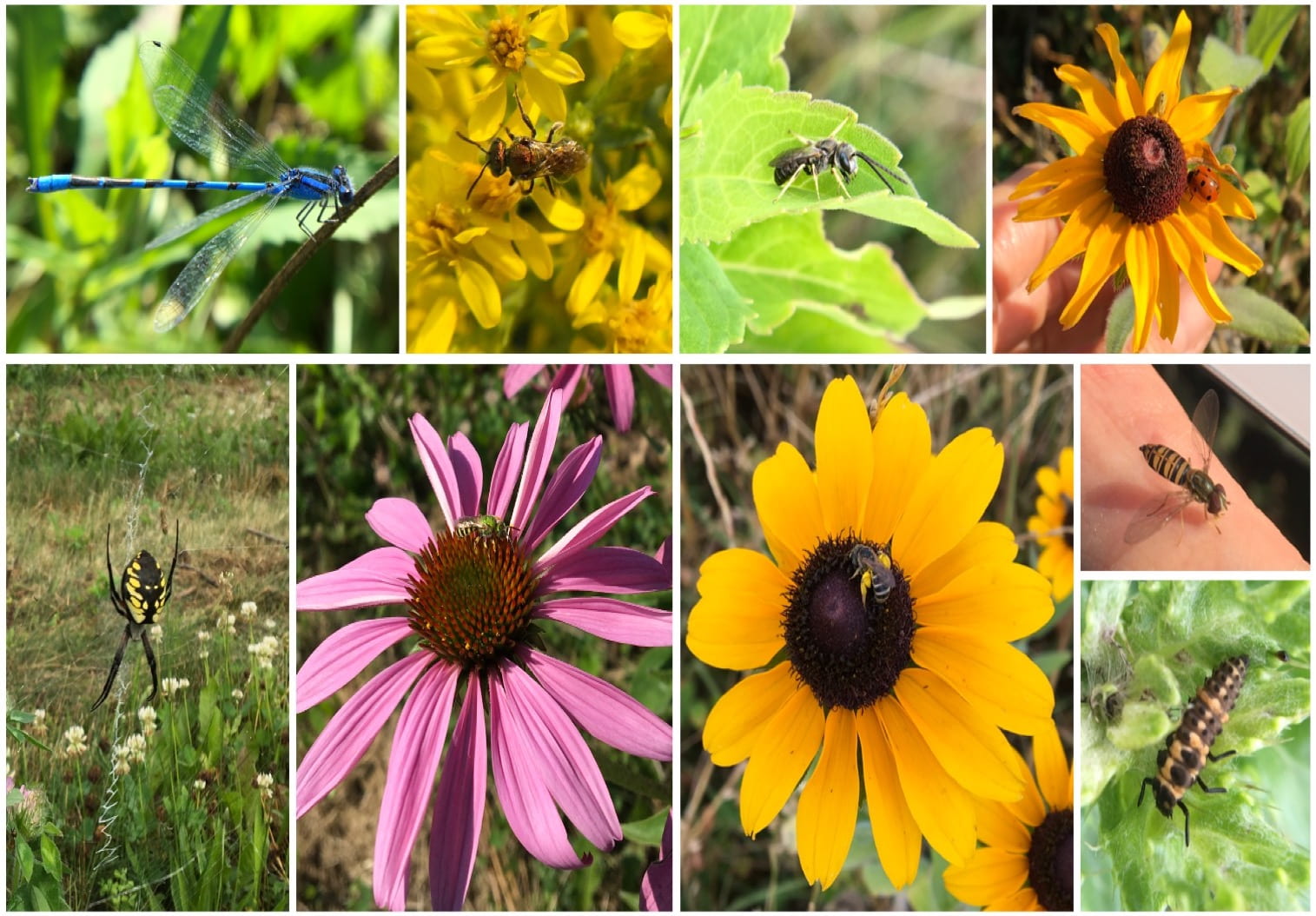
As many people did, we had to change our plans for this project in response to COVID-19. The biggest change was that we didn’t collect any insects this year. If you follow me on Twitter or Instagram, you saw some pictures of different insects I spotted while visiting these plots this summer. Here are a few highlights:
Just a few of the cool insects (and one arachnid) I was able to photograph during my weekly visits to the habitat plots.
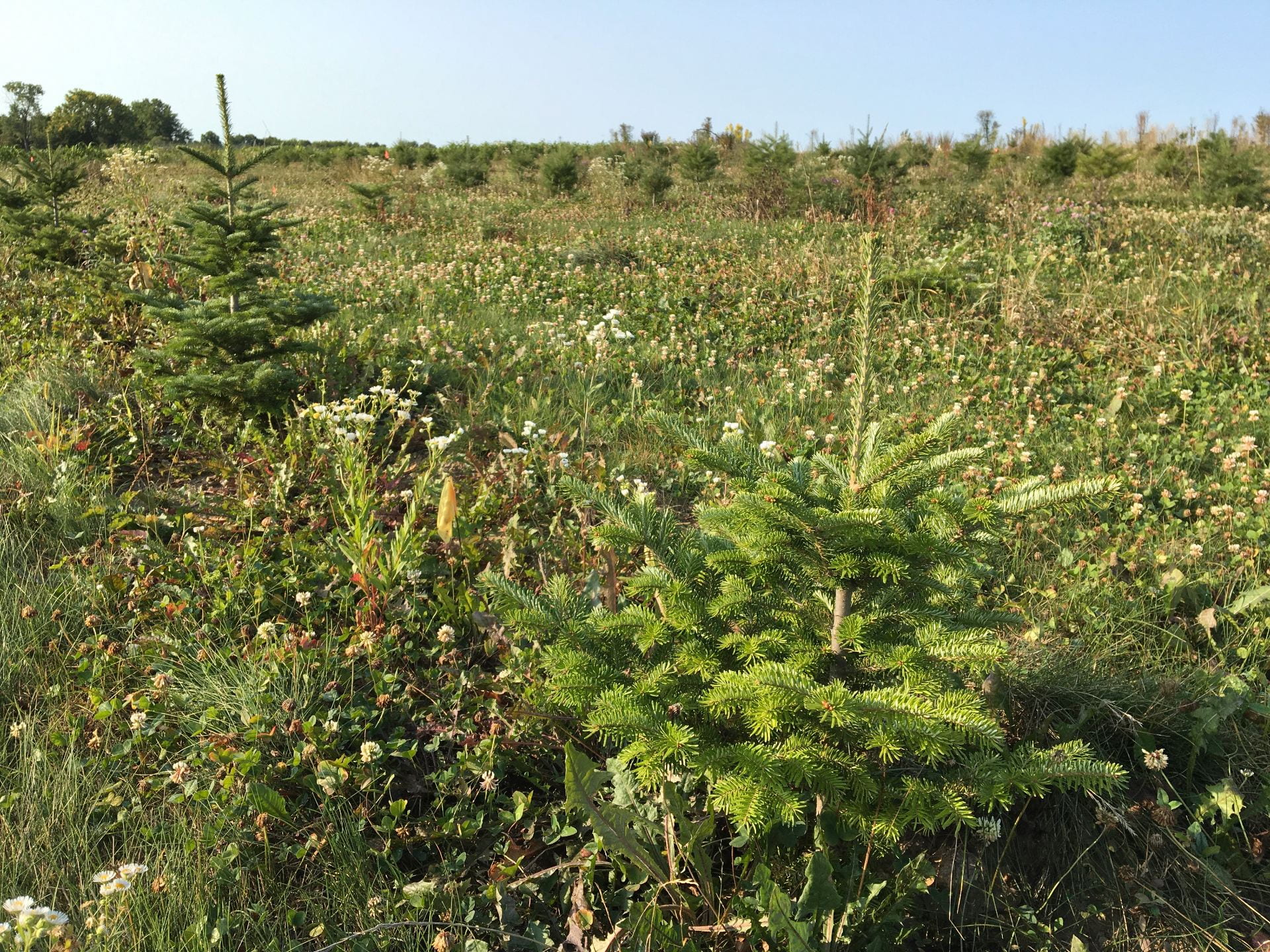
The Christmas trees are still growing, and Brian Eshenaur and I made sure that the weeds didn’t take over. One Christmas tree grower suggested that they might need some trimming next year. I’m adding “Christmas tree shearing” to the list of new things I will try (learn?) in 2021.
Slowly but steadily, the Christmas trees adjacent to our beneficial insect habitat plots are growing!
From May through mid-October, I visited our beneficial insect habitat plots once a week to take pictures and document what was blooming. Brian and I also mowed plots that were direct seeded in fall 2018 twice (May and June). Those of you reading this from NY know how dry much of our summer was, and there really wasn’t a need for more frequent mowing. We decided not to mow Treatment C, which had been direct seeded in spring of 2018. The standard recommendation for establishing perennial wildflowers from seed is to mow for the first two growing seasons, and in the third year to start scaling back on the mowing. Since this was the third season for these spring-seeded plots, we skipped the mowing. I’m not sure we made the right decision for our plots.
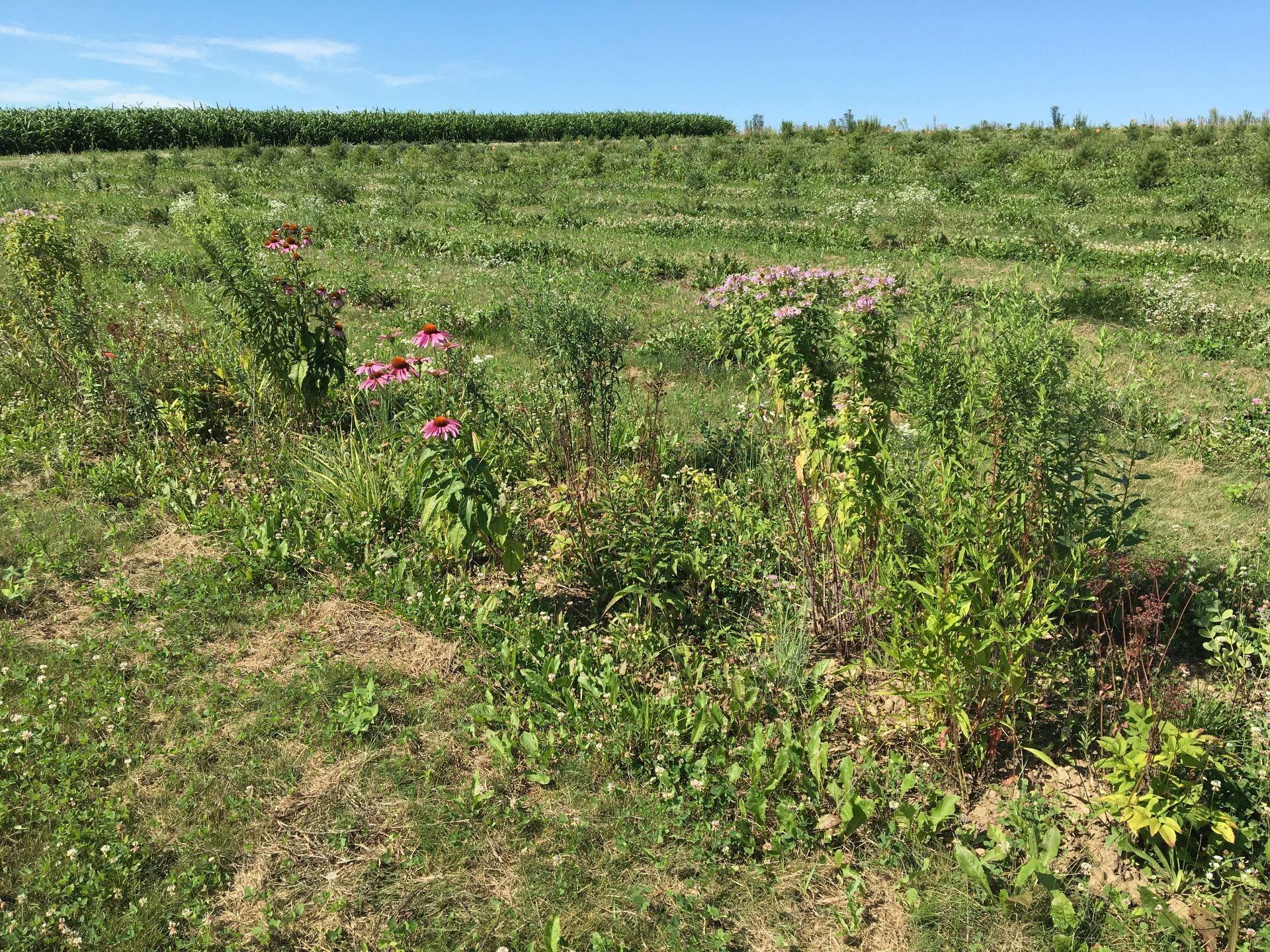
One plot that was direct seeded in the spring of 2018 and not mowed this year. There were a lot of weeds (some blooming) in addition to some of the species we seeded.
Some of the perennials we seeded bloomed, but mostly these plots were over-run by grass and some weedy asters. It could be that the wildflower establishment was poor. Spring is not the recommended time for planting perennial wildflower seeds. Or it could be that these plots needed to be mowed at least once this season. Since 2021 will be the third year for the fall-seeded plots, I’m wondering about reducing the mowing in these plots, instead of stopping “cold turkey”.
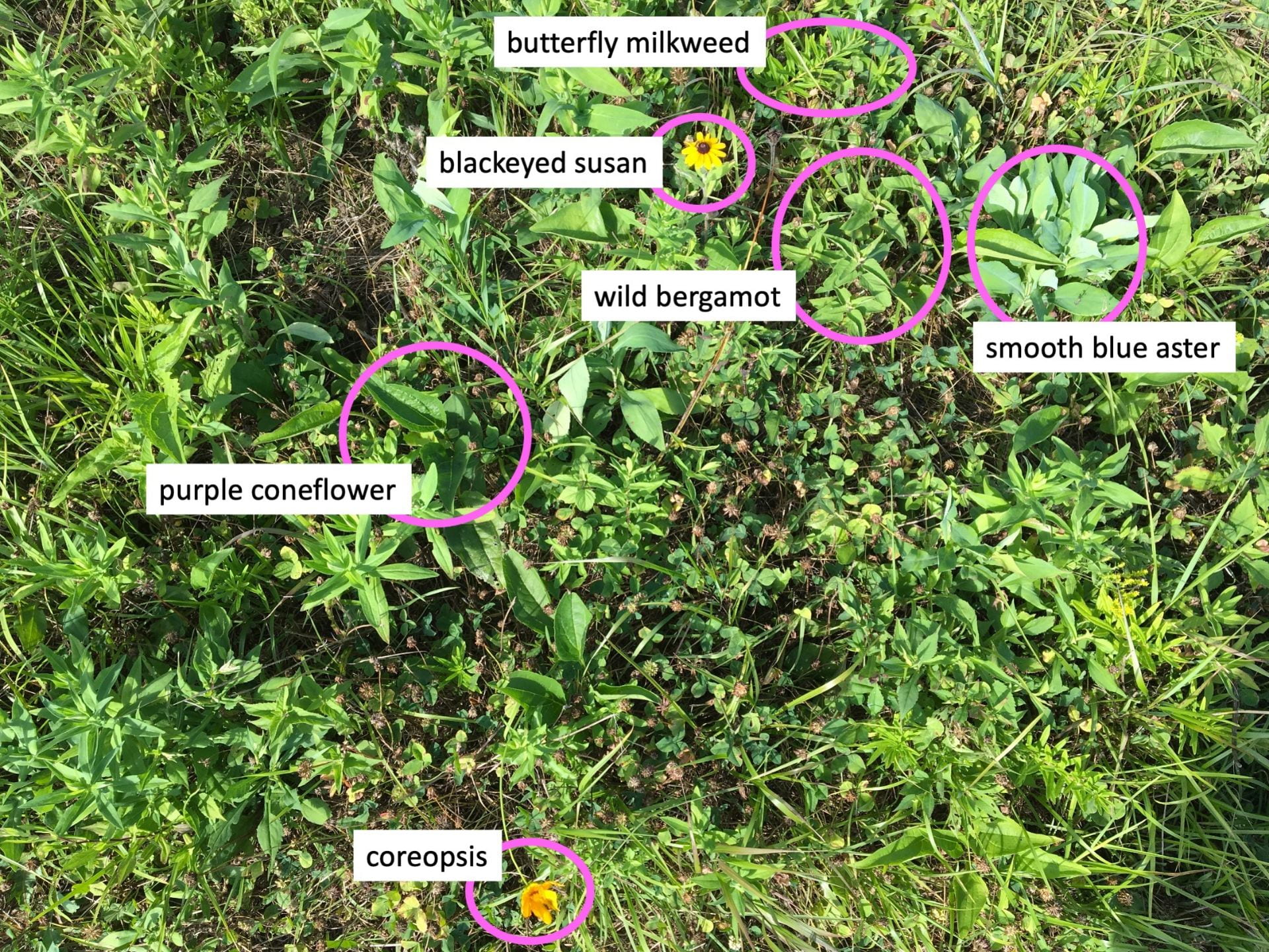
In the meantime, the fall-seeded Treatments F and G (mowed twice in 2020) are developing nicely! Even when there weren’t many flowers, I could recognize lots of wildflower seedlings.
At first glance, this might look like a patch of weeds, but I’ve learned to spot some of the seedling perennial wildflowers direct seeded in fall 2018.
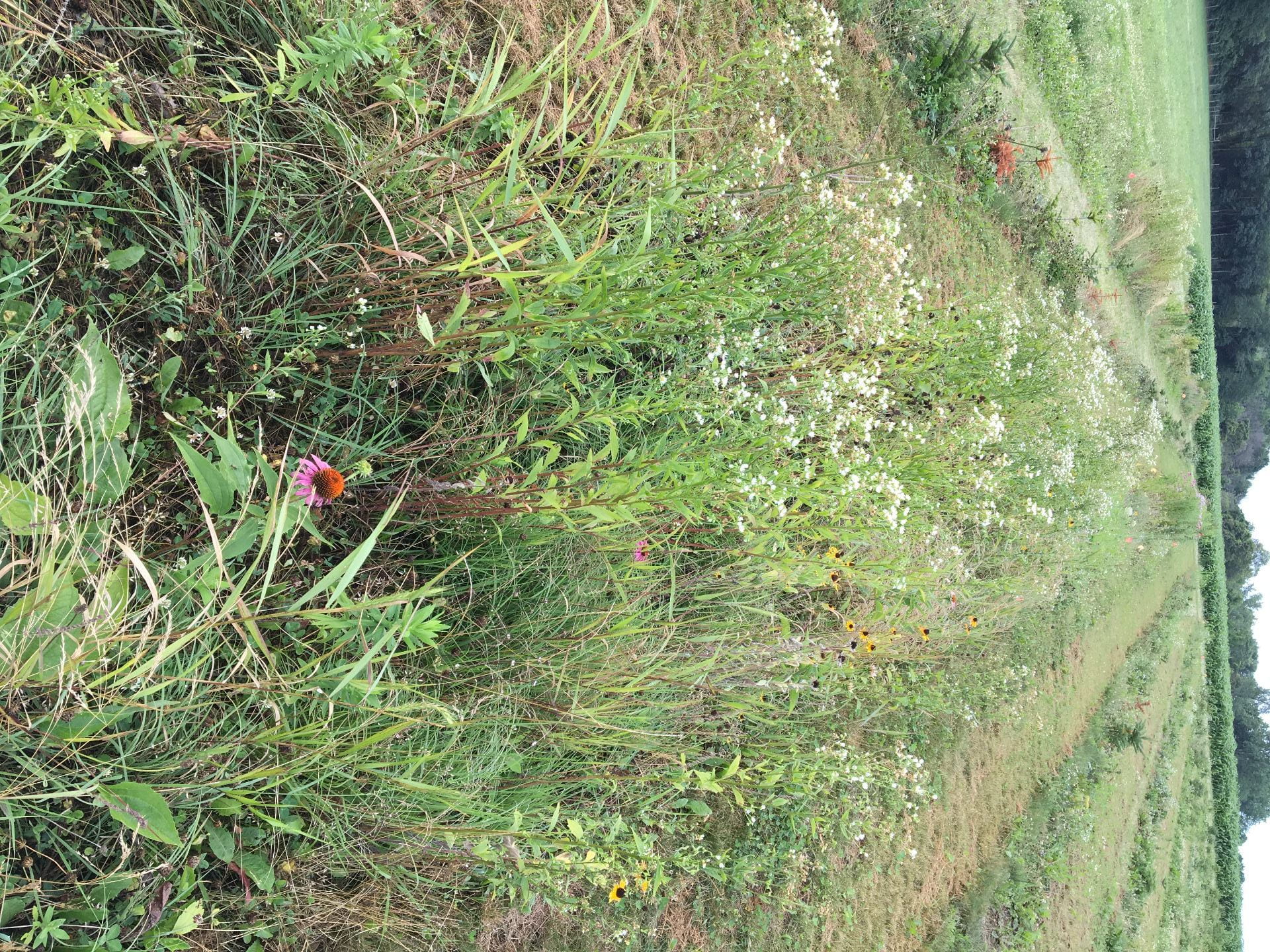
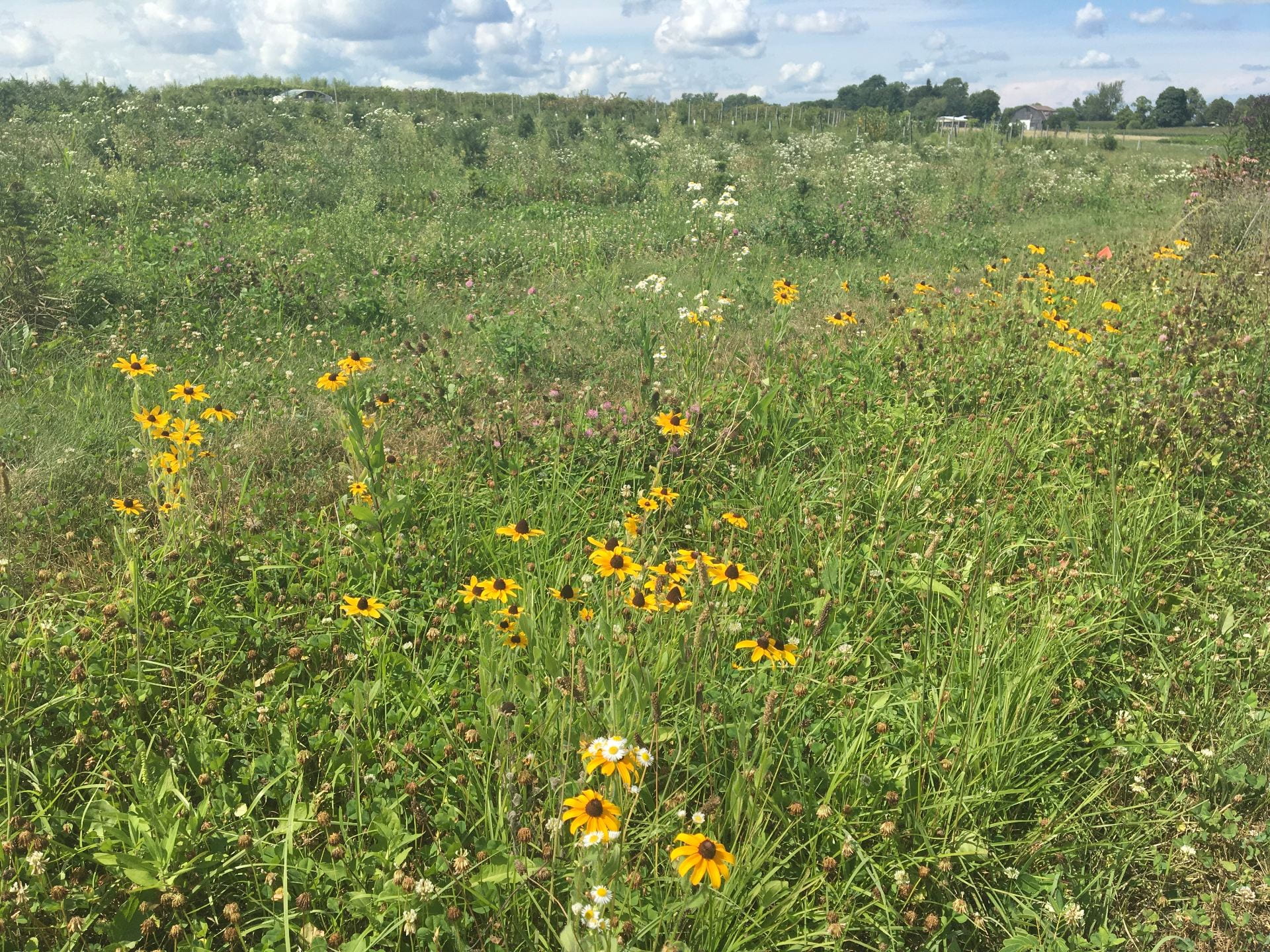
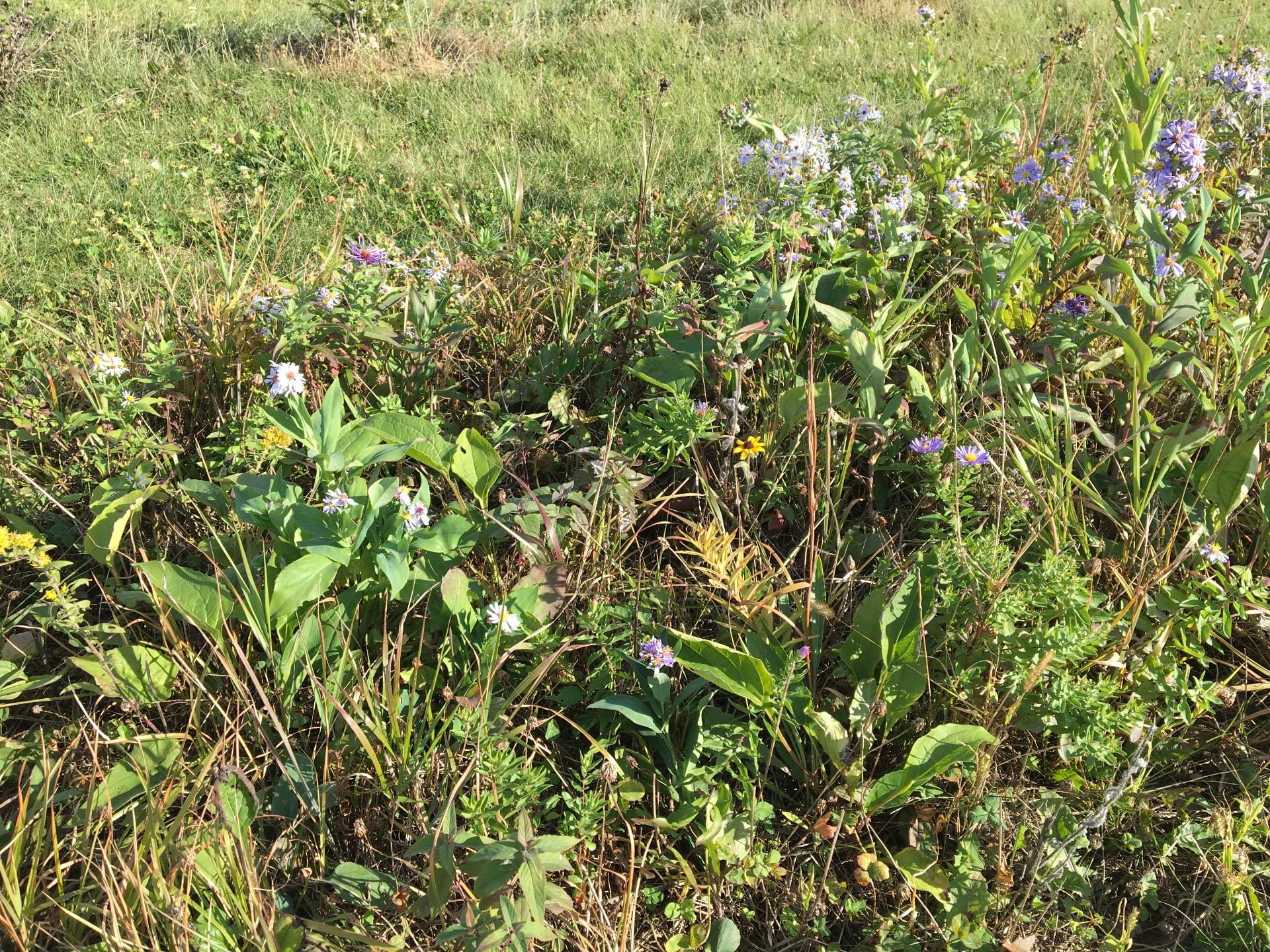
In July and August, there were abundant blackeyed susan blossoms, and in September and October all four aster species bloomed.
The fall-seeded habitat plots don’t look manicured like the plots that were transplanted in spring and mulched, but there were a lot of blackeyed susans blooming in mid to late summer this year!Direct seeded plots contained New England asters (darker purple flowers), zigzag asters (pale flowers, stems grow in zigzag pattern), smooth blue asters (pale purple flowers, smooth leaves and stems), and aromatic asters (more compact growth habit, light purple flowers).
This year, I kept notes not only on what was blooming each week, but on whether blossoms had just started to open (E = early bloom), were fully open (P = peak bloom), or were fading (F = fading bloom). Because there were 12 plots for each transplanted or direct seeded species, if the plots were evenly split between early and peak (E/P) or peak and fading (P/F), I included these two intermediate categories. You can see a color version of the following tables here. The colors give a nice visual of the progression of blooms over the season (including some weeks when there was a bit of a lull in blooms).
E
early bloom
E/P
evenly mixed early & peak bloom in different plots
P
peak bloom
P/F
evenly mixed peak & fading bloom in different plots
F
fading blooms
When transplanted wildflowers bloomed in 2020
May
Jun
Jul
Aug
Sep
Oct
5
12
21
27
1
9
16
23
30
6
14
21
28
6
12
17
26
1
8
15
22
28
6
14
Golden alexanders
E
P
P
P
F
F
Ohio spiderwort
E
E
E
P
P
P
F
F
F
F
F
F
F
F
Catmint
E
P
P
P/F
F
F
F
F
F
F
F
F
F
F
F
F
F
F
F
F
Lanceleaf coreopsis
E
P
F
F
F
Blue false indigo
E
P
Tall white beard tongue
E
P
F
F
F
F
Common milkweed
E
F
Purple coneflower
E
E
P
P
P
F
F
F
F
F
F
F
Wild bergamot
E
P/F
F
F
F
F
F
Anise hyssop
E
P
P
F
F
F
F
F
Boneset
E
P
P
F
F
F
F
NY ironweed
E
E
E
P
P
P
P
F
F
Orange coneflower
E
E
P
P
P
P
P/F
F
F
F
F
New England aster
E
E
E
E
P
P
P
F
Showy goldenrod
E
P
P
F
F
When direct seeded wildflowers bloomed in 2020
May
Jun
Jul
Aug
Sep
Oct
5
12
21
27
1
9
16
23
30
6
14
21
28
6
12
17
26
1
8
15
22
28
6
14
Golden alexanders
E
P
P/F
Hairy beard tongue
E
E
Lanceleaf coreopsis
E
P/F
F
F
F
F
F
E
P
F
F
F
F
F
F
Tall white beard tongue
E
Blackeyed susan
E
E
P
P
P
P
P
P
P/F
P/F
F
F
F
F
F
F
Purple coneflower
E
E
P
P
P
P
F
F
F
F
F
F
E/P
Wild bergamot
E
F
F
Butterfly milkweed
P
F
E
Orange coneflower
E
P
P
P/F
F
F
Smooth blue aster
E
E
P
P
P
P
Gray goldenrod
E
E
E/P
P
F
F
New England aster
E
E
P
P
P
Zigzag aster
E
E
P
P
P
Aromatic aster
E/P
E/P
P
Yellow false indigo
Partridge pea
Marsh blazing star
Narrowleaf mountainmint
Wild senna
Maryland senna
Early goldenrod
Ohio spiderwort
Common name
Scientific name
Anise hyssop
Agastache foeniculum
Aromatic aster
Symphyotrichum oblongifolius
Blackeyed susan
Rudbeckia hirta
Blue false indigo
Baptisia australis
Boneset
Eupatorium perfoliatum
Butterfly milkweed
Asclepias tuberosa
Catmint
Nepeta faassinii
Common milkweed
Asclepias syriaca
Early goldenrod
Solidago juncea
Golden alexanders
Zizia aurea
Gray goldenrod
Solidago nemoralis
Hairy beard tongue
Penstemon hirsutus
Lanceleaf coreopsis
Coreopsis lanceolata
Marsh blazing star
Liatris spicata
Maryland senna
Senna marilandica
Narrowleaf mountainmint
Pycnanthemum tenuifolium
New England aster
Symphyotrichum novae-angliae
NY ironweed
Vernonia noveboracensis
Ohio spiderwort
Tradescantia ohiensis
Orange coneflower
Rudbeckia fulgida va. Fulgida
Partridge pea
Chamaecrista fasciculata
Purple coneflower
Echinacea purpurea
Showy goldenrod
Solidago speciosa
Smooth blue aster
Symphyotrichumlaeve
Tall white beard tongue
Penstemon digitalis
Wild bergamot
Monarda fistulosa
Wild senna
Senna hebecarpa
Yellow false indigo
Baptisia tinctoria
Zigzag aster
Symphyotrichum prenanthoides
From the second or third week of May through the second week of October, there was always something blooming in these plots, whether they were transplanted or direct seeded. You can also see that a fair number of species in the seeded plots did not bloom this year. Hopefully next year.
In the meantime, I’ll be making plans for the 2021 growing season, which will hopefully include a return to insect sampling. Stay well and stay safe!
This post was written by Amara Dunn, Biocontrol Specialist with the NYSIPM program. All images are hers, unless otherwise noted.
This work is supported by:
Crop Protection and Pest Management -Extension Implementation Program Area grant no. 2017-70006-27142/project accession no. 1014000, from the USDA National Institute of Food and Agriculture.
New York State Department of Agriculture and Markets
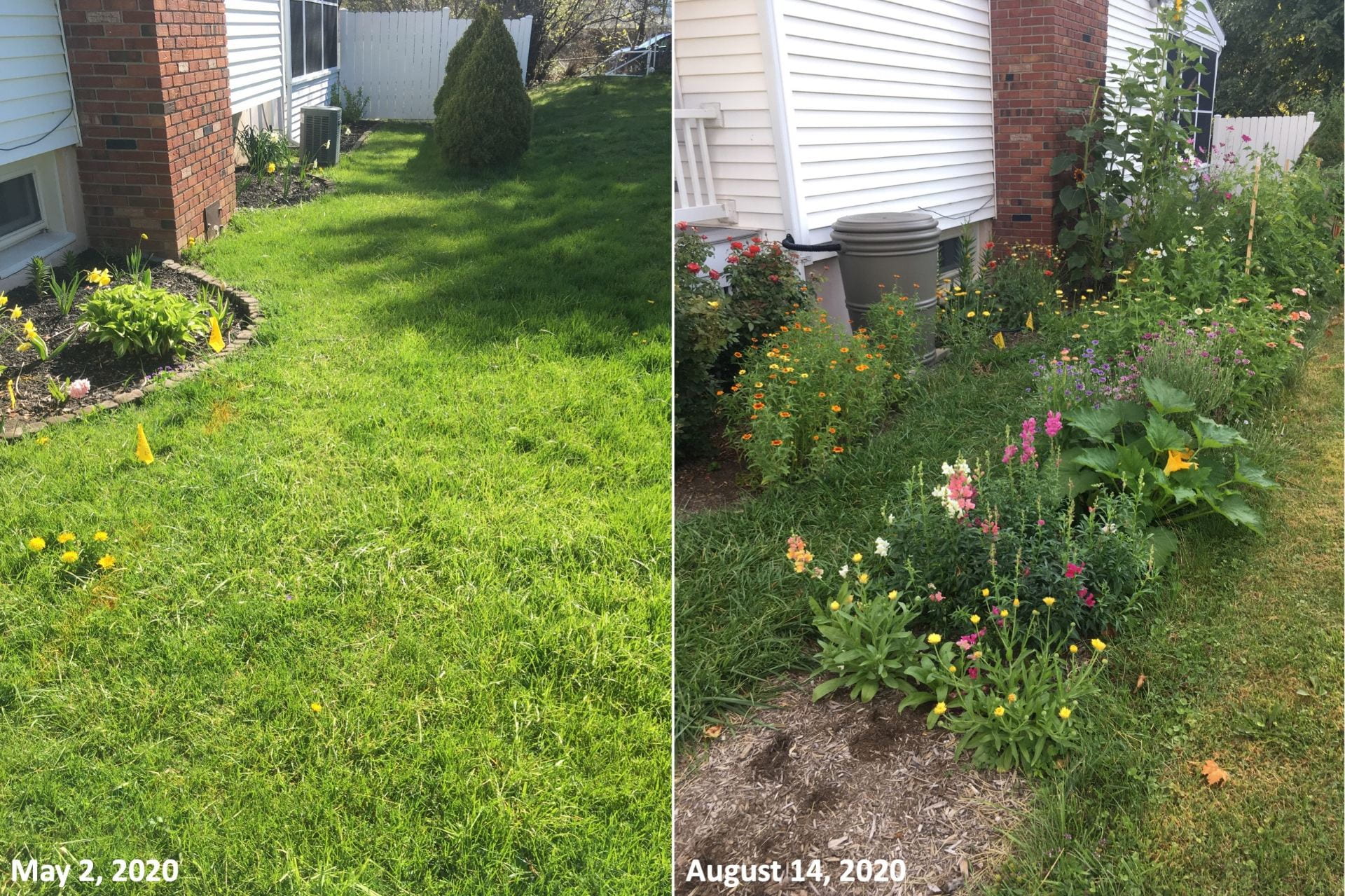
Having before and after pictures really helps me appreciate how far my beneficial insect habitat (plus a few vegetables thrown in for good measure) have come!
Well, the days are getting shorter, the air is getting cooler, and pumpkins are starting to show up on front porches. I guess it’s time for me to admit that fall is coming. So it seemed like a good time to provide an update on my efforts to establish habitat for beneficial insects around my home. If you need to catch up on this project, you can read more about site selection, plant selection, and weed control in previous posts.
#BeneficialHabitatAtHome in pictures
Overall, I’m pretty happy with how the garden turned out this first year! If you follow me on Instagram or Twitter, you’ve seen some of these pictures already.
I attracted quite a few pollinators…
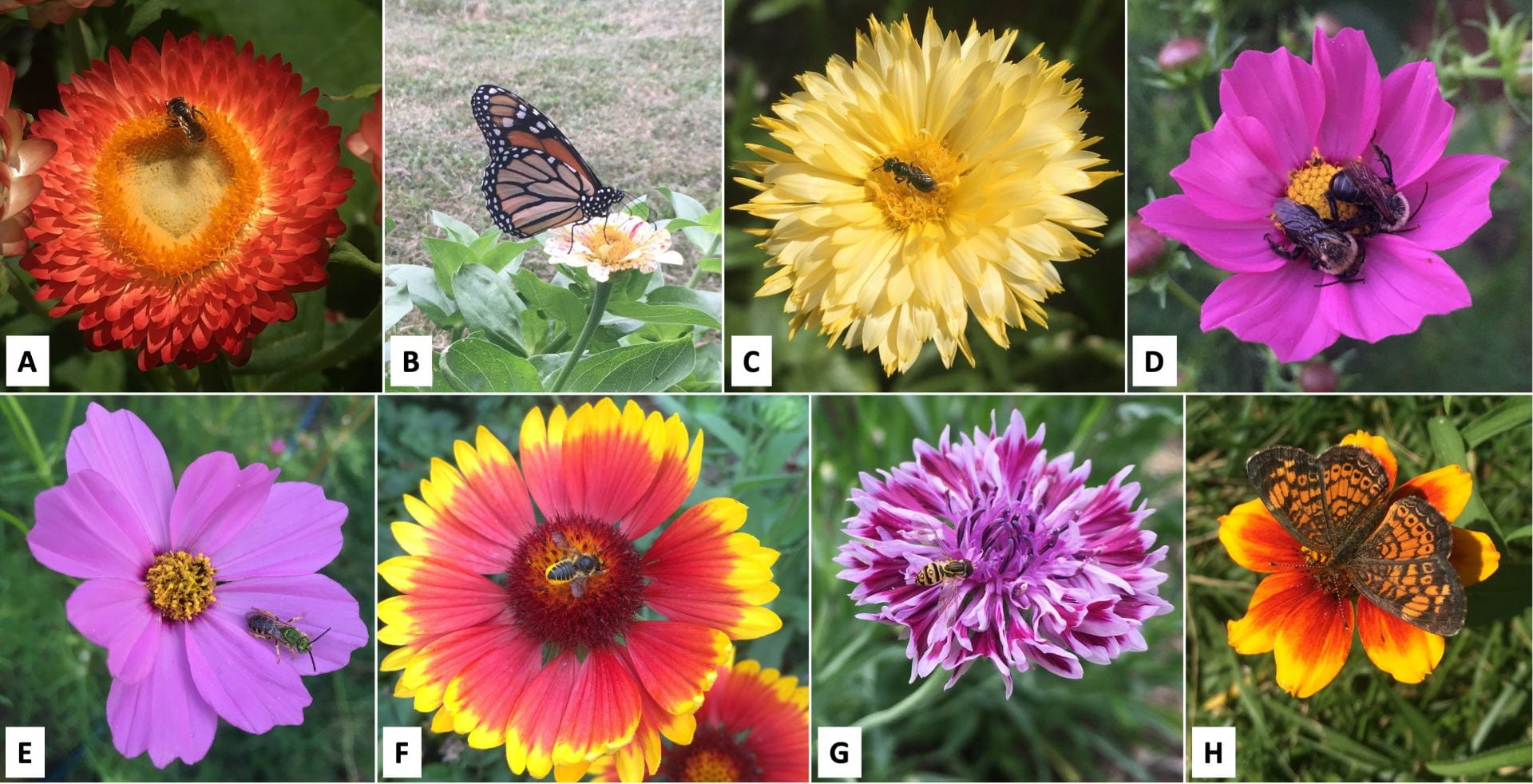
These are just some of the pollinators that visited my (A) strawflowers, (B) zinnia cultivar ‘Candy Cane Mix’, (C) calendula cultivar ‘Remembrance Mix’; (D) and (E) cosmos, (F) blanketflower, (G) bachelor’s buttons and (H) ‘Persian Carpet’ zinnia.
…and natural enemies.
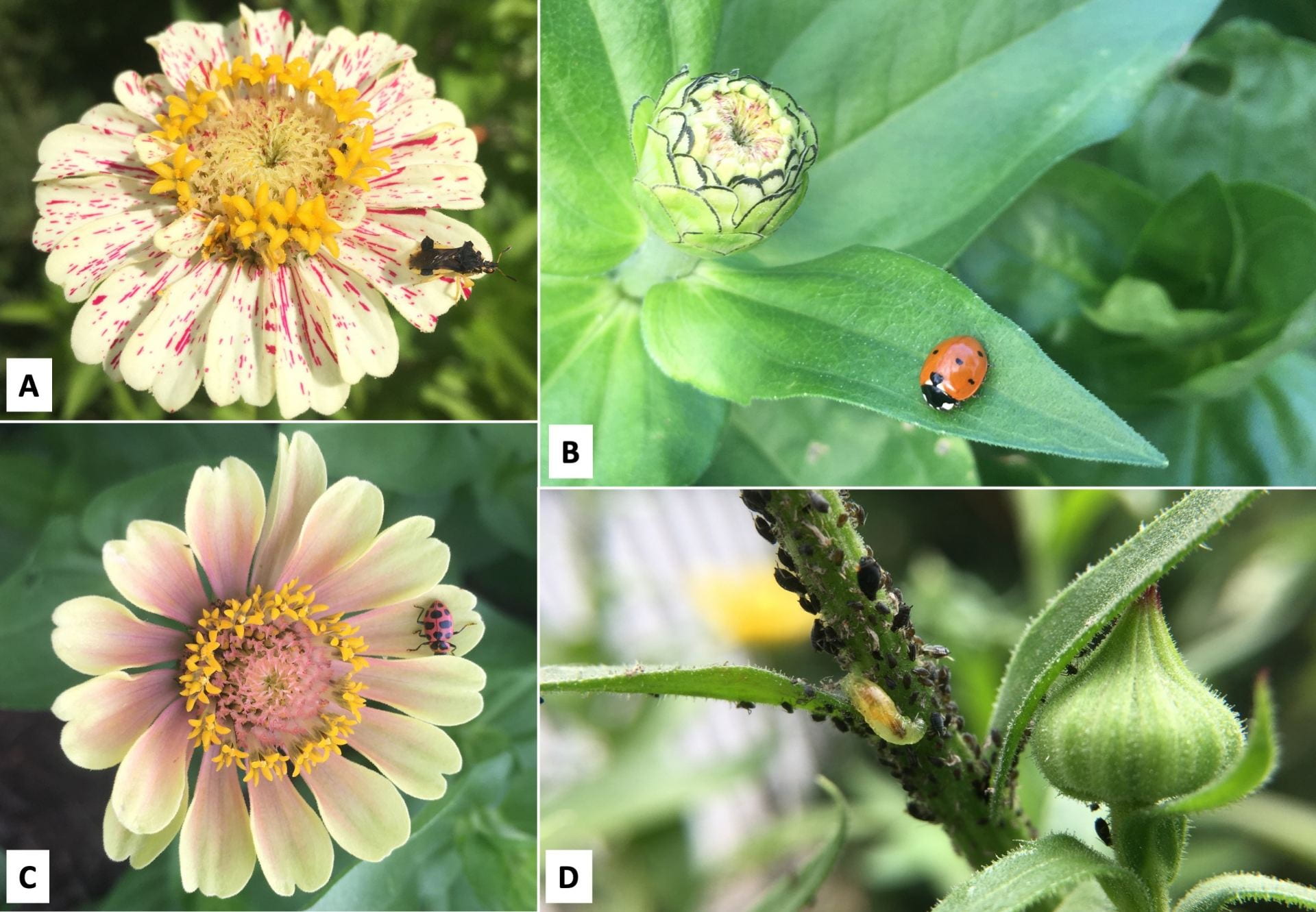
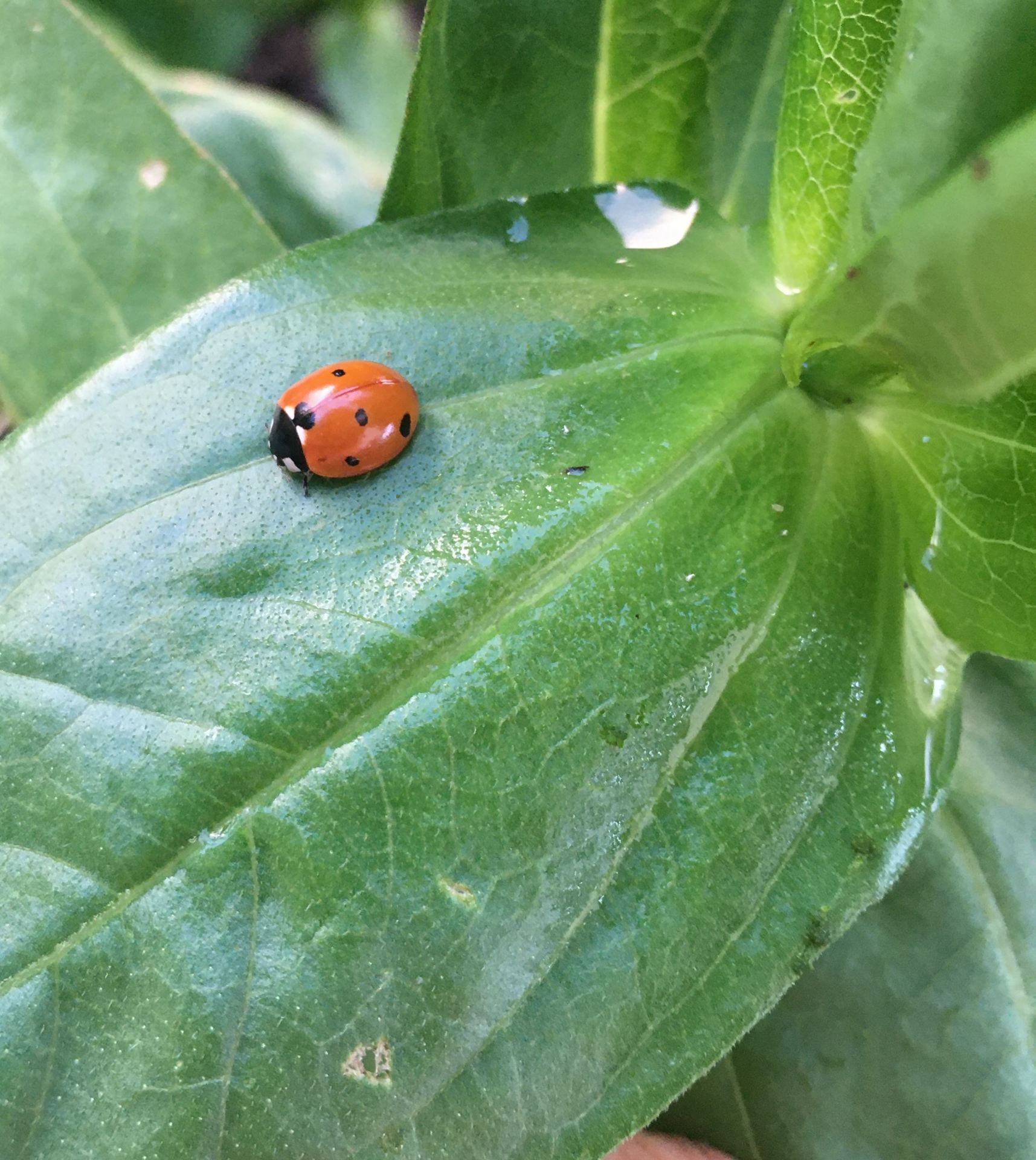
Most of the natural enemies I spotted this summer were ladybugs, like the seven-spotted ladybug in B and the pink spotted ladybug in C. But I also saw an ambush bug (A) and a hover fly larva (D). I saw plenty of adult hover flies, but the larvae are a bit less conspicuous.
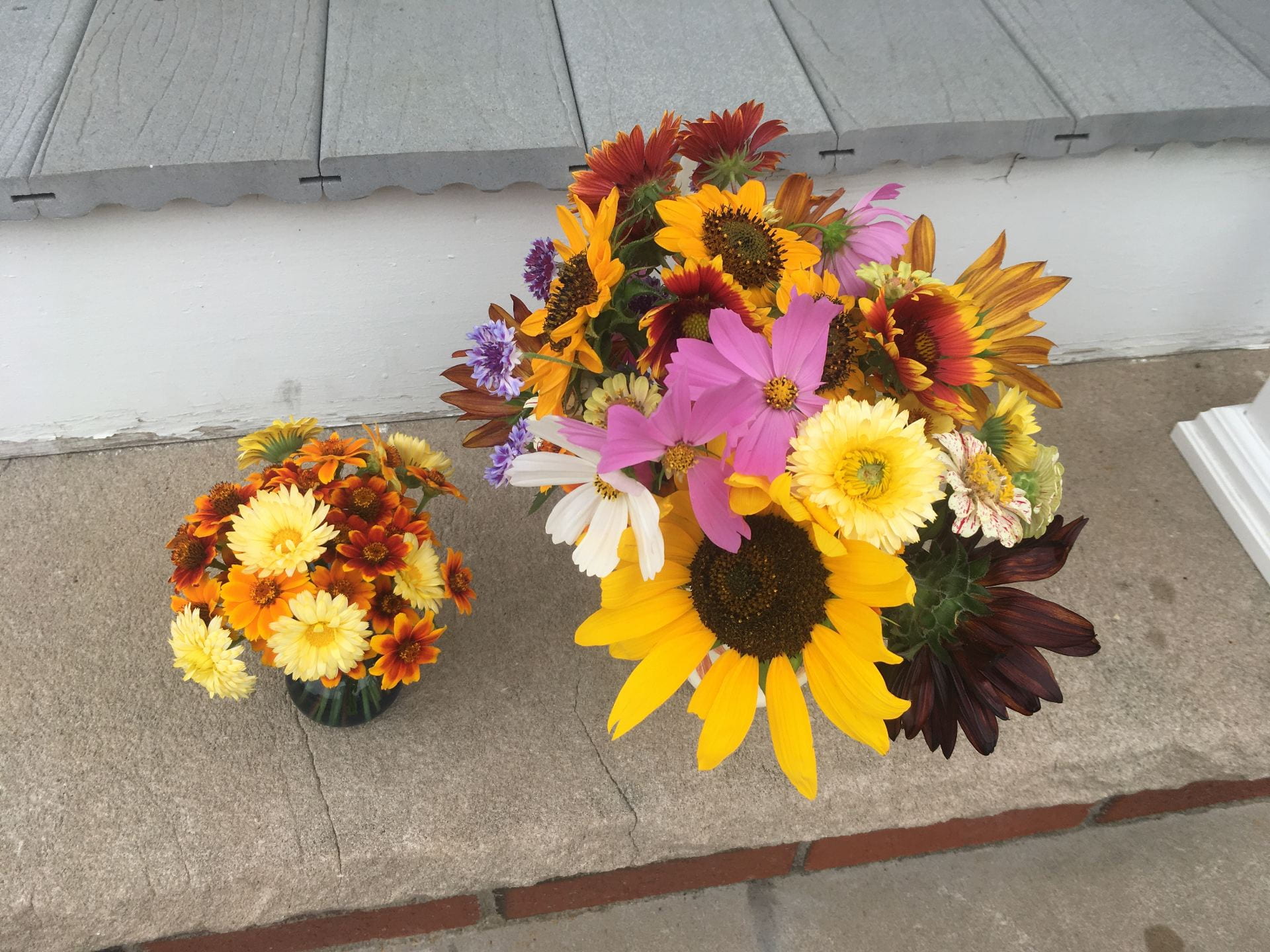
I also picked a lot of cut flowers!
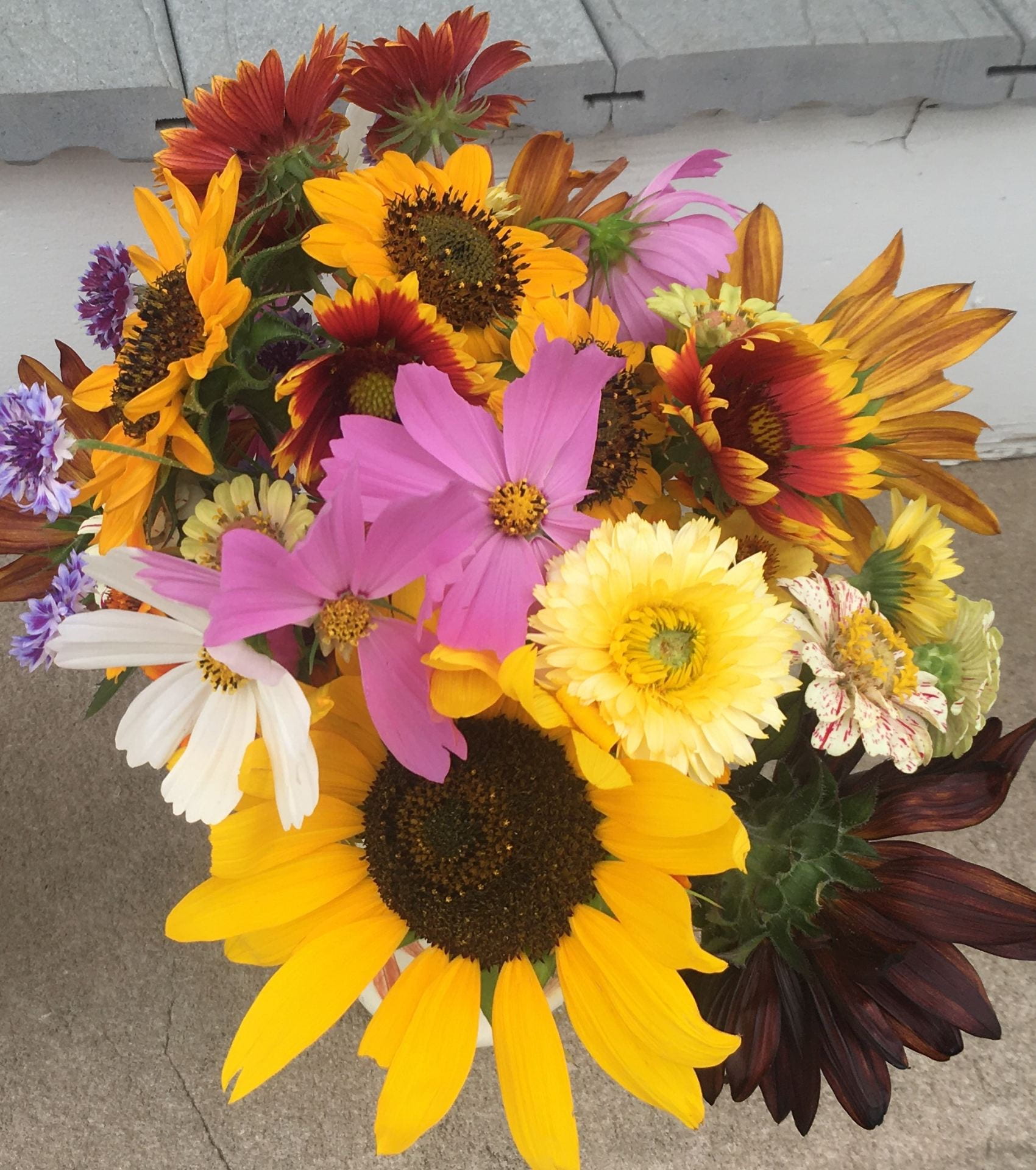
Admittedly, one of my goals in creating this habitat was to be able to pick cut flowers for myself and others this summer. I was hoping that I could grow flowers that would be attractive both to people and natural enemies of pests. I think I succeeded!
Plant establishment success
This spring, I planted four perennials: arnica (Arnica chamissonis), blanketflower (Gaillardia aristata), echinacea (Echinacea purpurea), pyrethrum daisy (Chrysanthemum coccineum), and ‘Chim chiminee’ rudbeckia (Rudbeckia hirta). I started some blue vervain from seed, but by the time I’d figured out that stratification was needed, it was pretty late in the spring. The seedlings that did emerge didn’t survive. The blanketflowers and rudbeckia bloomed already this first year.
Although they are perennials, the ‘Chim Chiminee’ rudbeckia and the blanketflowers bloomed this first year, and also looked nice as cut flowers.
The arnica, echinacea, and pyrethrum daisy put their energy into vegetative growth, and hopefully they will bloom next year.
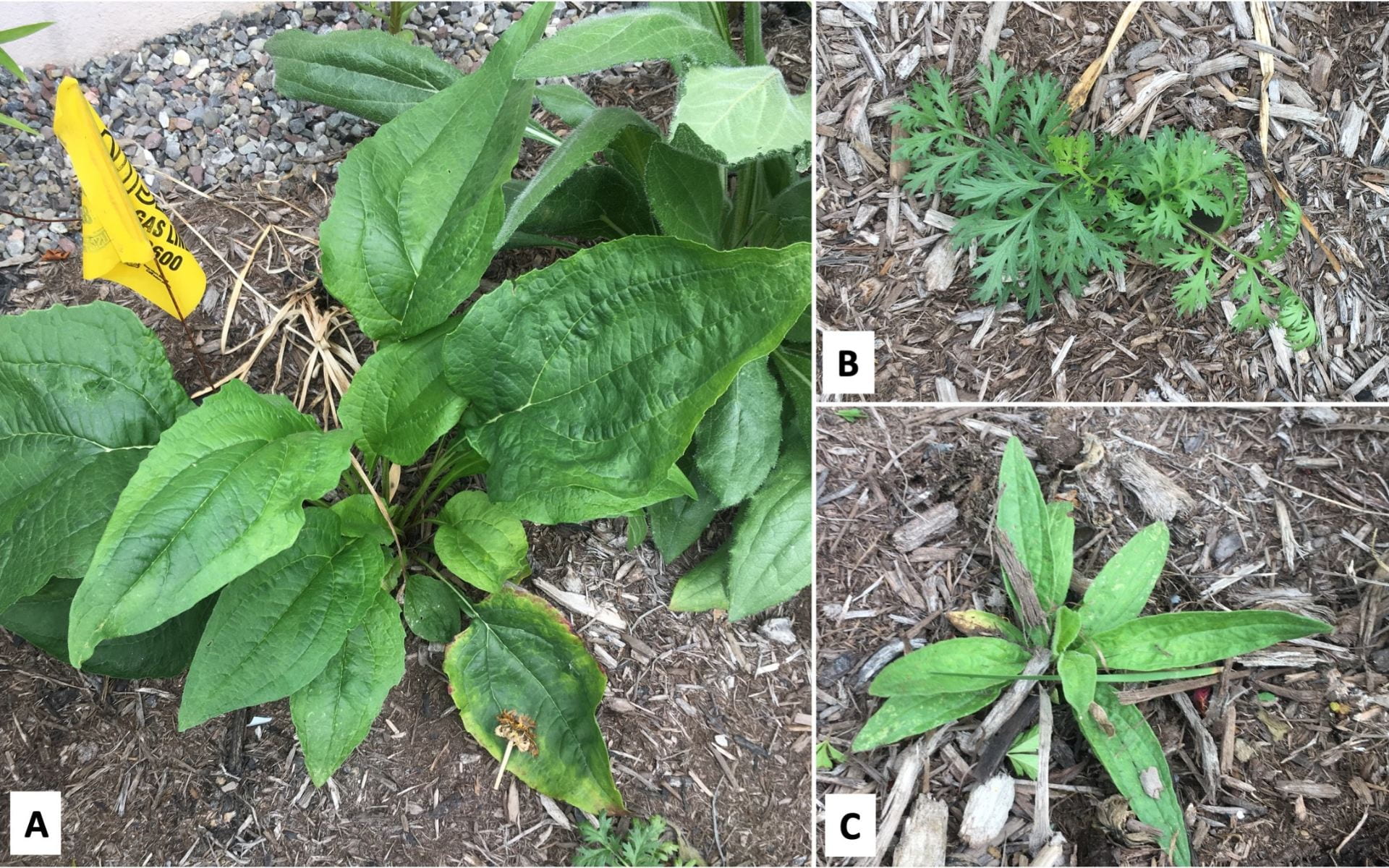
Three of the five perennials I planted this spring are growing, but haven’t bloomed this year: (A) echinacea, (B) pyrethrum daisy, and (C) arnica. Hopefully next year!
Not surprisingly, the annuals produced abundant blooms. Others have noted that there can be value in mixing annuals with perennials when you are establishing habitat for beneficial insects. The annuals will provide abundant flower resources right away, while it may take a few years to achieve peak bloom production on perennials.
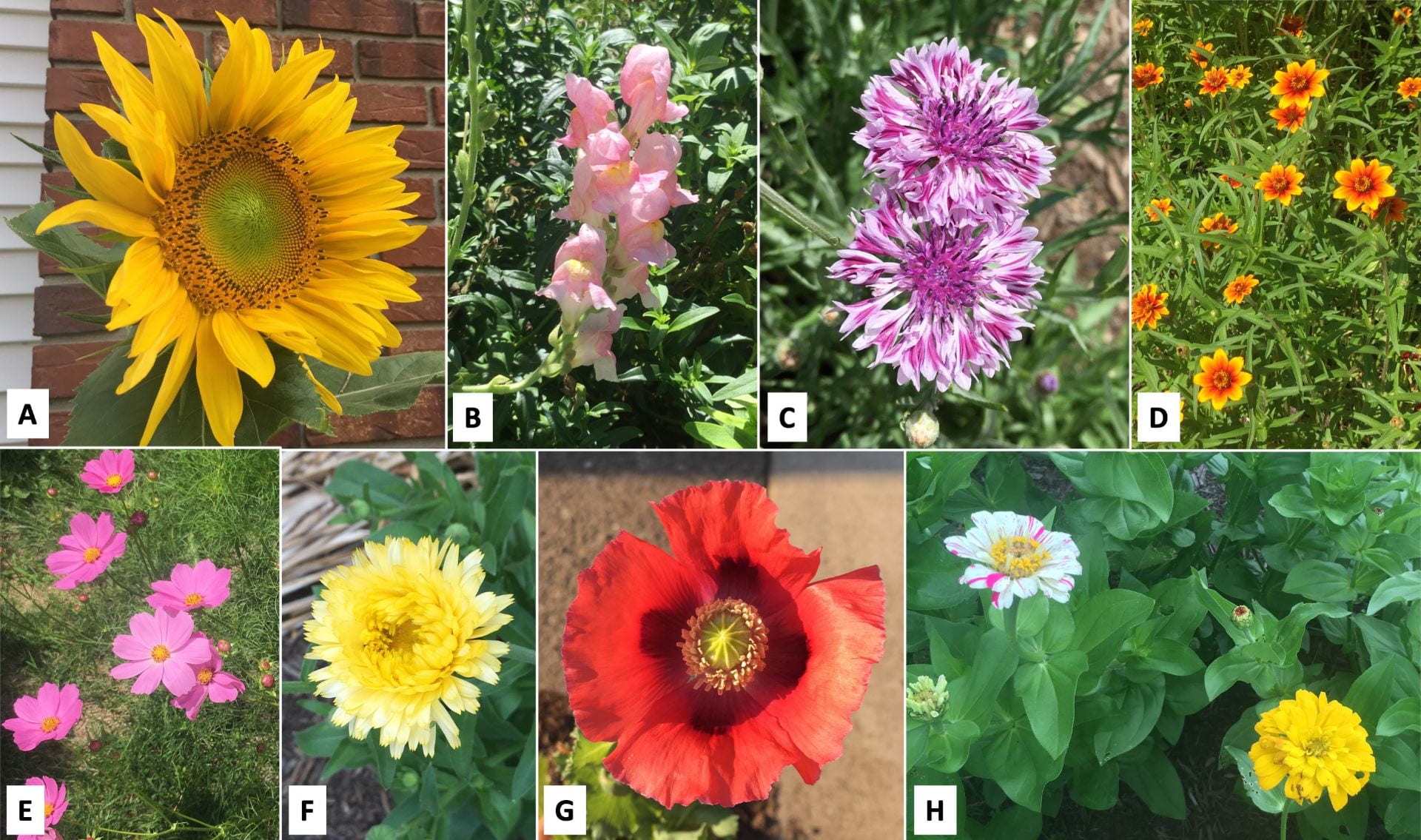
A few glamour shots of some of the annuals I grew this year: (A) sunflower, (B) snap dragon, (C) bachelor’s buttons, (D) ‘Persian Carpet’ zinnia, (E) cosmos, (F) calendula, (G) poppy, (H) zinnia.
Fall planting
Hopefully this is not the first time you’ve heard that “fall is for planting”. In preparation for this, I started some butterfly milkweed (Asclepias tuberosa) and columbine (Aquilegia sp.) seeds back in late July so that I’d have some seedlings ready to go in the ground this fall. The columbine benefitted from spending about three weeks in my fridge (after I’d seeded them in moist potting mix) before giving them some light and warmth. (Don’t judge me. The real question is why not reserve one shelf of your fridge for seed storage and germination!) Columbine seedlings will go in my backyard where there’s less sun.
Some of the seedlings I’m planting this fall.
I also snagged a few seed heads from the golden alexanders and the blackeyed susans (also Rudbeckia hirta, but the straight species) in our beneficial insect habitat research plots. I’m going to plant them this fall, too and hope to see some seedlings next spring.
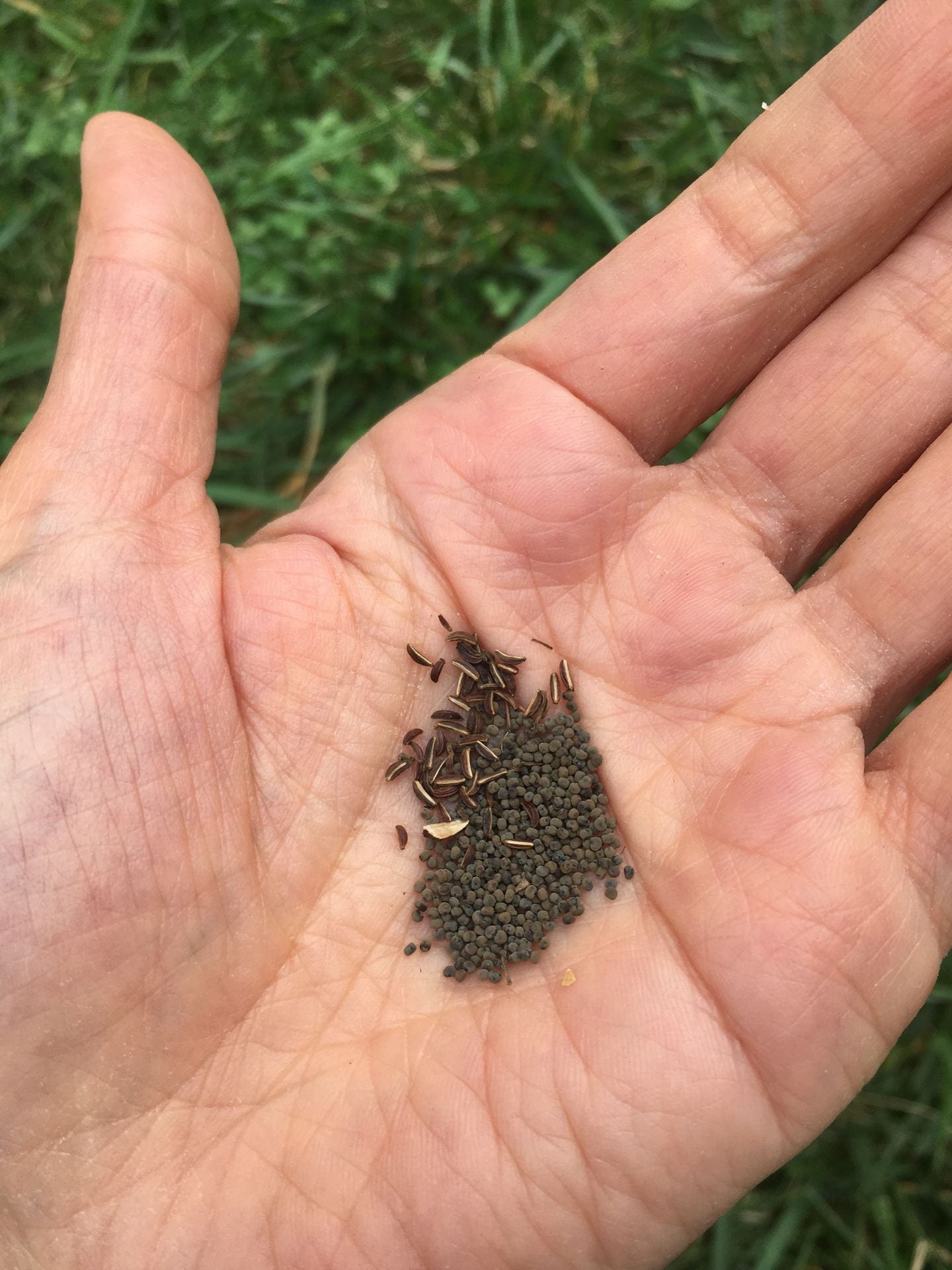
I’ll let the winter weather scarify these golden alexander and blackeyed susan seeds, preparing them to germinate in the spring.
Whether I’m working remotely next year or not, I’ll keep providing periodic updates on my efforts to establish habitat for beneficial insects around my house.
This post was written by Amara Dunn, Biocontrol Specialist with the NYSIPM program. All images are hers, unless otherwise noted.
This work is supported by:
Crop Protection and Pest Management -Extension Implementation Program Area grant no. 2017-70006-27142/project accession no. 1014000, from the USDA National Institute of Food and Agriculture
New York State Department of Agriculture and Markets
With all the Japanese beetles I’ve been pulling off my zinnias, it was a pleasant surprise to find a more friendly beetle!
It’s been two months since I since I wrote about the plants I selected to provide habitat for beneficial insects around my home. Today I’ll talk a bit about weed control and how my spring transplants are doing.
Weed control
I have mentioned before that managing weeds turns out to be far more than half the battle when it comes to establishing perennial wildflowers as habitat for beneficial insects. Based on the results from the habitat plots we planted on the edges of our Christmas tree research field, I decided to use mulch for weed management in my home gardens. While mulch does add extra cost, after you make the initial investment of time to spread the mulch, it really cuts down on the time required to manage weeds during the rest of the season. I had a relatively small area to mulch, and was able to purchase some relatively inexpensive mulch made from the brush and leaves picked up by my city. Also, while I haven’t tested the organic matter content of my soil, just digging up some of the grass told me that my soil could use more organic matter. The mulch will eventually help with that as it breaks down. One downside to mulch is that it could block access to the soil for ground-nesting bees. There are some spots of bare ground in other parts of my yard, and perhaps next year I will be a little more deliberate about keeping some areas bare to support these pollinators.
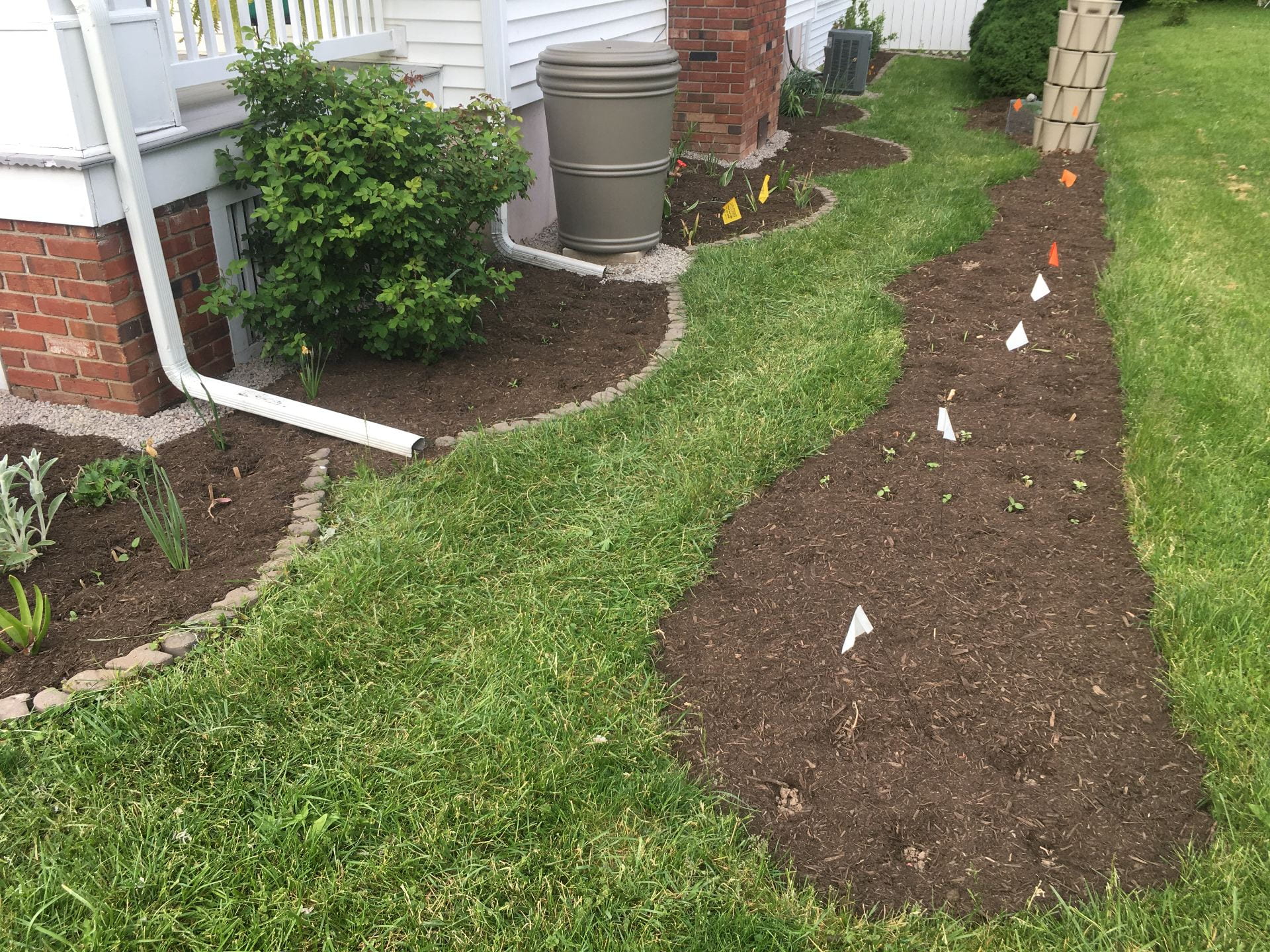
I decided to use mulch for weed control in my home beneficial insect habitat.
Like many (but not all) New Yorkers, I have found myself frequently wishing for more rain this summer. According to the closest NEWA station, we only got 1.3 inches of rain in May, 1.44 inches in June, and 1.48 inches in July (so far). This spring and summer is an excellent illustration of why experts recommend transplanting perennials in the fall, and not in the spring. Hot and dry are not ideal conditions for young seedlings just trying to get started. We often get more rain in the fall, and the cooler temperatures mean the transplants are subjected to less stress.
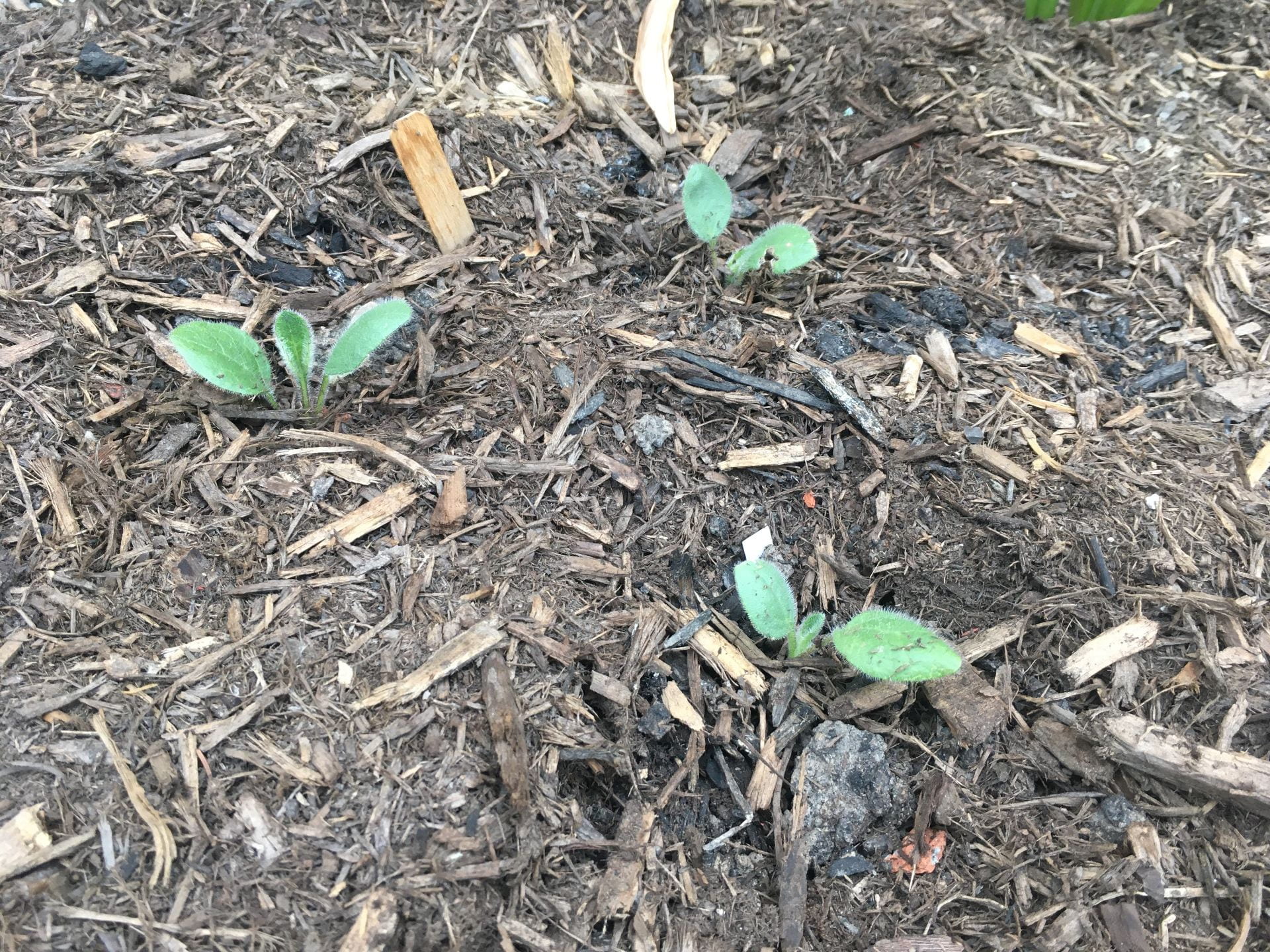
I started my plants from seed, and most of my seedlings were pretty small when I transplanted them the first week of June.
This picture was actually taken about 2 weeks after I transplanted my seedlings. They were a little on the small side.
I admit that I also didn’t harden off my seedlings exactly the way you are supposed to. After losing some un-protected plants to marauding bands of squirrels, and lacking a protective structure that would let me keep my seedlings in full sun, I hardened them off on my screen porch. Moving from this environment to the south side of my house in full sun was a bit of a shock, especially when it got so hot and dry so soon after transplanting. I’ve done a lot of watering over the past month and a half, and I still lost more of my perennial seedlings (and some annuals) than I had hoped.
There were supposed to be three echinacea plants in this picture. At least one of them survived!
In spite of these obstacles, quite a few of my transplants survived. The blanketflowers (Gaillardia aristata) are the only perennials that look like they will bloom this season. If I had bought seedlings from a local nursery, they might have been bigger and might have established faster. But I can be patient.
I think I can see the beginnings of a flower bud on this blanketflower.
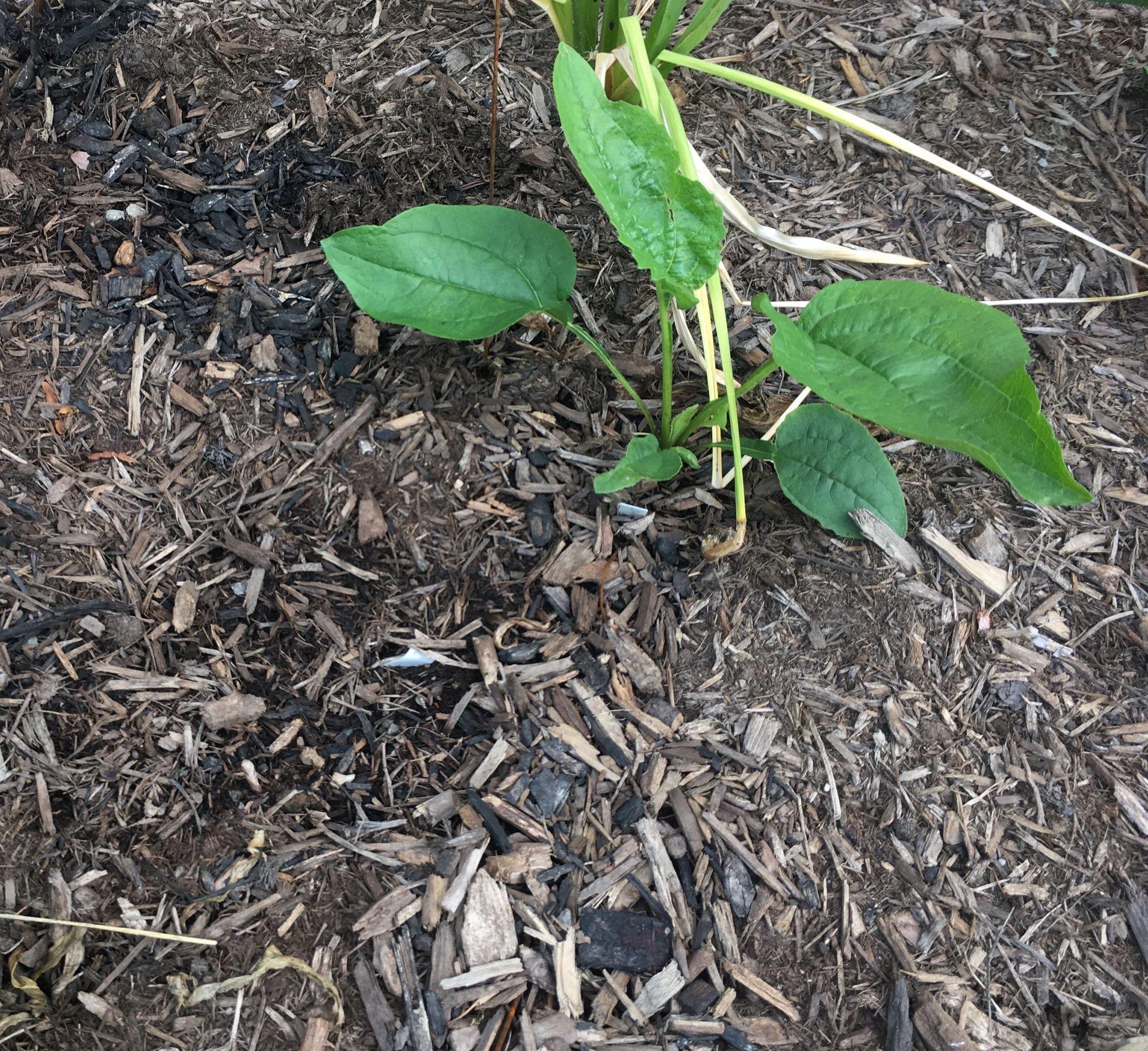
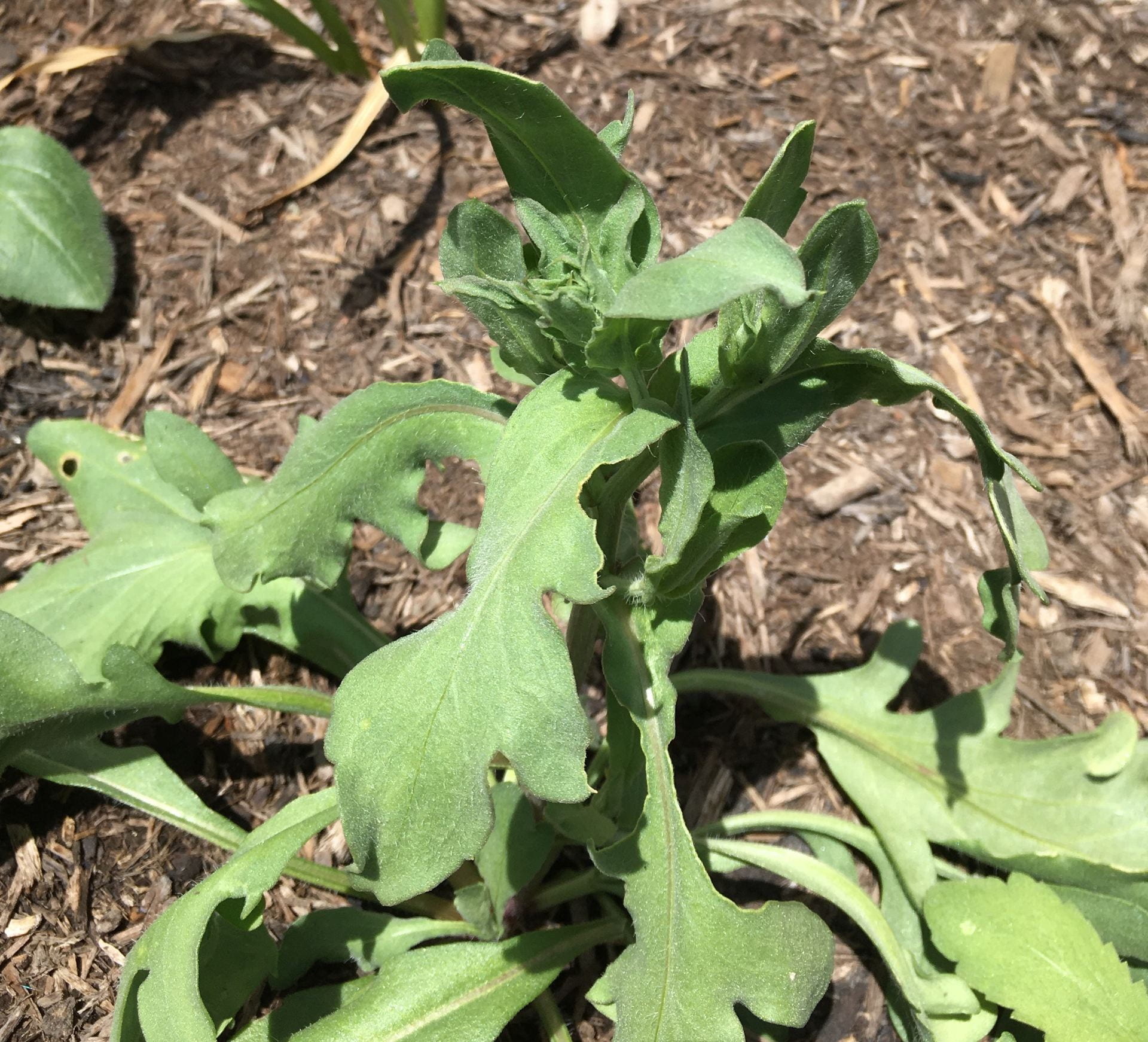
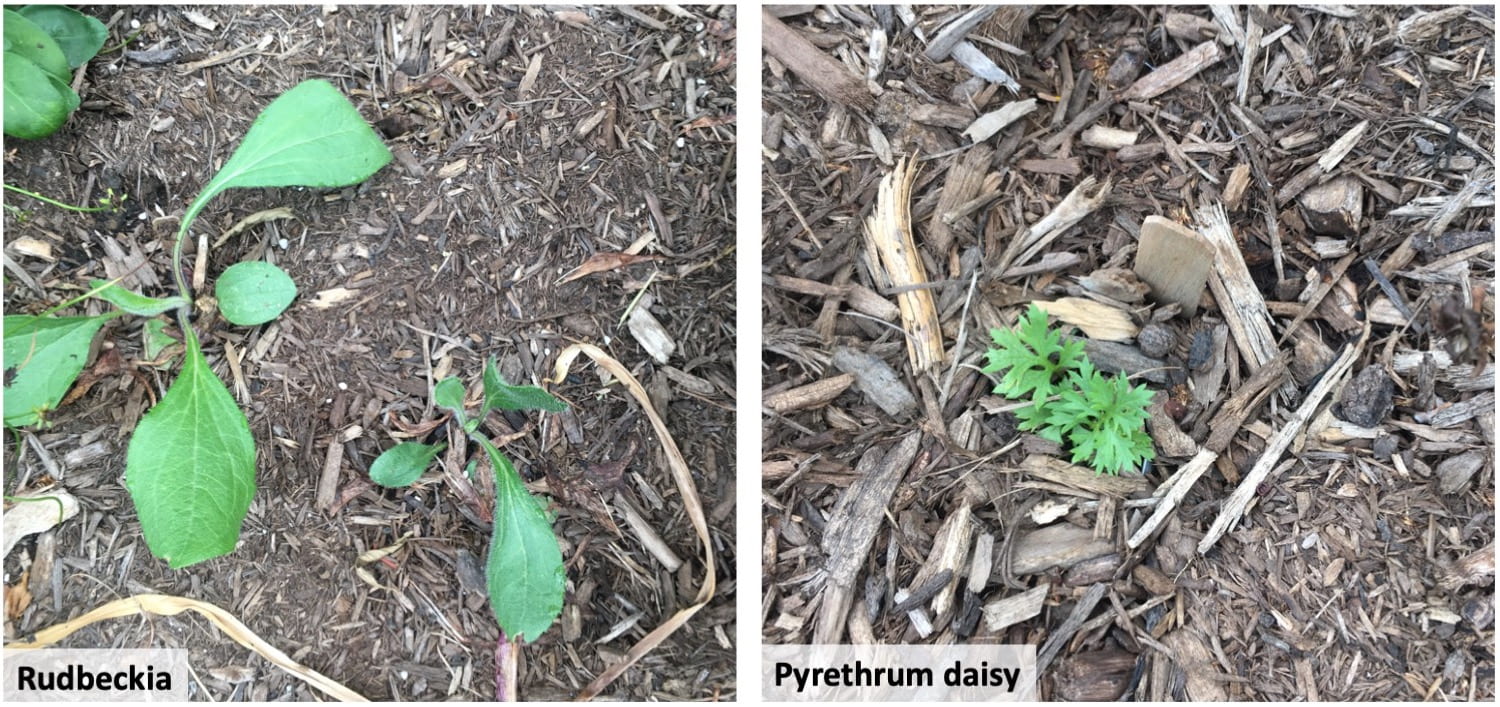
You already saw the echinacea. Here are some of the other perennials.
Some of the surviving rudbeckia (left) and pyrethrum daisy (right) seedlings.
Not surprisingly, the annuals have grown faster. (Remember, they’re in a race to reproduce and pass on their genes before winter returns!)
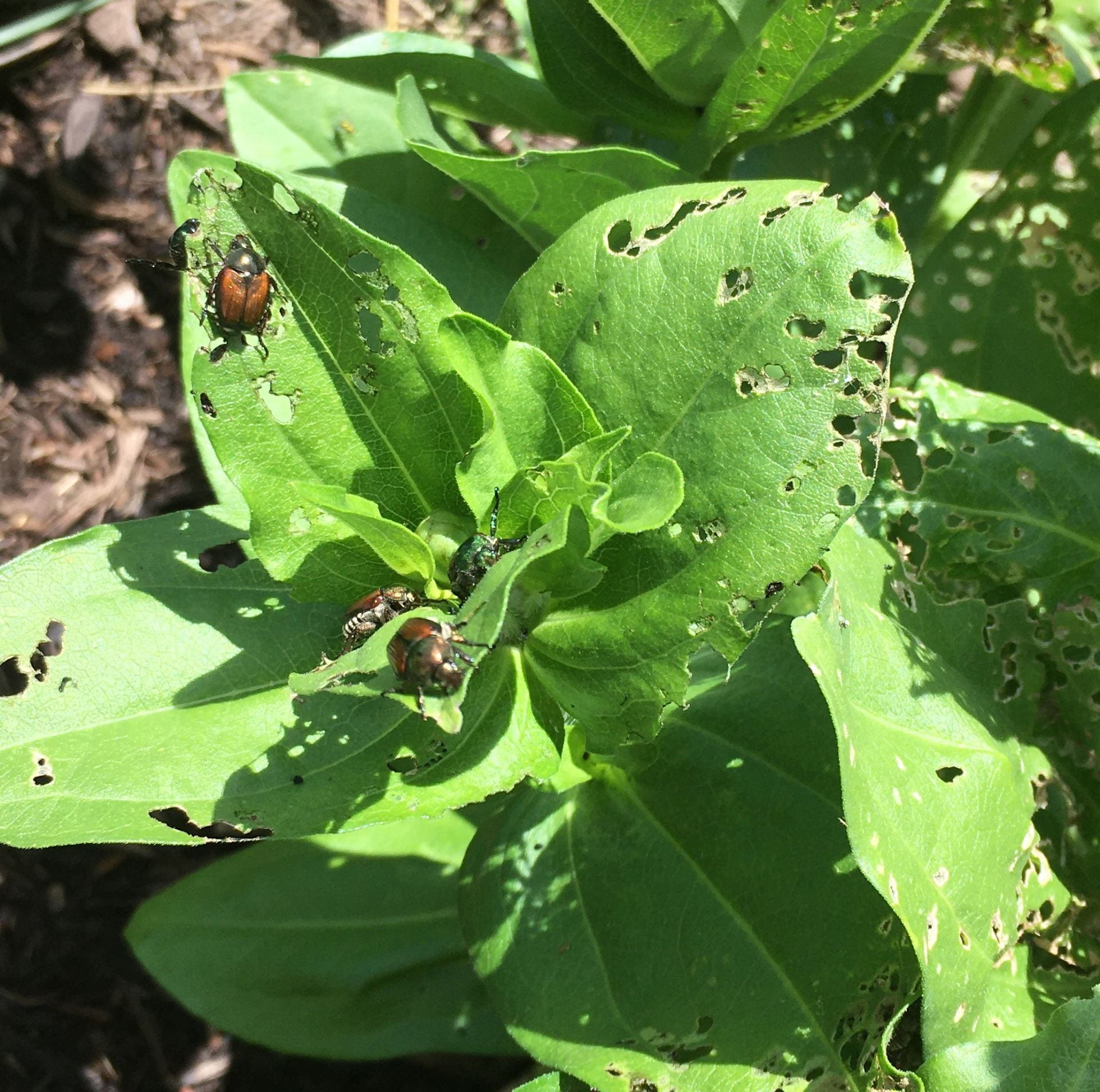
Japanese beetles are eating the common zinnias.
A small consolation is that the Japanese beetles seem to like my roses even more than they like the zinnias. The roses are functioning as a sort of trap crop.
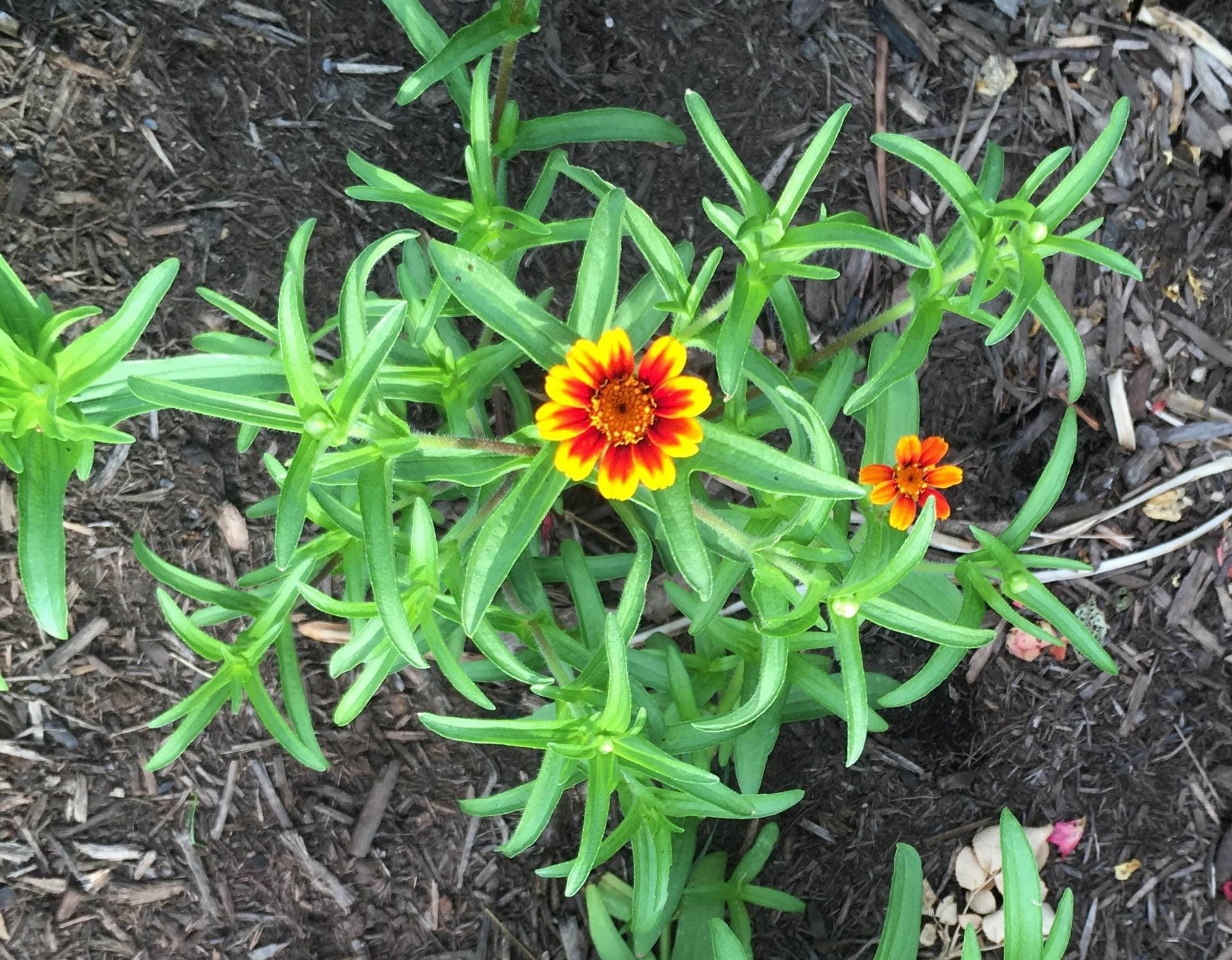
But they are leaving the ‘Persian Carpet’ zinnias alone. It turns out these are a variety of Mexican zinnias (Zinnia haageana), which is a different species than the common zinnias (Zinnia elegans).
‘Persian Carpet’ zinnias have smaller flowers, smaller leaves, and no Japanese beetle damage, even though I planted them right next to my roses.
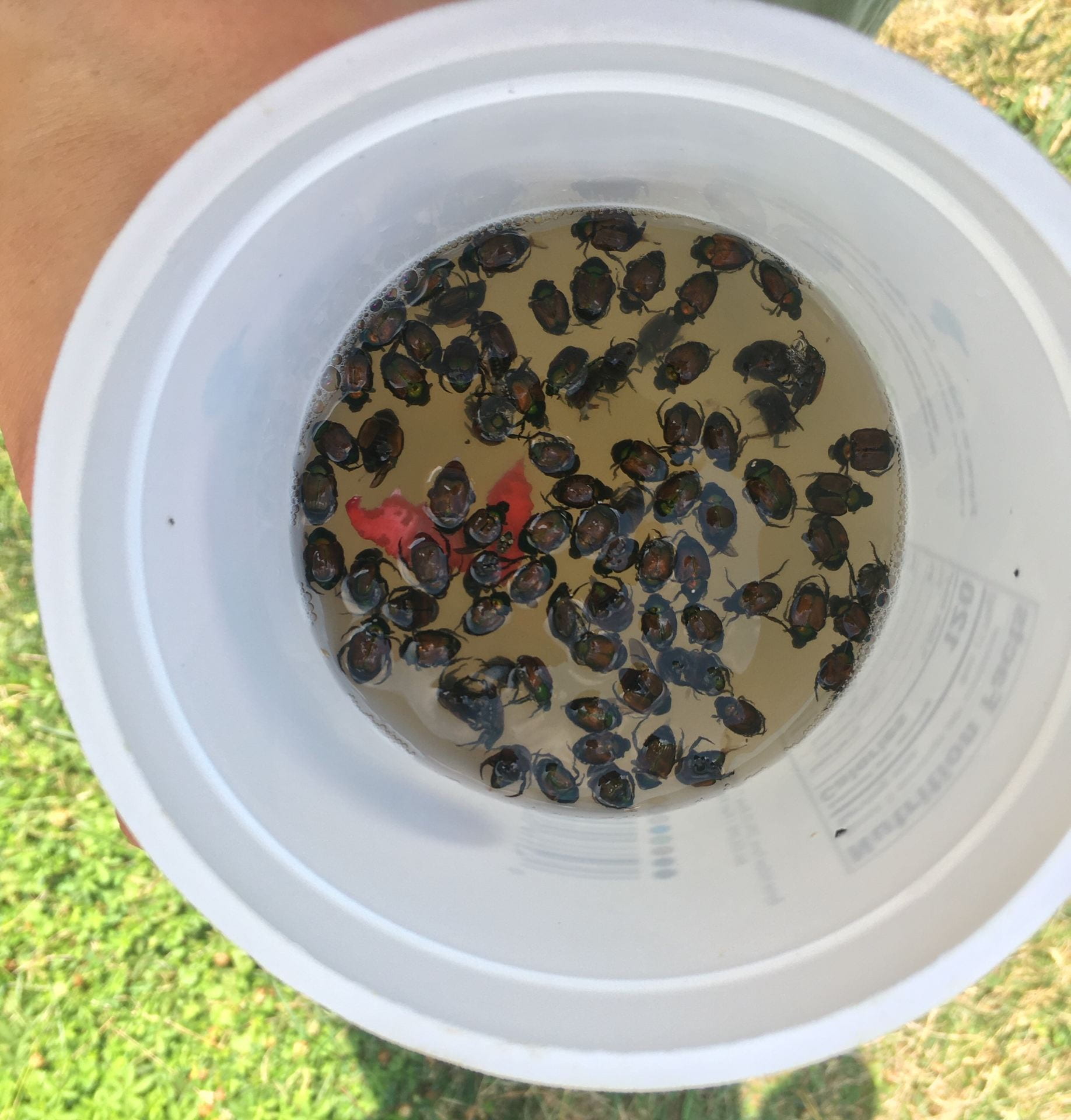
I’ve been picking the Japanese beetles off by hand (adding them to my compost bin after they drown). I found the beetles to be more sluggish in the evenings (although admittedly I wasn’t out at the break of dawn), and a colleague recently shared this article with me that suggests that hand-picking Japanese beetles in the evening is indeed the best option. This strategy has not prevented all damage (especially on my roses), but I think my plants will survive. And I admit I haven’t picked them every single day.
Japanese beetles picked off of my plants and drowned
The snap dragons have started blooming.
I planted snap dragons mostly because I like them as cut flowers, although I have seen reports that they support bees.
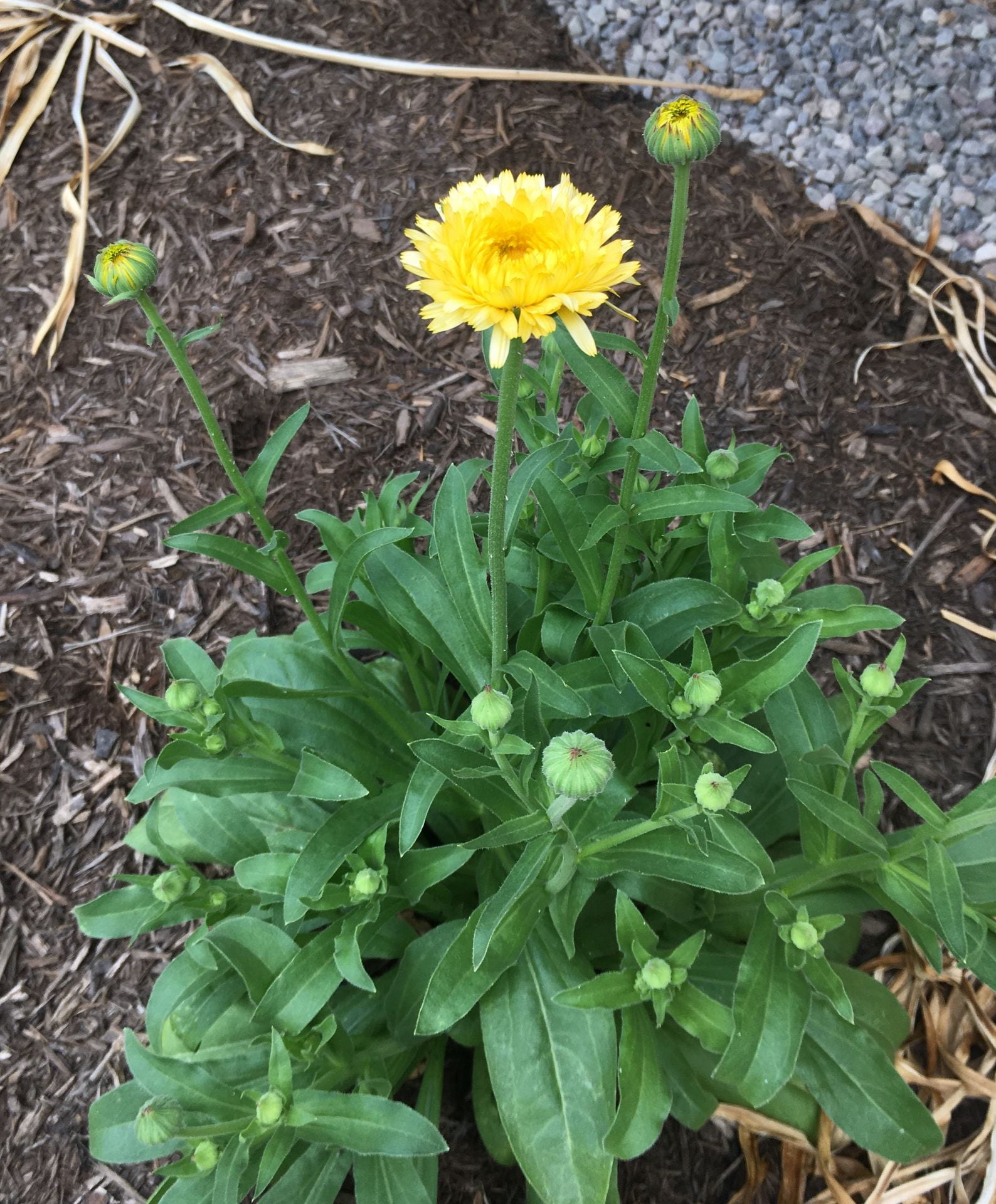
And so have the calendulas.
Calendula in bloom.
I’ve seen hover flies on the bachelor’s buttons. Remember the adult hover flies are pollinators, while their larvae are voracious aphid predators.
I’ve seen a few hover flies visiting the bachelor’s buttons.
The cosmos and sunflowers (that survived the squirrels and a local rabbit) haven’t started blooming yet, but they’re looking good!
The squirrels must not have found my first planting of sunflowers, because they and the cosmos planted with them look great!
This spring I ran out of space to start seeds indoors, and since fall is a better time for planting I saved a few perennials for the fall. Last week I seeded butterfly milkweed (Asclepias tuberosa) and some columbine. In the absence of grow lights, and since I’m not an expert transplant producer, I wanted to give these seedlings a good two and a half months to grow before I transplant them.
This post was written by Amara Dunn, Biocontrol Specialist with the NYSIPM program. All images are hers, unless otherwise noted.
This work is supported by:
Crop Protection and Pest Management -Extension Implementation Program Area grant no. 2017-70006-27142/project accession no. 1014000, from the USDA National Institute of Food and Agriculture.
New York State Department of Agriculture and Markets
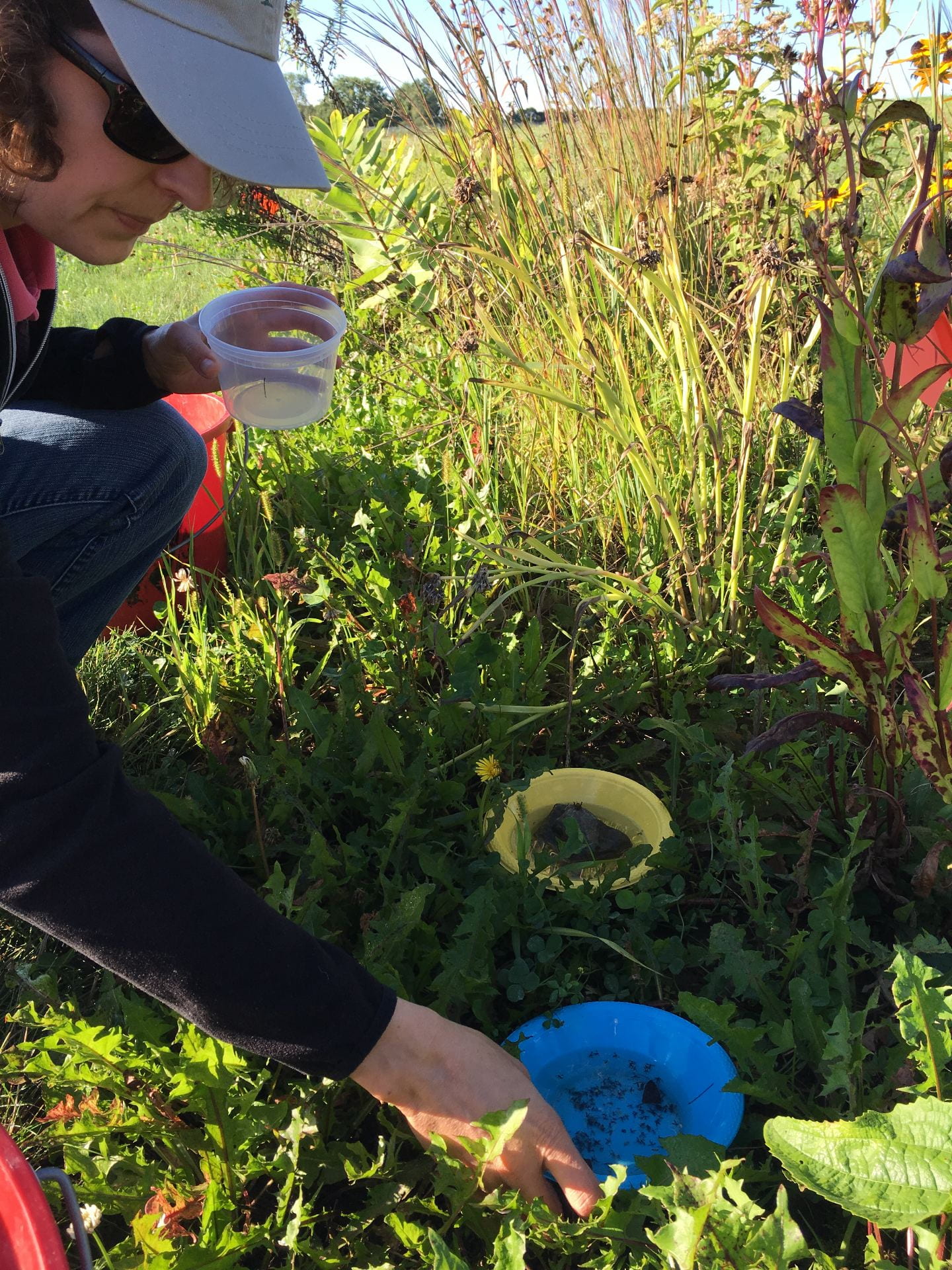
Here I am collecting insects from our yellow and blue pan traps last September.
Hopefully you’ve been following along with a project I’m working on with Betsy Lamb and Brian Eshenaur to establish (and document the impacts of) habitat for natural enemies of pests and pollinators (collectively, beneficial insects). In December, I wrote about how the plants were growing, and in February I wrote about the time and money we’d invested in the project so far and the success of our weed management strategies. I promised an update on insect sampling, and here it is!
First of all, let me clarify that we were collecting more than just insects. Insects only have six legs. We also collected arachnids like spiders (and harvestmen), which usually have eight legs, and pillbugs, millipedes, and centipedes, which have many more than eight legs. All of these “bugs” could be correctly called arthropods. But there’s more! We also counted earthworms (which are annelids) and slugs and snails (which are mollusks). Hopefully the entomologists in my audience will pardon my use of the term “insect” to include creatures that crawl or fly but may have more (or less) than six legs throughout the rest of this post.
Pan traps catch flying insects, especially those attracted to the colors yellow and blue.
Pitfall traps catch insects that crawl along the soil surface.
Sweep nets catch insects that are flying or hanging out on plants.
Different methods used for sampling insect from our habitat plots included pan traps, pitfall traps, and a sweep net.
Below is a quick reminder of our treatments. You can read all the details here. Except for Treatment H. These are “new” plots that we added in 2019. I just measured out four, 23-foot long sections of grass planted between rows of Christmas trees in the middle of the field. These row middles are mowed by the excellent Field Research Unit staff at Cornell AgriTech, where our research field is located. The grass mixture was seeded right after the Christmas trees were planted in Spring 2018, but it does include some blooming weeds from time to time (dandelions and clover, especially).
Treatment
Description
A
Spring transplant, no mulch
B
Spring transplant with mulch
C
Spring direct seed
D
Buckwheat cover crop, then fall transplant
E – control
Whatever was growing there, just keep it mowed
F
Soil solarization, then fall direct seed
G
Herbicide and tillage, then fall direct seed
H – control
Mow seeded orchard grass mix
Mowed grass between rows of Christmas trees in the middle of the field is a second control treatment for insect sampling.
And one last note before we get into the actual results. These are still preliminary results. Many, many thanks to Jason Dombroskie and Paige Muñiz for helping us with insect identification. Identification and number crunching of the data are still ongoing.
Ok, ready to see some cool insects (etc.)? Here we go!
Spiders and harvestmen
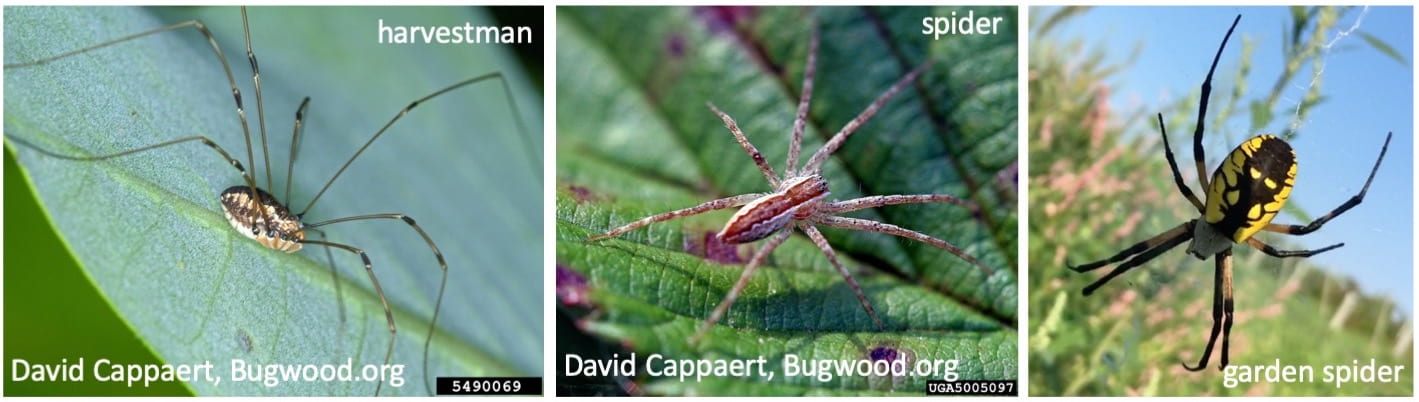
Spiders and harvestmen both have eight legs and are useful predators to have in a field or garden. The garden spider on the right was probably the largest arachnid I spotted in our habitat plots. The left and middle pictures were taken by David Cappaert.
We caught a lot of spiders and harvestmen, mostly in pan and pitfall traps. What’s a harvestman? You might know it by the name daddy long legs. It looks a lot like a spider, but instead of having a distinct narrowed “waist” (actually where the two body segments of the arachnid meet), their bodies just look like single “blobs”. Both spiders and harvestmen are predators and will eat many other insects (including some pests). They may also eat nectar and pollen. Very few spiders you are likely to encounter in New York are venomous, so welcome these eight-legged biocontrol agents to your fields and gardens without fear!
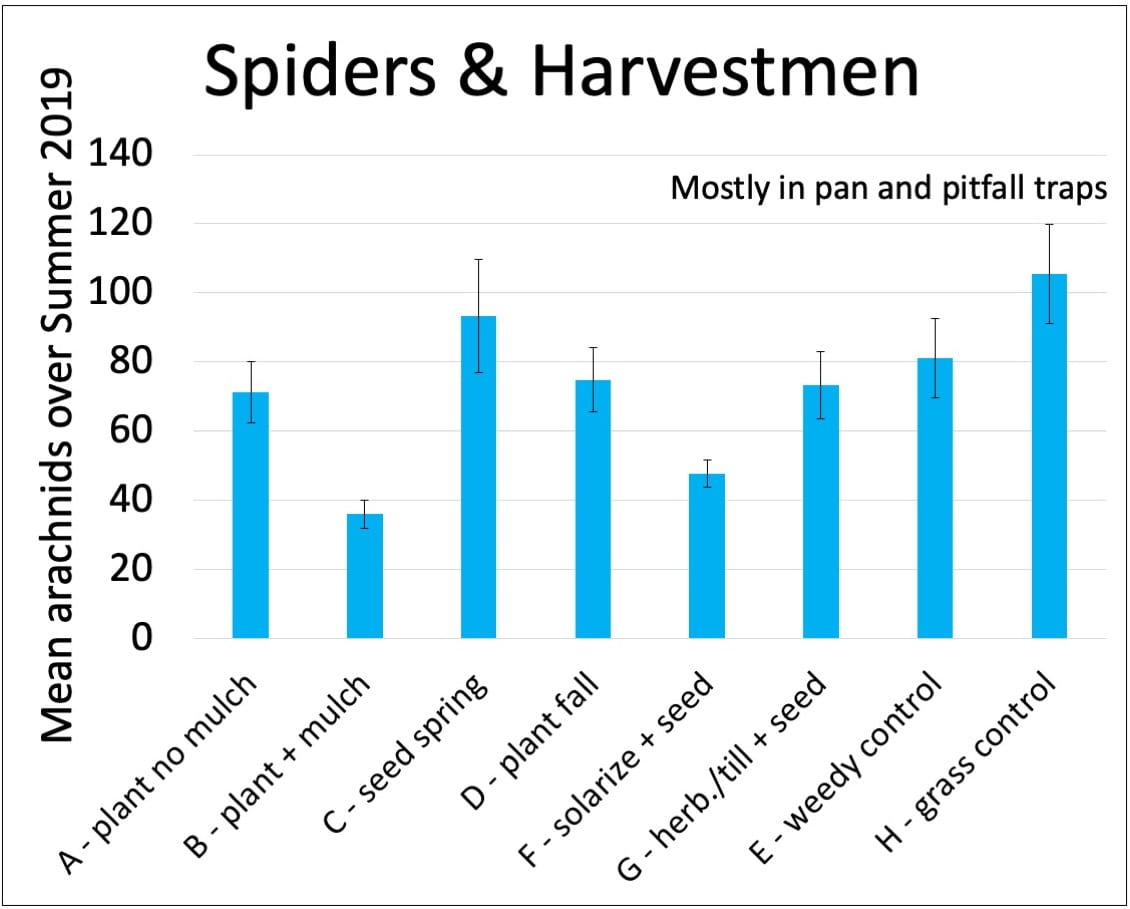
I added up all of the spiders and harvestmen we caught in each plot, then took the average of these summer-long counts from the four plots of each treatment in our field. The black lines stretching above and below the top edge of each bar show one standard error (measure of variability amongst the four plots) above and below the mean value.
We caught a lot of spiders and harvestmen, but it looks like there were fewer in the plots that were mulched at transplanting or solarized prior to seeding.
Carabid beetles
We caught a lot of tiger beetles (top picture) in our plots last summer, but carabid beetles come in many shapes, sizes, and colors.
You may not notice carabid beetles (also called ground beetles) because they crawl along the surface of the soil and are usually more active at night. Also, many of them move very quickly. They are great predators of insects (and other arthropods), as well as mollusks like slugs. Some also eat seeds.
I added up all of the carabid beetles we caught in each plot, then took the average of these summer-long counts from the four plots of each treatment in our field. The black lines stretching above and below the top edge of each bar show one standard error (measure of variability amongst the four plots) above and below the mean value.
From these preliminary results, it looks like we tended to catch more carabid beetles in the fall-planted treatments (whether they were transplanted or direct-seeded). We’ll have to see if this turns out to be a consistent pattern. There were generally fewer carabids in the two control treatments.
Rove beetles
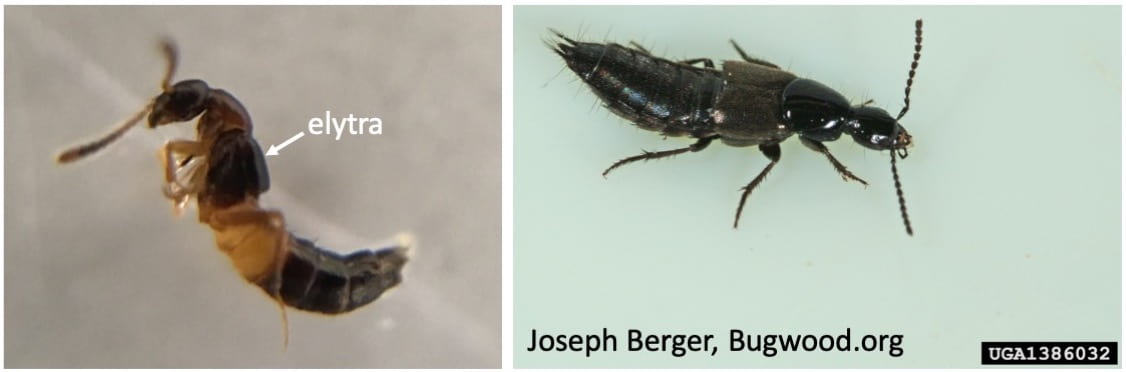
Rove beetles come in different sizes, but they all have short wing covers called elytra.
We did not catch very many rove beetles (only 55 in all of the plots for the entire summer), but like carabid beetles these predators live at the soil surface or in the soil. Some also scavenge things that are already dead or eat seeds. You can recognize them by the short wing covers (called elytra) on their backs. I think they look like mini capes.
Hover flies
Adult hover flies (left and middle pictures) have only two wings and big eyes, even though they are often black and yellow striped like bees. The visually unimpressive larva in the picture on the right is about to eat an aphid.
Hover flies (also called syrphids) come in many shapes and sizes and get their name from the way the adults hover in the air when traveling between flowers. Many look like bees, but if they hold still long enough and you look closely, you will see that they only have two wings (bees have four), and they have very large eyes. The adults feed on pollen and nectar and are also pollinators. The larvae are predators, eating aphids, whiteflies, and scales.
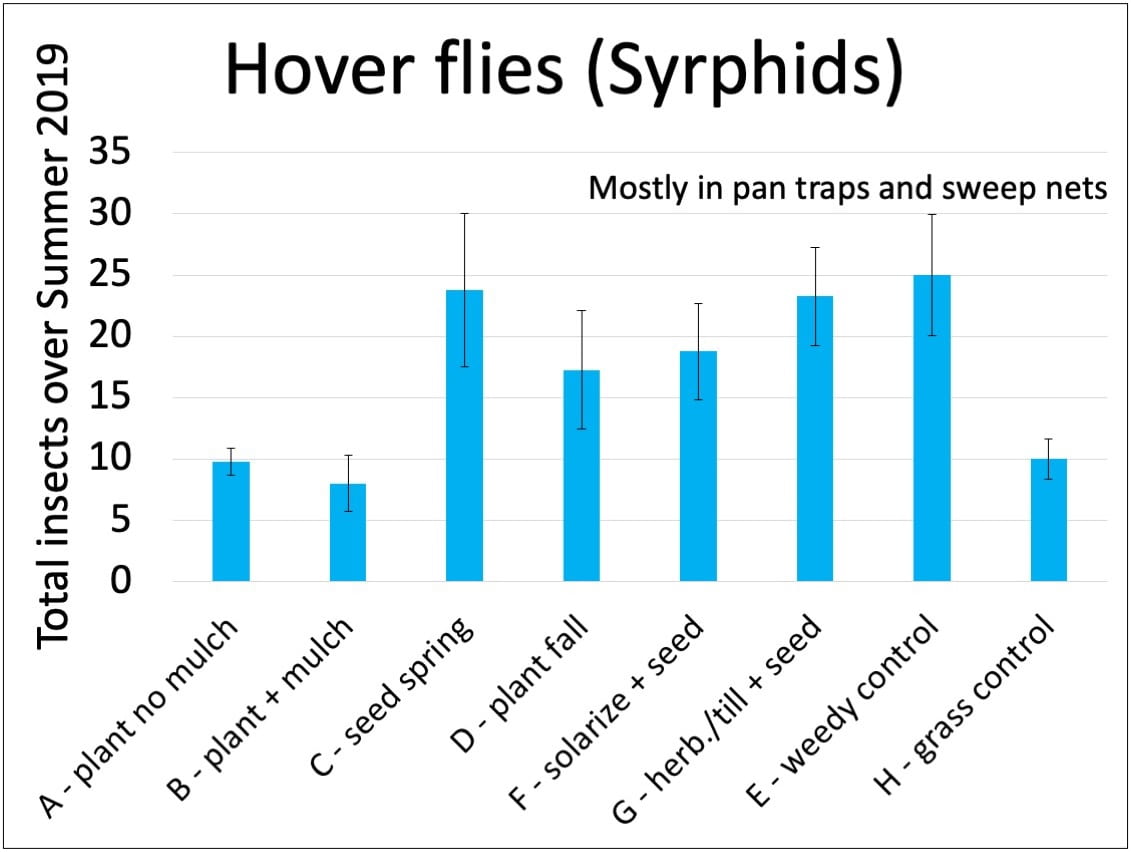
I added up all of the hover flies we caught in each plot, then took the average of these summer-long counts from the four plots of each treatment in our field. The black lines stretching above and below the top edge of each bar show one standard error (measure of variability amongst the four plots) above and below the mean value.
We were surprised to see similarly low numbers of hover flies in the two spring transplanted plots (in which deliberately-planted wildflowers were largest and produced the most flowers) and in the mowed grass control. More hover flies were collected from the weedy control, all the direct seeded plots, and the fall transplanted plots (which had smaller wildflowers with fewer blooms). We don’t know why.
Lady beetles
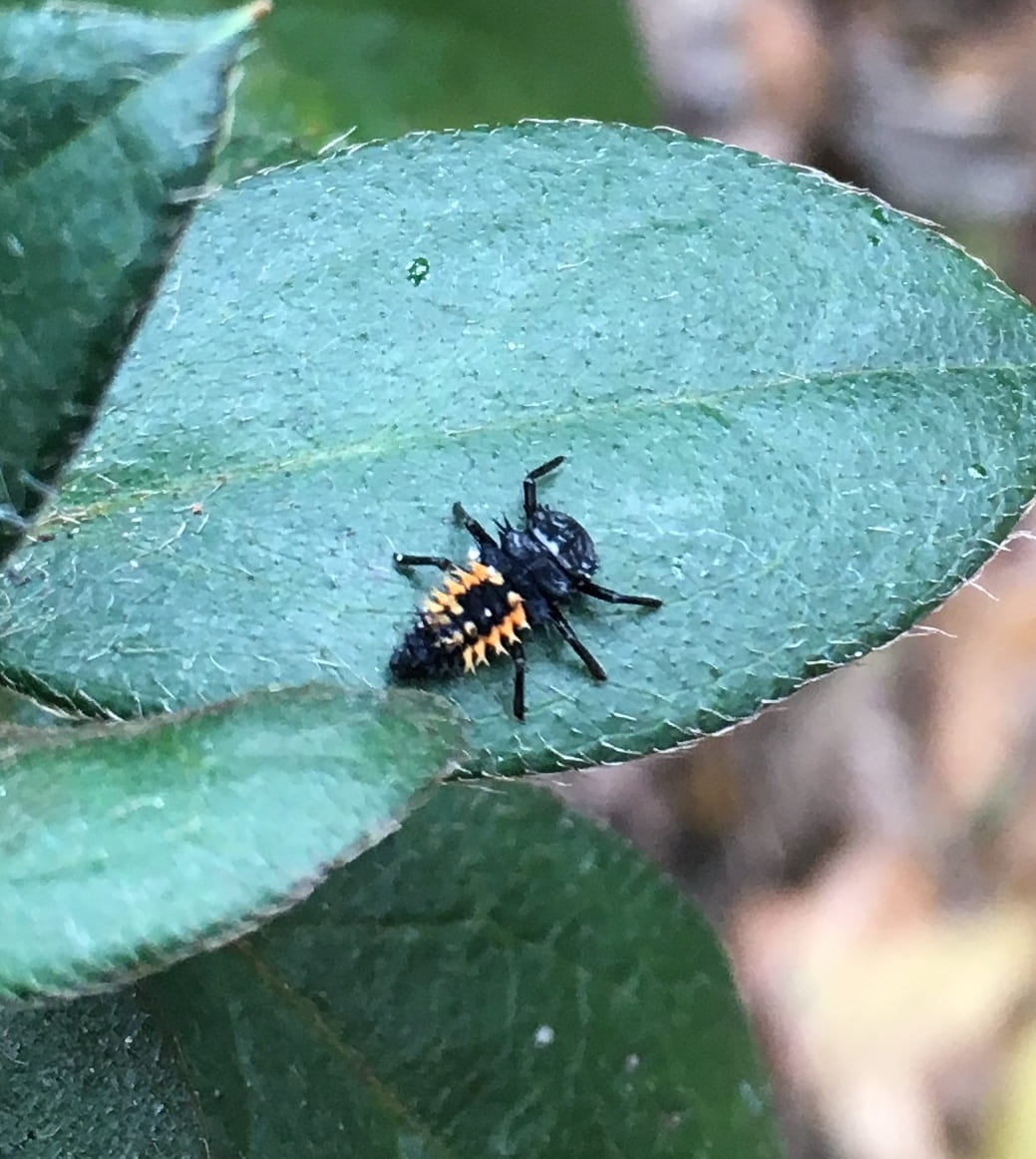
Although lady beetles are familiar as natural enemies of pests, their larvae (like this one) are not always so easily recognized. Larvae are often (but not always) elongated, look a bit spiny, and are orange and black.
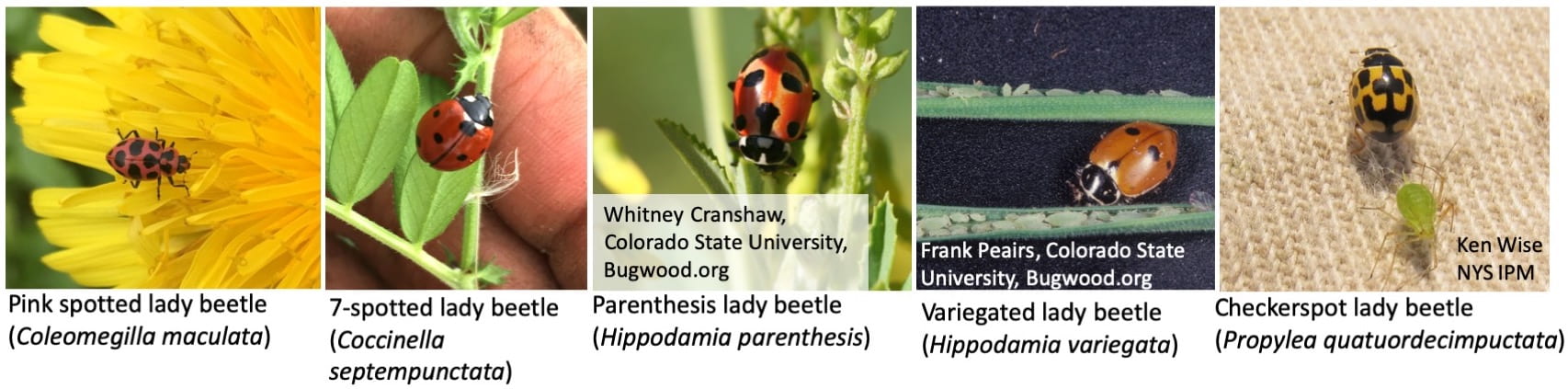
Lady beetles may be the most well-recognized biocontrol agent, but they were not the most abundant one collected in our sampling. We only collected 65 larvae or adults from all plots over the entire summer. Both life stages are predators, but adults of at least some species will also eat pollen and nectar. We identified the species of each adult (but not the larvae), and a picture of each is below.
We collected adults of these five lady beetle species in our plots during Summer 2019.
Lacewings
Lacewing larva (top) and adult (bottom). Adults may also be brown, but will have a similar shape.
All lacewing larvae are predators, and the more easily recognized adults of some species are also predators. Others eat pollen as adults. We did not catch very many in our plots; only 40 all summer from all plots.
Minute pirate bugs
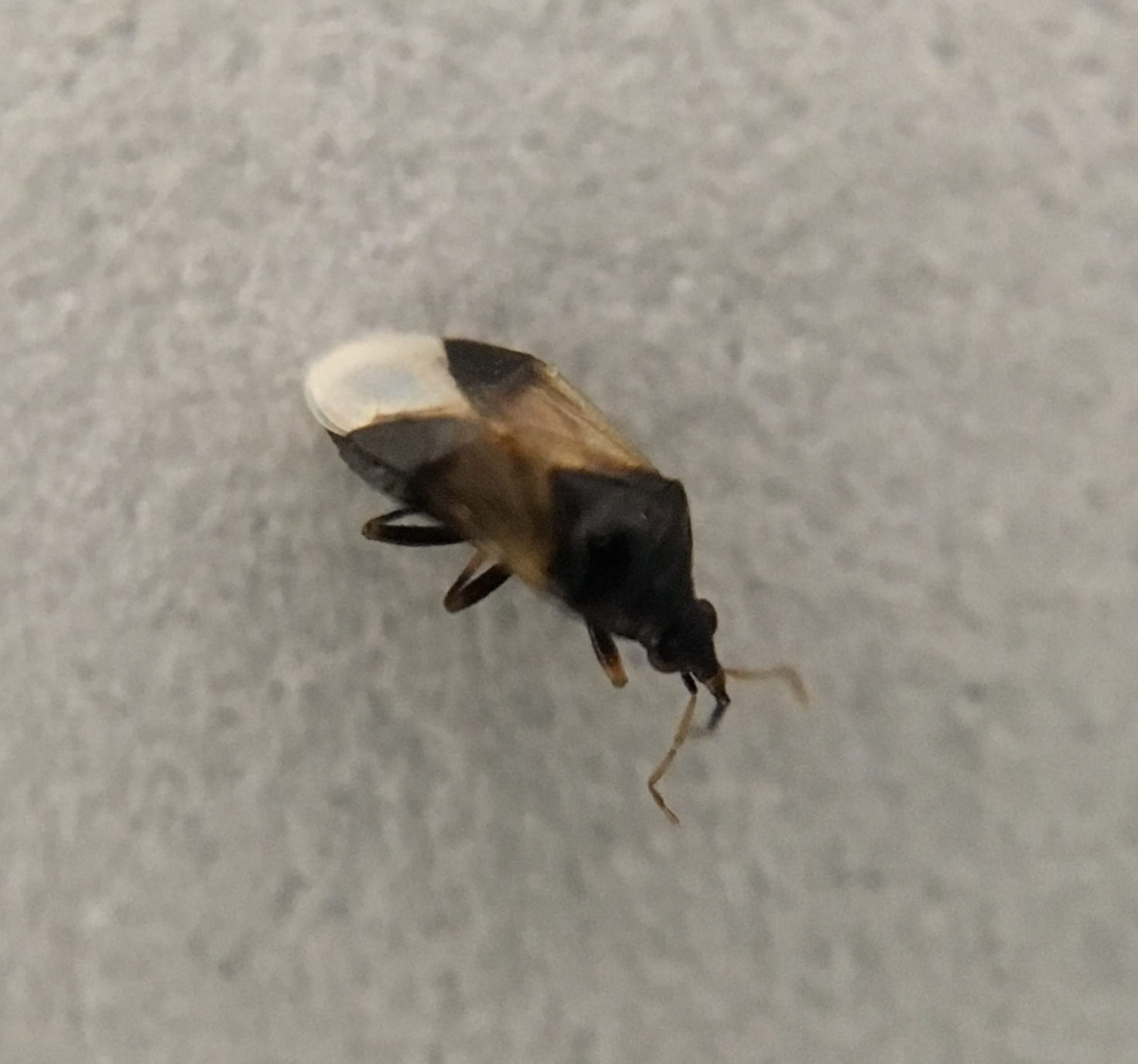
Minute pirate bugs may be small, but they are mighty predators!
This may be one of my new favorite natural enemies. They are definitely minute (no more than a quarter of an inch long) but feed on small insect pests like aphids, mites, scales, and thrips, as well as pollen and nectar. We only collected 19 from all plots over the whole summer. At home, I sometimes find them running across my table after I’ve brought freshly cut flowers inside. In this video, you can see one exploring the map of a corn maze. Actually, it was looking for thrips to eat.
When we think of bees, sometimes we think of just honey bees and bumble bees. But many different bees utilized the pollen and nectar from the wildflowers we planted. Just a few are pictured here.
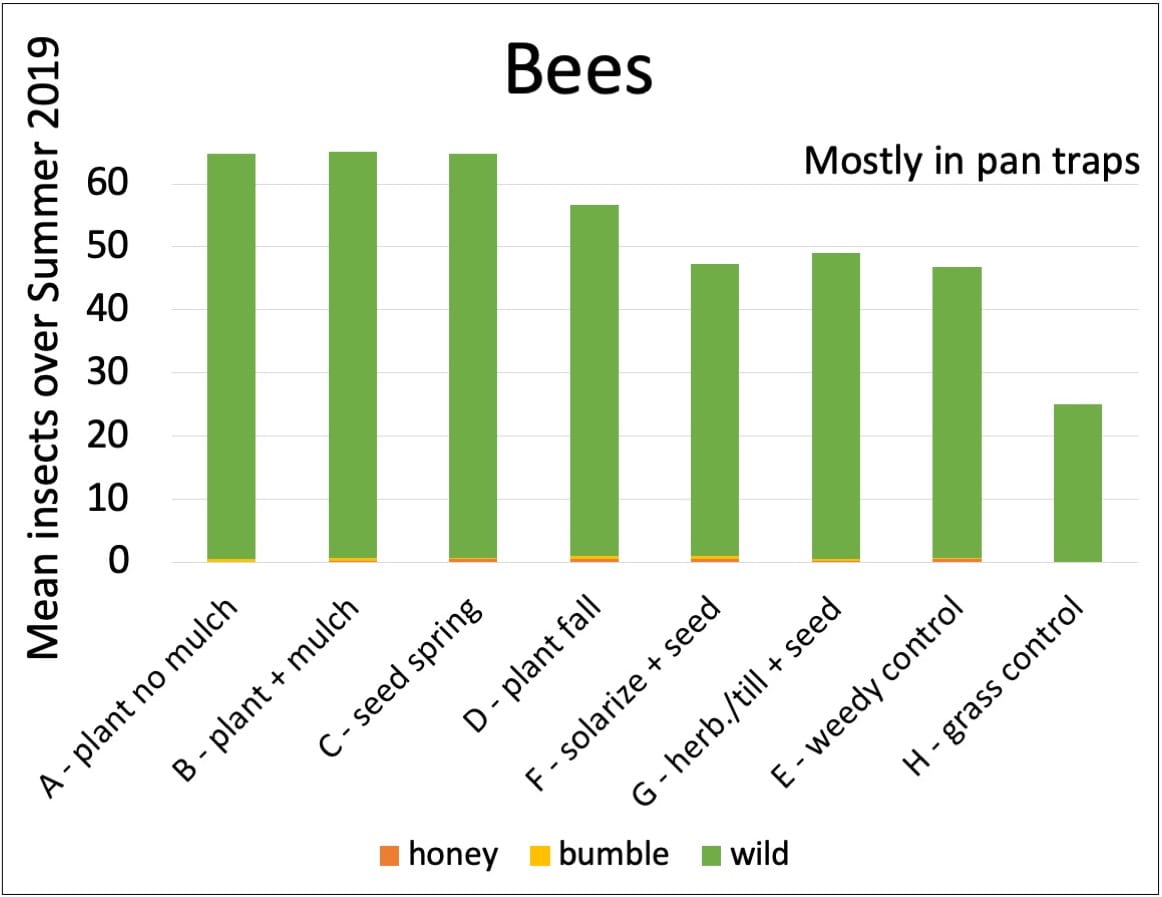
Interestingly, while we collected a lot of bees of many different kinds over the summer (at least 18 different genera), very few were the iconic honey bees or bumble bees. I have been told by a bee expert that the pan traps tend to catch bees other than honey or bumble bees, and we did set these traps about twice as often as we used sweep nets. So this may have impacted the types and numbers of bees we collected. Nevertheless, these data are a reminder that there are lots of bees out there besides the ones we’re most familiar with. I encourage you to learn more about wild bees of New York.
We caught quite a few bees last summer! However, the vast majority of them were not honey or bumble bees. Importantly, we don’t have bee counts for all sampling dates, yet.
Butterflies
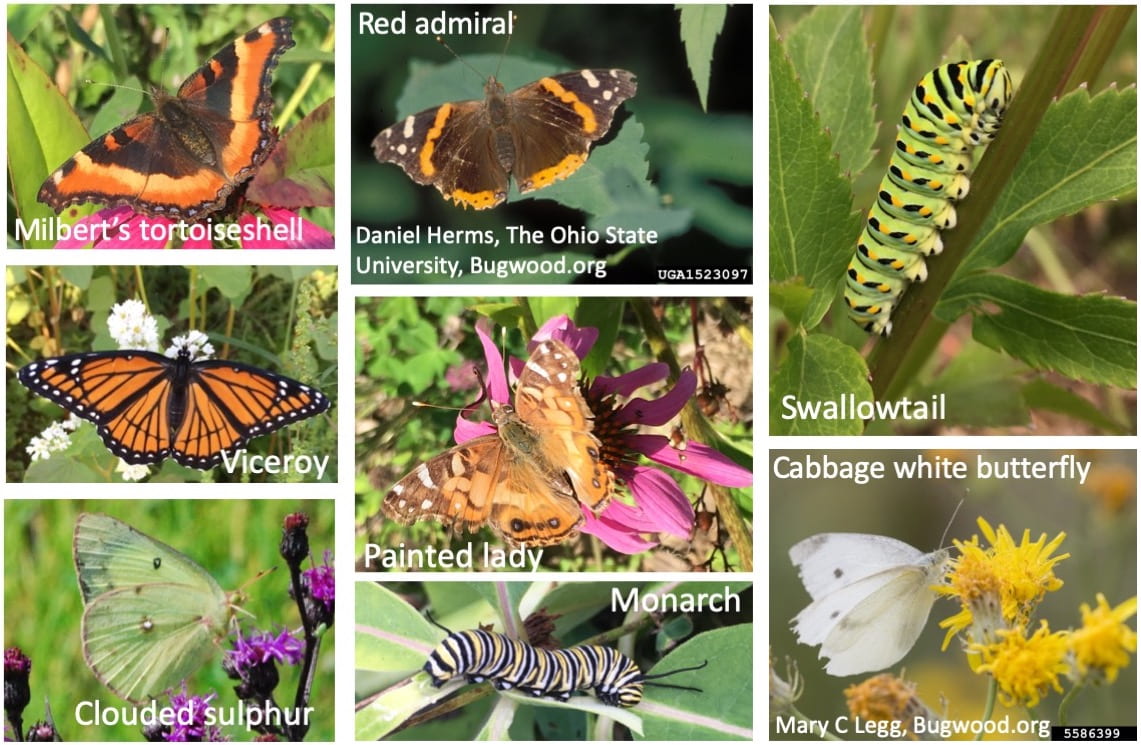
At the beginning of this post, I listed three methods we used to collect insects. Well, actually there was a fourth method, but it was used to count insects rather than to collect them. We did a Pollard Walk through each plot once a month by simply walking along the side of the plot and counting the number and type of butterflies we saw. We counted very few butterflies during these walks, but here are pictures of the species that did visit our plots (either in the adult or caterpillar life stage).
These are the butterflies we observed in our beneficial insect habitat plots during Summer 2019. Some, like the monarch and swallowtail we only saw as caterpillars; never as adults.
So that’s it for the beneficial insects I’m going to write about today. We also caught some not-so-beneficial insects (and mollusks).
Tarnished plant bugs
Tarnished plant bugs have a distinct pattern on their backs, and also benefit from the same floral resources that support beneficial insects.
These are generalist herbivores, feeding on leaves, fruits and flowers of many plants. They can be damaging pests on some fruits (like strawberries) and vegetables. In our plots, I think they caused some damage to the coreopsis flowers. We’re not too worried because they aren’t pests of Christmas trees, but we were disappointed to find the largest numbers of tarnished plant bugs in the more mature habitat plots (those started by transplanting, as opposed to direct-seeding). Other researchers also reported that planting wildflower strips adjacent to strawberries could increase tarnished plant bug populations.
I added up all of the tarnished plant bugs we caught in each plot, then took the average of these summer-long counts from the four plots of each treatment in our field. The black lines stretching above and below the top edge of each bar show one standard error (measure of variability amongst the four plots) above and below the mean value.
Leafhoppers
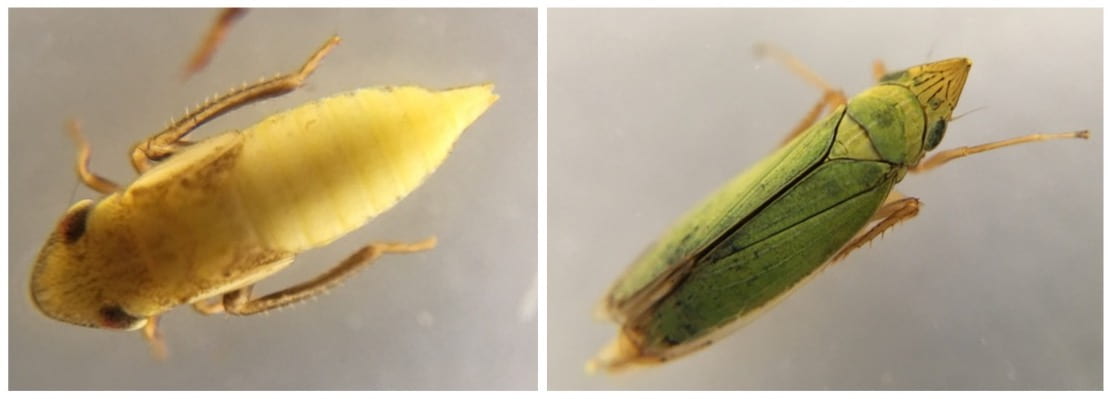
There are many different species of leafhoppers out there, but they all have pointy heads that are flattened and bristles on their back legs. The bristles are much easier to see with magnification, as in these pictures.
Leafhoppers are another insect that we aren’t too concerned about with Christmas trees, but can be a pest of other crops. I learned that you can distinguish this group of insects by their pointy flattened (top to bottom) heads and the bristles on their back legs. The spring transplanted plots in which wildflower plants were most mature and produced the most blooms also had fewer leafhoppers than other treatments.
I added up all of the leafhoppers we caught in each plot, then took the average of these summer-long counts from the four plots of each treatment in our field. The black lines stretching above and below the top edge of each bar show one standard error (measure of variability amongst the four plots) above and below the mean value.
Slugs
Biggest slug of 2019 insect sampling!
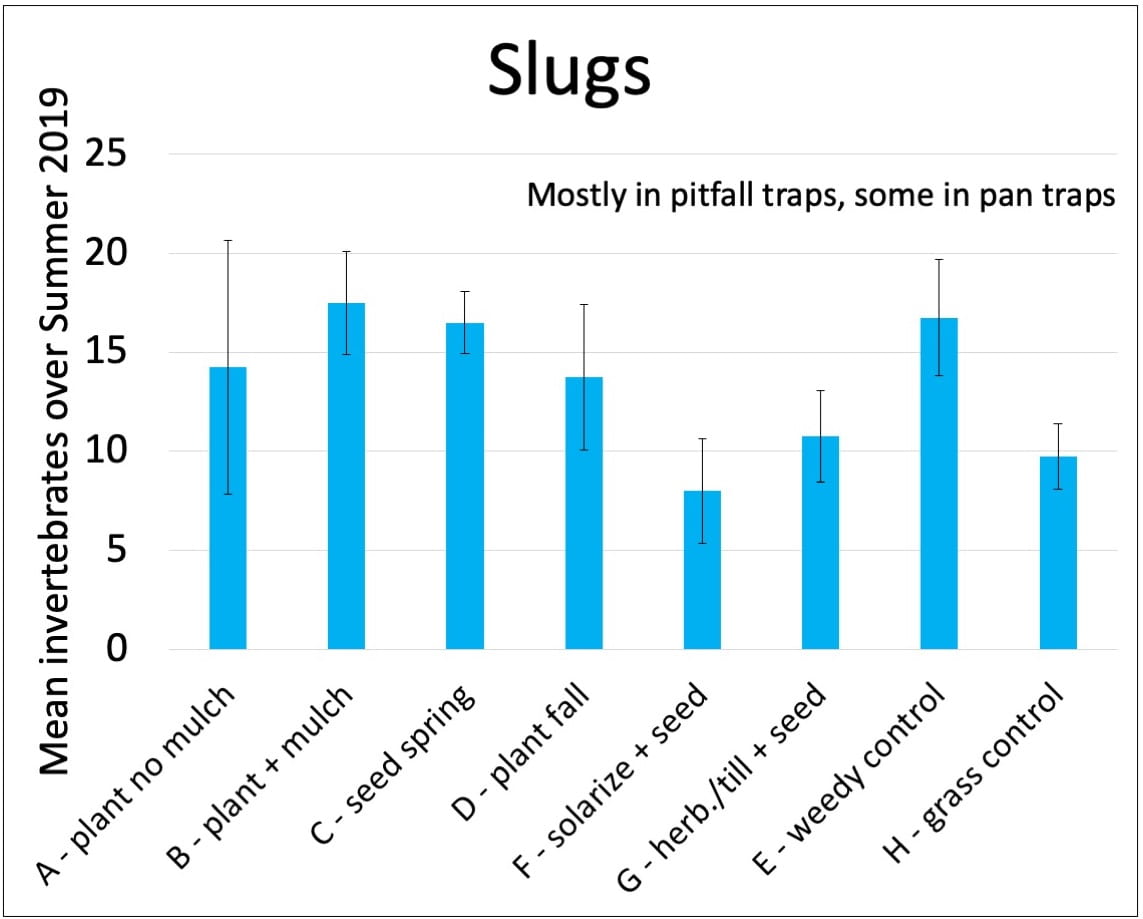
As I mentioned at the beginning of this post, slugs are mollusks, not insects (or even arthropods) and they can be pests of many different crops. The picture above is definitely the largest slug that we collected during 2019. Interestingly, there seemed to be fewer slugs in the plots where we solarized the soil during the 2018 growing season. I was interested to learn that soil solarization is known to kill slug eggs, and I wonder if we’re seeing that effect here. I don’t know how far slugs move from where the eggs hatch, and it will be interesting to see if this effect persists in future years.
I added up all of the slugs we caught in each plot, then took the average of these summer-long counts from the four plots of each treatment in our field. The black lines stretching above and below the top edge of each bar show one standard error (measure of variability amongst the four plots) above and below the mean value.
Believe it or not, this is not the full list of insect (or arthropod, mollusk, or annelid) groups we collected and counted. Also, I will remind you again that these data (especially the bee data) are preliminary. Although I’m sad to be unable to collect insects this summer due to COVID-19, I’m looking forward to finishing the analysis of the 2019 data and getting ready to hopefully collect insects again in 2021. In the meantime, you can see pictures of what’s happening in these plots throughout the summer on my Twitter and Instagram accounts. And I will write at least one more post about this project later this year.
This post was written by Amara Dunn. All pictures or videos were taken by her, unless otherwise credited.
This work is supported by:
Crop Protection and Pest Management -Extension Implementation Program Area grant no. 2017-70006-27142/project accession no. 1014000, from the USDA National Institute of Food and Agriculture.
New York State Department of Agriculture and Markets
Recall from this post that I’m creating habitat for beneficial arthropods (including insects, spiders, predatory mites, etc.) around my house this spring. Because more of us may be doing this while we’re staying home to keep each other safe, I’m sharing my experiences here (as well as on Twitter and Instagram). The previous post covered site selection. Today I will talk about the species I’ve chosen (and why).
What I’m planting in my yard
My side yard faces south and gets the most sun. But it’s a pretty small area and I want it to look reasonably tidy. I’m still building rapport with my neighbors.
The front and side yards get plenty of sun (because they face south and west), so I’m looking for plants that thrive in full sun. And I’ll admit that I’m interested in more than just supporting beneficial arthropods. I also want my front and side yards to look reasonably nice. (I don’t want to make enemies of my new neighbors!) And I want to grow flowers for cutting. So I am not sticking strictly to native plant species or to perennials. Some plants I picked just because I thought they looked nice. For example, I was beguiled by ‘Chim Chiminee’ Rudbeckia. The pollen and nectar produced by the native species may have been bred out of this variety. I’ll find out. I also just love ‘Persian Carpet’ zinnias.
I grew these ‘Persian Carpet’ zinnias in my garden last year. I love the mix of colors and the abundant blooms that last well when cut.
I’ve started a lot of plants from seeds I had in my fridge (e.g., snap dragons, echinacea, bachelor’s buttons). Others I will direct-seed outside (e.g., sunflowers, zinnia, cosmos), and I may also purchase some transplants from local nurseries (many have great strategies for safe curbside pick-up!).
I’m starting some plants from seed at home. Using paper pots means that I can compost them when I’m done, and not worry about carrying pathogens over from year to year on plastic pots that I would have to wash very thoroughly after use. Once a plant pathologist, always a plant pathologist!
Choosing plants for beneficial arthropods – the basics
Which plant species to grow to support beneficial arthropods (whether it’s pollinators or natural enemies of pests, or both) is a common question. The answer is both straight-forward, and also complicated. In addition to shelter and protection from pesticides, all beneficial arthropods need something to eat. In general, plants that provide plenty of nectar and pollen help to provide this food. Many natural enemies of pests will also eat pollen or nectar (e.g., at certain life stages, or as a supplement to the pests they eat). Even if they don’t, the pollen and nectar will often attract small arthropods that natural enemies can feed on. So, the simple answer is that a plant that produces lots of pollen and nectar, will thrive in the setting where you want to plant it, and is not invasive is a good choice for supporting beneficial arthropods. Plants that are marketed as supporting pollinators are easy to find and are likely to also support natural enemies.
This Ohio spiderwort (Tradescantia ohiensis) in our beneficial arthropod habitat plots is being visited by a hover fly. Hover fly larvae are excellent aphid predators!
But, of course, it’s not exactly that simple…
Choosing plants – natives, cultivars, and more
Many people ask if they should only grow native plant species, or if it’s ok to plant cultivated varieties of native species, or non-native species. (Hopefully it’s obvious that you should never plant an invasive species in your yard!) Annie White at the University of Vermont wrote a 254-page dissertation on the topic. These two sentences from her abstract summarize her findings nicely: “Our study shows that many insect pollinators prefer to forage on native species over cultivated varieties of the native species, but not always, and not exclusively. Some native cultivars may be comparable substitutions for native species in pollinator habitat restoration projects, but all cultivars should be evaluated on an individual basis.” You might also want to take a look at this article from the University of Maryland and this one from the Xerces Society. In summary, I would say it’s up to you whether you want to plant exclusively native species, or not.
According to David Smitley from Michigan State University, perennials are usually better choices for bees than annuals, but this article includes a list of annuals that are attractive to bees. Alyssum is an annual that definitely supports natural enemies, but many of the other annuals on this list may also support natural enemies.
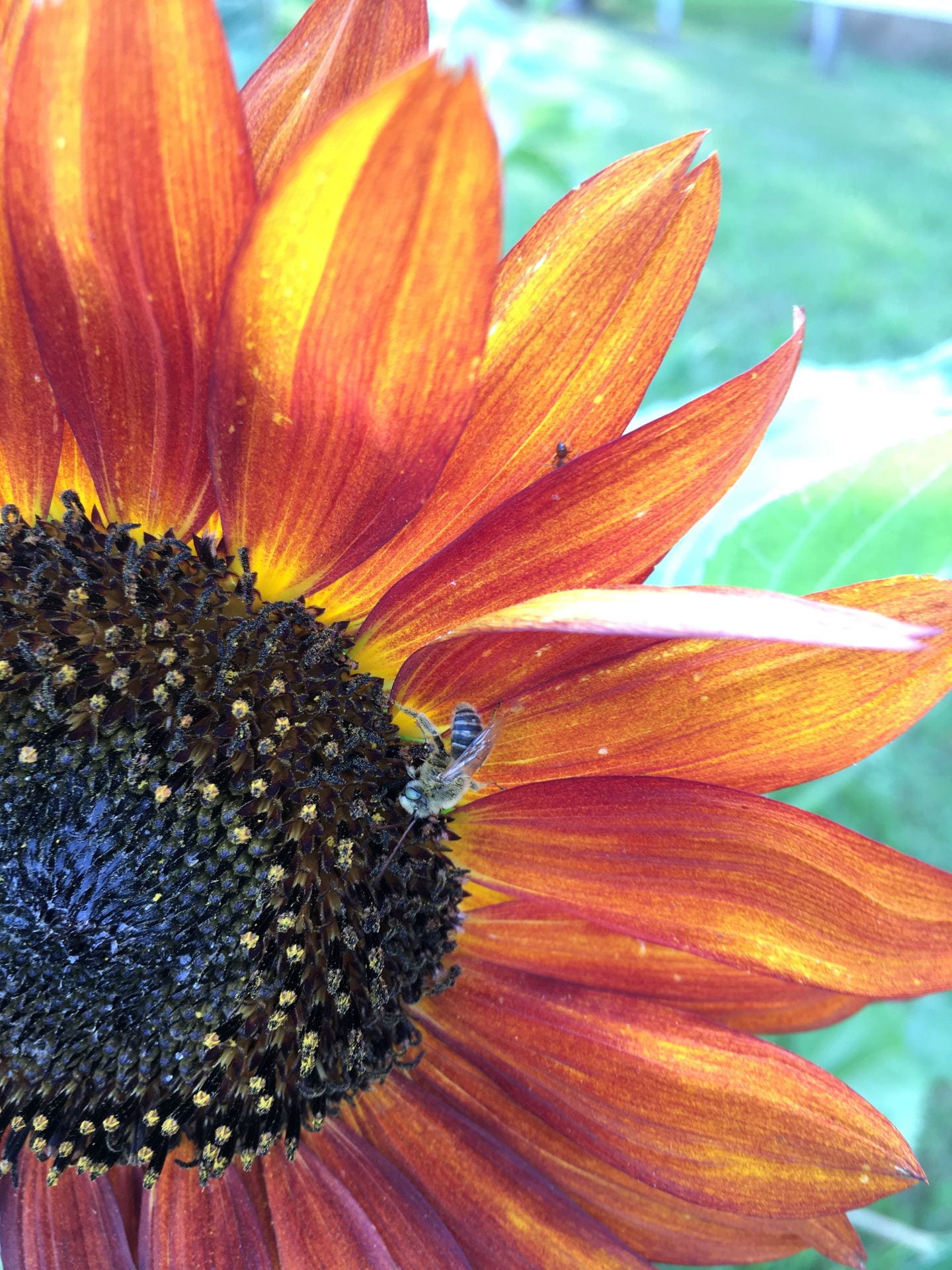
Although they are annuals, sunflowers are still very attractive to bees. Also, I like them as cut flowers.
Choosing plants – attracting specific arthropods
If you are trying to attract very specific natural enemies (e.g., parasitoid wasps, lady beetles) your plant choice can also get more complicated. Some great work has been done by researchers at Michigan State University documenting which arthropods (pollinators, natural enemies, and some pests) visited different plant species native to Michigan. They also offer a simplified summary. “Habitat Planning for Beneficial Insects” from the Xerces Society includes notes in the charts at the end about which beneficial insects are particularly attracted to the species listed. This resource from Oregon State University describes some specific plants and the arthropods they support. Finally, although this study was conducted in the United Kingdom, there might be some relevance to the Northeast U.S.
Update: During Summer 2020 (while I was doing less field work), I reviewed the literature I could find on the value of specific plants for specific natural enemies. Here is the spreadsheet I compiled.
Lists and searchable databases
In addition to the resources already listed, you may find the following helpful in selecting plants:
If you want to focus on native plants, there are many organizations committed to supporting local native plants…too many to list here, but some online searching may turn up an organization that is local for you.
My current plant list
This table lists what I either have already seeded (inside or outside), or am planning to direct seed outside when it gets a little warmer. In addition to the common, scientific, and cultivar name of each plant and whether it is a perennial or an annual in NY, I also included information about why I chose it. I only marked plants as supporting bees or natural enemies if I could find documentation of that fact in the resources above. It may be that more of the plants on this list support beneficial arthropods. If you have additional information on these plants, please let me know! In some cases (for example, zinnia) the species is reported to support beneficial arthropods, but I don’t know if the cultivars I’m growing will. In many cases, the decorative value of the plant was a big part of why I chose it. The arnica? Well, I just saw that in a seed catalog this winter and ordered some on a whim.
Common name
Scientific name
Cultivar
Annual or Perennial in NY
Bees
Natural enemies
Decorative
Arnica
Arnica chamissonis
perennial
Bachelor’s buttons
Centaurea cyanus
annual
X
X
Blanketflower
Gaillardia aristata
Burgundy
perennial
X
X
X
Blue vervain
Verbena hastata
perennial
X
Calendula
Calendula officinalis
Remembrance Mix
annual
X
X
Celosia
Celosia argentea cristata
Red Flame
annual
X
X
Cosmos
Cosmos bipnnatus
Dwarf Sensation
annual
X
X
X
Echinacea
Echinacea purpurea
perennial
X
X
Marigold
Tagetes erecta
Senate House
annual
X
X
Poppy
Papaver somniferum
Frilled White Poppy
annual
maybe
X
Poppy
Papaver sp.
seed saved by a colleague
annual
maybe
X
Pyrethrum daisy
Chrysanthemum cocineum
perennial
X
Rudbeckia
Rudbeckia hirta
Chim chiminee
perennial
maybe
X
Snap dragon
Antirrhinum majus
annual
X
X
Strawflower
Xerochrysum bracteatum
annual
X
Sunflower
Helianthus anus
Mammoth Greystripe
annual
X
probably
X
Sunflower
Helianthus anus
Evening Sun
annual
X
probably
X
Sunflower
Helianthus anus
Sonja Dwarf
annual
X
probably
X
Zinnia
Zinnia elegans
Queen Lime with Blush
annual
maybe
X
Zinnia
Zinnia elegans
Candy Cane Mix
annual
maybe
X
Zinnia
Zinnia elegans
Benary’s Wine
annual
maybe
X
Mexican zinnia
Zinnia haageana
Persian Carpet
annual
maybe
X
This post was written by Amara Dunn, Biocontrol Specialist with the NYSIPM program. All images are hers, unless otherwise noted.
This work is supported by:
Crop Protection and Pest Management -Extension Implementation Program Area grant no. 2017-70006-27142/project accession no. 1014000, from the USDA National Institute of Food and Agriculture.
New York State Department of Agriculture and Markets