All posts by Thomas Björkman

The Alpha Vegetable

The New York Times ran a long Magazine piece about doing an image makeover for broccoli. The goal was to have broccoli be a “cool” food among younger people who don’t care about broccoli at all. Author Michael Moss brought out some important points about the relationship people have with vegetables, as well as the challenges of growing more vegetables in the current economic environment. Our project was mentioned as important, but a drop in the bucket towards that goal.

Victors & Spoils’ campaign seeks to have broccoli pick up the cachet of kale as the “kale backlashbegins against this trendy vegetable.

What do Eastern consumers want?

Prof. Miguel Gómez, team member in the Dyson School of Applied economics is determining what qualities Eastern consumers look for in their broccoli, and what variation from the Western standard they accept. The results will inform the breeding process, and perhaps identify types that will be well accepted in the US East Coast that are not accepted in East Asia.

With graduate student Xiaoli Fan, he is running auctions of broccoli types to asses consumer’s relative willingness to pay for different appearances.

Consumers were presented with three types of broccoli for consideration. A: New type with large beads and lighter green; grown in New York. B: Perfect appearance by current standards, but has been shipped across country; grown in California. C: Conventional broccoli with mixed large and small flower buds, a defect common in the East; grown in New York.
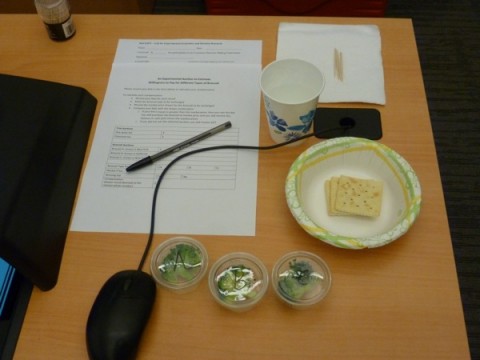
Consumers at each station have small parboiled samples of each broccoli. Many find that the local broccoli has a milder and fresher flavor.
Xiaoli Fan (right), a doctoral student on the project, leads the experiment. Graduate assistant Adeline Yeh presents head of the three types to consumers for inspection as they prepare to bid.
Consumers on the panel are members of the community. Students were excluded, since they were not considered representative broccoli purchasers.

Commercial breeder visits

The commercial breeders on the project are inspecting trials this late summer, while the differences in quality are most apparent. Brassica breeder Cees Sintinie of Bejo (right front) stopped in Geneva as part of his North American tour. He was accompanied by his colleague Jan van der Heide (rear) when he visited with Phillip Griffiths (left). Characteristic of this summer, the rain was pouring. But rain does not slow this group.

Making seeds for Regional Trials

The regional trials require a lot of seeds of the new varieties. These are made by hand pollinating one flower at a time. This week, Griff’s group is finishing some hybrid seed for use in 2014.

a
Parental plants in greenhouse. Each parent line only has three or four plants, so all the hybrid seed must come from them.
Jeff McNamara prepares a flower for pollination by separating the sepals to expose the stigma. The flowers must be pollinated at this stage so they are not fertilized by their own pollen, which matures once the flower opens on its own.
The flower is pollinated by rubbing the pollen-laden anthers of the pollen parent on the stigma of the seed parent.
After a flower is pollinated, it is tagged with the names of the parent plants. The fruit are allowed to grow and seed develop inside. With fecund plants, as many as 10 seeds can come from one flower.
When the fruit have matured, they are collected and taken to the seed processing room along with their tag. There, the seeds are removed and placed in labelled envelopes.
Some crosses result in few seeds. These fruits only have one seed each.