Profitability of contrasting organic management systems from 2018-2021 in the Cornell Organic Cropping Systems Experiment

Kristen Loria1, Allan Pinto Padilla2, Jake Allen1, Christopher Pelzer1, Sandra Wayman1, Miguel I. Gómez2, Matthew Ryan1

1School of Integrative Plant Science, 2Charles H. Dyson School of Applied Economics and Management, Cornell University, Ithaca, NY 14853.

About the Cornell Organic Cropping Systems Experiment

The Cornell Organic Cropping Systems (OCS) experiment was established in 2005 at the Musgrave Research Farm in Aurora, New York to serve as a living laboratory for organic field crop management systems and provide practical insights to farmers. This ongoing long-term experiment compares four management systems along a dual spectrum of external inputs and soil disturbance over a multi-year crop rotation. An advisory board consisting of a dedicated group of organic farmers provides guidance on management decisions. The four systems are compared in terms of several sustainability indicators including yield, profitability, soil health and greenhouse gas emissions.

Both external input and soil disturbance gradients of the four treatment systems range from an extensive approach (low input) aimed at maximizing profitability by reducing costs via efficient resource use, to an intensive approach (high input), aimed at maximizing profitability by maximizing yield. Risk associated with low input management includes reduced crop production from inadequate soil fertility or weed competition, which can lead to decreased returns despite low input costs. Risk associated with high input management include diminishing returns where productivity increases are insufficient to justify additional cost.

The four management systems of OCS are: 1) High Fertility (HF), 2) Low Fertility (LF), 3) Enhanced Weed Management (EWM), and 4) Reduced Tillage (RT). In 2018, the crop rotation was modified from a three-year rotation to a  four-year rotation based on advisor input.: This article includes an economic analysis of the complete four-year crop rotation cycle from 2018-2021, which consisted of: 1) triticale / red clover, 2) corn / interseeded cover crop mix, 3) summer annual forage mix / cereal rye cover crop, 4) soybean (Figure 1).

Figure 1. Four-year crop rotation for the OCS phase 2018-2021.

Looking back: key takeaways from past OCS cycles

Caldwell et al. (2014) compared the yields and the profitability during and after the initial phase of organic transition in OCS following two three-year rotation cycles (corn-soybean-winter spelt/red clover) from 2005-2010. The first three years were considered as transitional production years in which crops could not be sold as certified organic, while crops produced from 2008 to 2010 could be sold as such. They used flexible interactive crop budgets to calculate relative net returns based on crop yields, tillage, weed management and fertility practices and, after the three-year transition period, compared relative net returns of organic production with concurrent organic price premiums to Cayuga County yield averages with conventional crop production inputs and prices. With a 30% organic price premium, the relative net return of organic production in all systems except RT was positive. The RT system was excluded from most analyses due to major challenges with experimental ridge-till practices resulting in decreased crop competitiveness. For both corn and soybean phases averaged across entry points, relative net return in the HF system was significantly lower than LF or EWM, due to higher input costs without corresponding higher yields in the HF system. For the spelt phase averaged across entry points, relative net return was higher in HF than LF and EWM (though not significantly so), with increased input cost in the HF system corresponding with a yield increase. The HF system led to higher weed biomass over time than the EWM and LF systems.

Trial design and system differences

The Cornell Organic Cropping Systems experiment uses a split-plot randomized complete block design with four blocks. The main plot treatments are the four management systems, whereas subplot treatments are two crop rotation entry points (A and B) . Entry points A and B represent different phases of the crop rotation. For example, in 2018 entry point A was planted to triticale while entry point B was planted to soybean.

Treatment systems are arranged along a fertility gradient as well as a soil disturbance gradient (Figure 3). For triticale, summer forage, and corn, the HF system had a 50% higher fertilization rate than RT and EWM. LF received fertilizer rates 50% lower than RT and EWM on the same crops. Intermediate fertilizer rates were applied to both EWM and RT. With respect to soil disturbance, EWM received additional weed management operations in several crops, while RT and LF incorporated an organic no-till soybean phase. Overall number of primary tillage events was not substantially different between systems, though mechanical cultivation was reduced in the soybean phase for RT and LF.

Figure 2. Contrasting management approaches in four systems.

Crop yields across management systems

No matter the management system, crop yield is a key component of profitability. Yields across all four years of the cycle comprising five harvested crops are summarized below. Ryelage was only harvested in EWM and HF systems as the cereal rye cover crop was rolled-crimped for no-till soybean in LF and RT systems. Triticale was grown as a grain crop in EWM and HF and taken for forage in the LF and RT systems. Organic no-till practices were implemented in RT and LF systems only, with soybean planted into tilled soil in HF and EWM. In entry point A soybean yields were comparable across systems, but in entry point B organic no-till soybean yields were nearly half of cultivated yields, likely due to dry conditions in the soybean phase in 2018.

Table 1. Mean yields for all harvested crops across four management systems and crop rotation entry point from 2018-2021. Within an entry point, systems sharing a letter were not significantly different (p < 0.05). Means were not compared between entry points. Triticale in RT and LF systems was harvested as forage (lbs DM/ac) while in HF and EWM it was harvested as grain (lbs/ac). Means were not compared.

Net return of management systems

Net return subtracts total variable costs (TVC) of production (inputs + labor + equipment-associated costs) from gross income (crop yield x price). Prices for corn and soybean were obtained from the USDA organic grain report (USDA National Organic Grain and Feedstuffs Report, February 4, 2022). As commodity price references for triticale grain, cereal rye forage and summer annual forage were unavailable, prices were based those typically fetched for organic forage in NY (MH Martens and P Martens, personal communications, 2022). All operation-related costs were taken from Pennsylvania’s 2022 Custom Machinery Rates (USDA NASS 2023). To correct the absence of an inflation adjustment, crop prices and input costs used in this study were converted to real values using the U.S. Consumer Price Index (CPI), with 2016 as the reference year.

All values are denominated in U.S. dollars and represent the average annual revenue, production costs, and net return over four years. In the case of crop rotation entry point A, the LF cropping system exhibited the lowest Total Variable Cost (TVC). Conversely, the HF system had the highest TVC, which despite higher grain and forage yields, resulted in lower net return than LF, EWM and RT systems (Figure 4).

Overall, across four years of the crop rotation and in both crop rotation entry points (i.e., temporal replications of the trial) the EWM system maximized net return via intermediate fertility rates and relatively high yields, though the HF system yielded higher in both entry points Net return for RT and LF systems was more variable between crops and entry points, possibly indicating higher weather-related risk associated with those system approaches, i.e. reliance on cover crops for fertility in LF, and use of organic no-till management for LF and RT (Figure 4).

Figure 4. Comparison of net return and components across four systems in entry point A.

In entry point A, LF demonstrated higher net return than both HF and RT despite lower yields due to reduced input costs. Net return in RT narrowly surpassed HF due to lower input costs as well. In entry point B, LF ranked lowest in net return due to low grain yields across the rotation. HF ranked second and RT ranked third, with RT characterized by intermediate to low yields with intermediate input costs.

Figure 5: Comparison of net return and components across four systems in entry point B.

When net return of each management system is summarized by entry point, high variability in profitability was observed across entry points, largely due to yield differences between growing seasons of the same crop. Because management was nearly identical for each crop within each system across entry points, temporal variation in net return can be attributed to yield response from seasonal environmental or climatic factors either directly or in interaction with management. This highlights the complexity of systems experiments given year-to-year variation (Figure 6).

Figure 6: Net return comparison of all four cropping systems and two entry points.

Conclusions

Differences in yield and subsequent net return between systems varied significantly across entry points, making it difficult to draw conclusions on the most profitable system overall. However, the HF system had the lowest net return across entry points, indicating that input levels were likely higher than optimum and yield gains to justify increased inputs were not realized. EWM had the highest net return across entry points, indicating that intermediate levels of fertility combined with additional cultivation passes in the row crop phases and full tillage soybean production “paid off” as a management strategy, with increased labor or fuel costs outweighed by increased yields. Of course, this assumes availability of labor required which may be out of reach for some farms, and can be challenged by finite weather-related windows conducive to field operations.

Variability in net return between entry points was particularly high for the LF and RT systems, largely driven by yield variation in the soybean phase between temporal replications. For entry point B, intermediate corn yields and low organic no-till soybean yields drove low profitability in LF, while relatively high corn yield in RT partially made up for low organic no-till soybean yield. This variation in soybean yield highlights a challenge with an organic no-till management approach that dry conditions can reduce yields to a greater extent compared to a tillage-based approach. However, in an extremely wet year where adequate weed control was not possible, no-till management may pay off.

By accounting for system profitability only, this article does not consider other tradeoffs between systems such as soil health outcomes or greenhouse gas emissions from contrasting management, additional sustainability metrics to evaluate organic production system success.

References

Caldwell, B; Mohler, CL; Ketterings, QM; and DiTommaso, A. (2014). Yields and profitability during and after transition in organic grain cropping systems. Agronomy Journal, 106(3):871–880.

Gianforte, L personal communication. 2022.

Jernigan, A. B., Wickings, K., Mohler, C. L., Caldwell, B. A., Pelzer, C. J., Wayman, S., and Ryan, M. R. (2020). Legacy effects of contrasting organic grain cropping systems on soil health indicators, soil invertebrates, weeds, and crop yield. Agricultural Systems, 177:102719.

USDA National Organic Grain and Feedstuffs Report, February 4 2022. Agricultural Marketing Service.

Martens, MH personal communication. 2022.

Martens, P personal communication. 2022.

Pennsylvania’s 2022 Machinery Custom Rates. USDA NASS.

For more results from the Cornell Organic Systems Experiment visit the Sustainable Cropping Systems Lab website.

Value of Manure Calculator Cell Phone App Available Now

Juan Carlos Ramos Tanchez¹, Kirsten Workman¹𝄒², Carlos Irias¹, and Quirine M. Ketterings¹ 

Cornell University Nutrient Management Spear Program¹, PRO-DAIRY²

Introduction

Quantification of nutrients in manure is essential to ensure efficient resource management, maximize agricultural productivity, and minimize negative environmental impact. A Value of Manure Calculator cell phone app was developed to estimate the agronomic and economic fertilizer replacement value of manure. To use the app, users will need to enter (1) the percent solids, N, P, and K nutrient content from a recent manure analysis, (2) the implemented or planned manure application rate, (3) crop nutrient needs, and (4) fertilizer costs. The app will then return past and current N credits, P and K credits, the fertilizer replacement value of the manure. Once the land application cost per gallon of manure is added, the tool also calculates the land application cost per extra mile hauled and the break-even hauling distance and costs. The app uses manure N credits that are in line with Cornell’s Nitrogen Guidelines for Field Crops in New York (2023). If you are in another state, consult your local land grant university guidance for manure N credits.

Calculator Access 

The Value of Manure app can be accessed at Value of Manure Calculator (https://valueofmanure-nmsp.glideapp.io/) with any browser or by scanning the QR code to the right. Once opened, the user will see the opening page of the calculator (Figure 1 left). The front page shows, at the bottom of the screen, seven tabs: Lab Analyses; Past Application; Current Application; Crop Needs; Fertilizer Value; Hauling; and Results (Figure 1 right).

Two phone screens.
Figure 1. Value of Manure App main page showing the manure analyses tab (left) and the results page (right).

Calculator User’s Guide

Recently a User’s Guide explaining what the app does and how to use it, was released (Figure 2). The guide walks the user through the different taps and explains in detail the following topics:

  1. Entering a Manure Analysis
  2. Calculating Nitrogen Credits from Past Applications
  3. Calculating Current Year Manure Nutrient Credits
  4. Entering Crop Needs
  5. Entering Fertilizer Value
  6. Calculating Break-Even Hauling Distances and Costs
  7. Understanding the Results
  8. Signing in to Save Results
An image of the cover of the Value of Manure project calculator user's guide.
Figure 2. Value of Manure Calculator User’s Guide.

The Value of Manure Calculator User’s Guide can be accessed at the NMSP website by clicking on the following link: http://nmsp.cals.cornell.edu/publications/extension/ValueManure2025.pdf.

Additional resources

Acknowledgments

The original manure crediting system was developed based on many years of field research under the leadership of S.D. Klausner, with contributions by D.J. Lathwell, D.R. Bouldin, and W.S. Reid of Cornell University, Department of Crop and Soil Sciences. This app was developed with financial support from the Northern New York Agricultural Development Program, the New York Agricultural Viability Institute, and USDA-NIFA. For questions about this project, contact Quirine M. Ketterings at 607-255-3061 or qmk2@cornell.edu, and/or visit the Cornell Nutrient Management Spear Program website at: http://nmsp.cals.cornell.edu/


New End-Of-Season Assessment Tool for Nitrogen Management of Corn Silage

Agustin J. Olivo1, Olivia F. Godber1, Kirsten Workman1,2, Karl J. Czymmek1,2, Kristan F. Reed1, Daryl V. Nydam3, Quirine M. Ketterings1

1Department of Animal Science, 2PRO-DAIRY, 3Department of Public and Ecosystem Health Cornell University, Ithaca, NY United States 

Introduction

            Effective nitrogen (N) management is an essential aspect of productivity and sustainability of corn silage production for dairies. In New York (NY), end-of-season evaluations that consider indicators like N balance (N supply – N removal) and ratio of N removal to N supply can be implemented to assess nutrient use efficiency. Comparing these results with feasible outcomes can help farmers identify opportunities to refine N management over time, and support field experimentation through the NY adaptive N management process. To identify target values for these indicators, characteristics of 994 corn silage field observations across eight NY dairies, together with land grant university guidelines for N management were used to create the “Green Operational Outcomes Domain” (GOOD) assessment framework. The GOOD combines feasible target values for field-level N balances, N removal/N supply, and an indicator related to manure inorganic N utilization efficiency. Indicators were derived using the method outlined in Agronomy Factsheet 125.

Key findings

The GOOD was defined by a 50% minimum N removal/N supply and a 142 lbs/acre maximum balance

A line graph depicting N balances and the "Green Operational Outcomes Domain."
Fig. 1. Feasible outcome values for maximum tolerable N balance and minimum N removal/N supply that define the GOOD framework.

            The GOOD framework was defined by comparing field N removal and available N supply (Fig. 1). Fields performing inside the GOOD (green area in Fig. 1) have an N removal/N supply that is at least 50%, and a field N balance of 142 lbs N/acre or less. The latter was defined based on the maximum balance that fields in the present dataset would display if managed according to land grant university guidelines. The GOOD was set to identify fields with large N balances and low efficiencies in the context of adaptive N management, without restricting application rates to less than annual P crop removal.

Average farm performance remained within the GOOD, but with large variability

            When considering actual farm management practices (“achieved” indicators) across all 994 fields, 66% of observations were within the GOOD and 34% outside. However, there was large variability across the eight farms evaluated.  The percentage of fields outside the GOOD ranged from only 1% for one farm (Fig. 2 left) and up to 54% for another farm (Fig. 2 right). The annual averages for achieved available N balance on all farms ranged between 4 and 192 lbs N/acre, and for N removal/available N supply between 38% and 95%.

Two line graphs describing the relationship between farm animal density and N balances.
Fig. 2. Nitrogen (N) removal and achieved available N supply as calculated from farm management data for corn silage fields of two different dairy farms. Percentages at the top of each graph represent the percentage of fields inside (green, left), and outside (red, right) the green operational outcomes domain (GOOD). Yellow diamonds represent the area-weighted average performance across all fields data was collected for in each farm.

Manure N use was efficient in this dataset, but with opportunities for refinement

            Forty-six percent of observations had spring manure injection or surface application followed by incorporation, whereas 32% received manure application but manure inorganic N contributions were zero (manure was either applied in fall, or in spring with no incorporation within five days). Twenty-six percent of observations were both within the GOOD and had manure inorganic N contributions larger than zero. This shows an overall efficient use of N for corn silage production. For 20% of the observations, manure injection or incorporation in the spring did take place, but the fields fell outside of the GOOD, reflecting opportunities to reallocate a portion of the nitrogen applied to other fields.

Additional graphical tools and indicators complement the GOOD framework well

A graph describing the relationships between yield and balances.
Fig. 3. Graphical tool displaying field achieved N balance vs corn silage yield, in the context of the feasible maximum tolerable N balance (142 lbs N/acre) and farm average yield. Q = quadrant.

            A series of additional graphical tools and numerical indicators were created to provide farms with more information to identify opportunities to refine N management in corn silage production. For example, one tool helps to identify fields with low yields and high N balances (Q3 in red, Fig. 3). These fields can represent the first target when attempting to refine N management in corn silage.

Conclusions

            The GOOD framework is introduced as an end-of-season assessment tool for farms to identify corn silage fields with large N balances and low N removal/N supply. This can be used in the context of the NY adaptive N management process, and/or to identify opportunities for N management refinement over time. On the latter, this study showed that the strategies with largest potential for refining N management and meeting the GOOD feasible targets included reducing N inputs, evaluating non-N yield barriers (e.g. drainage, pests) for fields with low yields and high balances, crediting N contributions from sod, and increasing manure N utilization efficiency (with spring injection or incorporation) and adjusting rates accordingly.

Full citation

            This article is summarized from our peer-reviewed publication: Olivo, A.J., O.F. Godber, K. Workman, K.J. Czymmek, K. Reed, D.V. Nydam, and Q.M. Ketterings (2024). Doing GOOD: defining a green operational outcomes domain for nitrogen use in NY corn silage production. Field Crops Research. https://doi.org/10.1016/j.fcr.2024.109676.

Acknowledgements

            We thank farmers and their certified crop advisors who shared farm data. This research was funded by a USDA-NIFA grant, funding from the Northern New York Agricultural Development Program (NNYADP), and contributions from the New York Corn Growers Association (NYCGA) managed by the New York Farm Viability Institute (NYFVI), and the Department of Animal Science, Cornell University. For questions about these results, contact Quirine M. Ketterings at qmk2@cornell.edu, and/or visit the Cornell Nutrient Management Spear Program website at: http://nmsp.cals.cornell.edu/.

Icons for the Nutrient Management Spear Program, Cornell University, Cornell CALS, and PRO-DAIRY

Manure nutrient variability during land application in four New York dairies

Aidan Villanueva1, Carlos Irias1, Juan Carlos Ramos Tanchez1, Kirsten Workman1,2, Quirine Ketterings1

1 Department of Animal Science, Cornell University, Ithaca, NY, United States; 2PRO-DAIRY, Department of Animal Science, Cornell University, Ithaca, NY, United States

Introduction

               Dairy manure is a rich source of essential plant nutrients, making it an excellent natural fertilizer. When applied correctly, it can enhance soil health, boost crop yields, and reduce reliance on synthetic fertilizers, thereby increasing agriculture’s sustainability and contributing to a more circular economy. Unlike inorganic fertilizers that have a guaranteed analysis, manure dry matter and nutrient content can vary, influenced by numerous factors such as dairy rations, type and amount of bedding, rainfall and wash water, manure storage systems and handling. Manure sampling and analyses will be essential in determining the potential value of the manure as a nutrient source. Our objectives were to assess the variability in manure dry matter (DM), nitrogen (N), phosphorus (P), and potassium (K) content across farms, across different storage units within a farm, and across time (hourly versus daily sampling), and to document the impact of agitation on DM and manure nutrient content. 

How was the data collected?

               Four New York dairy farms participated in this study. Manure samples were collected during land application in the spring of 2023 for all four farms and repeated in the spring of 2024 for one of the farms. Manure management and storage practices (Table 1) varied from farm to farm. Storages were sampled in the spring across days (“daily sampling”), and for the 2023 sampling we also took samples every two hours on selected days (“intense sampling”) to compare variability across hours and across days.

Table indicating manure management of different farms.

A manure spreader moving in a field on the left and a bucket of liquid manure on the right.
Fig. 1. Manure collection from a spreader.

               Manure samples were collected by filling a five-gallon bucket directly at the pump or the manure spreader (Figure 1). For each sampling round, three subsamples were taken and submitted for nutrient analyses to ensure outliers could be captured. Samples were analyzed for DM, total N, inorganic N, organic N, P, and K. Means, standard deviation, and coefficient of variation (CV) were determined to assess variability in the results across farms, storages, spreading events, and sampling intensity.

What was found?

               Storages varied greatly from farm to farm (results not shown) and within a farm (Figure 2). This highlights the importance of sampling each storage unit individually and maintaining accurate storage-to-field application records. 

A bar graph indicating mean nutrient content.
Fig. 2. Mean nutrient content at farm D for dry matter, total nitrogen, inorganic nitrogen, organic nitrogen phosphorus (P2O5), and potassium (K2O) in manure samples collected from four manure storage units (S1, S2, S3, and S4) in 2023. Error bars are standard deviations.

               Composition varied as the manure storage was emptied (results not shown). In general, across storages and farms, K content showed lower variability compared to P and N. In general, variability in N (total, organic, and inorganic) and P among hours within a day was much smaller than the variability from day to day (Figure 3). Hourly sampling often resulted in CVs below 13% while daily sampling showed CVs up to 34%. Because of the much lower CVs for hourly sampling, sampling over multiple days is recommended instead of sampling within a day.

Bar graph showing manure variation.
Fig. 3. Coefficient of variation for daily versus hourly sampling at three dairy farms for total nitrogen, phosphorus (P2O5), and potassium (K2O) in manure samples collected in 2023. # = Agitation, + = solid-liquid separation.

               Manure agitation completed the day before and on the day of application resulted in higher nutrient content, specifically for total N and P (Figure 3), reflecting settling of manure solids without agitation. Dry matter content was correlated with total N and P with lower N and P content for the more liquid upper layers in the storage. Potassium did not show much variability reflecting that K is predominantly found in the liquid fraction of the manure. These results show the benefits of consistent agitation to ensure a greater homogeneity over time as manure is land applied.

Bar graph indicating the impact of agitation.
Fig. 4. Impact of agitation the day before land application, during land application, and no agitation on manure mean nutrient content at farm B24 for dry matter, total nitrogen, inorganic nitrogen, organic nitrogen, phosphorus (P2O5), and potassium (K2O).

Conclusions

               Manure nutrient composition and variability differed across farms and across storage units on the same farm. Variability was also present over time as storages were emptied, although there was little variability between samples taken just a few hours apart (same day sampling). Agitation helped reduce variability. We recommend sampling each storage unit separately, keeping storage-to-field application records, agitating storages where feasible prior to and during land application, sampling manure from pumps or spreaders during land application, and sampling every time a significant change in manure dry matter content is seen.

Additional Resources

Acknowledgements

               We thank Dairy Support Services as well as farmers and their certified crop advisors who worked with us to collect manure samples. This research was funded by a USDA-NIFA grant, funding from the Northern New York Agricultural Development Program (NNYADP), the New York Farm Viability Institute (NYFVI), New York State Department of Agriculture and Markets (NYSAGM) and Environmental Conservation (NYSDEC). For questions, contact Quirine M. Ketterings at qmk2@cornell.edu, and/or visit the Cornell Nutrient Management Spear Program website at: http://nmsp.cals.cornell.edu/.

Icons for the Nutrient Management Spear Program, Cornell University, Cornell CALS, and PRO-DAIRY

Enhancing nitrogen management in corn silage: insights from field-level nutrient use indicators

Agustin J. Olivo1, Kirsten Workman1,2, Quirine M. Ketterings1

1 Department of Animal Science, Cornell University, Ithaca, NY, United States; 2PRO-DAIRY, Department of Animal Science, Cornell University, Ithaca, NY, United States

Introduction

              Optimizing nitrogen (N) management in corn silage production can help improve farm profitability while reducing potential environmental impacts derived from N losses in dairy farms. One strategy to monitor and improve nutrient management at the field level is the calculation of end-of-season field balances, the difference between nutrients supplied to the crop, and what is removed with harvest. Ideal field-level N balances are positive, but not excessively large.

Fig. 1. Nitrogen pools considered for N supply and N uptake when calculating field-level N balances.

              To assess the use of field N balances as an evaluation tool, field-level N balances (N supply – N uptake) and associated N use indicators were derived for 994 field observations from eight NY dairy farms across NY. Available and total N balances per acre, which differed only in the fraction of manure N accounted for (plant-available N or total N), yield-scaled N balances, and N uptake/N supply were calculated (Fig. 1).

Key findings

Nitrogen use indicators varied widely

              The median balance across all fields was 99 lbs/acre for available N and 219 lbs/acre for total N. Excluding soil N contributions reduced these medians to 26 lbs/acre for available N and 145 lbs/acre for total N. Median N uptake/N supply were 0.60 (available N) and 0.41 (total N). Balances varied by farm, ranging from 41 to 145 lbs/acre for available N and from 126 to 338 lbs/acre for total N (Fig. 2).

Two bar graphs.
Fig. 2. Relative frequency distributions for available nitrogen (N) balances per ac (A), and total N balances per ac (B), for all observations across farms and years.

Nitrogen supply considerably affected N use indicators

              Nitrogen supply was a bigger driver for N use indicators than N uptake (Fig. 3), suggesting that decisions on N inputs influence N use indicators more than yield itself. Larger balances were associated with high N supply and low-yielding fields, indicating that for those fields factors other than N supply limited yield. These could be in-season factors that prevent a field from achieving its yield potential (such as extreme weather events and pest problems), or (semi) permanent limitations (such as shallow depth to bedrock, subsurface compaction, and drainage issues) not acknowledged in N application planning.

Manure-N availability impacted N use efficiency

              The database showed a wide range of manure and fertilizer N supply to fields. Available manure organic and inorganic N played the largest roles in explaining the variability of N use indicators, with available N balances increasing with an increase in manure N supply. The study showed a 0.2 unit decrease in fertilizer N application on average in corn fields, with a 1 unit increase in available N from manure. This suggests that manure is valued as an N source, but its N content is not credited to the full extent possible, resulting in larger N balances at the end of the season.

Scatter plot.
Fig. 3. Available nitrogen (N) balances per acre, as related to N uptake and available N supply. Each data point represents a field*year observation in the database.

Sod-N crediting impacted N use efficiency

              First year corn fields showed reduced fertilizer and manure N applications than 2nd through 4th year fields (Fig. 4). Average available N balances (black dots in Fig. 4) for 1st year corn were, however, slightly larger than for fields with no sod N credits, suggesting opportunities for further reductions in nutrient allocation to 1st year corn.

A bar graph.
Fig. 4. Area-weighted average available nitrogen (N) from fertilizer and manure applications (colored bars), across all farms and years and for different stages of the crop rotation. Blue numbers (line one) on top of the graph represent number of observations in each category, and green numbers (line two), the area-weighted average N credits from sod for observations in each rotation stage. Black bolded numbers on top of each bar represent the sum of the area-weighted average available N from fertilizer and manure. COS1, COS2, COS3 = first, second and third crop year of corn silage after sod.

Farm animal density was associated with N use indicators

              At the whole-farm level, N balances per acre were positively related to animal density (animal units per acre) and impacted by farm crop rotations and within-farm allocation of manure N (Fig. 5).

Fig. 5. Relationship between farm animal density and (A) area-weighted farm averages for available nitrogen (N) balance, and (B) total N balance. Dotted horizontal gray lines represent the area-weighted average for each dependent variable across farms and years. AU = animal unit = 1,000 lbs of live animal weight.

Conclusions

              Nitrogen supply impacted N balance indicators more than N uptake (yield) and N balances tended to increase with larger farm animal density. Adjusting N supply based on realistically attainable yield, fully crediting manure and sod N contributions, improving manure inorganic N utilization efficiency, optimizing animal density, and/or exporting manure can aid in improving field N use indicators over time.

Full citation

              This article is summarized from our peer-reviewed publication: Olivo A.J., K. Workman, and Q.M. Ketterings (2024). Enhancing nitrogen management in corn silage: insights from field-level nutrient use indicators. Frontiers in Sustainable Food Systems 8. https://doi.org/10.3389/fsufs.2024.1385745.

Acknowledgements

              We thank farmers and their certified crop advisors who shared farm data. This research was funded by a USDA-NIFA grant, funding from the Northern New York Agricultural Development Program (NNYADP), and contributions from the New York Corn Growers Association (NYCGA) managed by the New York Farm Viability Institute (NYFVI), and the Department of Animal Science, Cornell University. For questions about these results, contact Quirine M. Ketterings at qmk2@cornell.edu, and/or visit the Cornell Nutrient Management Spear Program website at: http://nmsp.cals.cornell.edu/.

What’s in a Net? Citizen Scientists Sweep Alfalfa Fields for Pests and Predators

Ashley Bound1, Emily Anderson2, Erik Smith1

 1CCE Central NY Dairy, Livestock, and Field Crops Team
2CCE Chenango County 

Introduction

Potato leafhopper (PLH) is a major pest to alfalfa crops across the US and in Central New York. It causes damage to young plants and successive regrowth, resulting in a decrease in overall quality with the potential to cause financial losses to farmers. With funding from the Chobani Community Impact Fund and leadership from the Central New York Dairy, Livestock, and Field Crops (CCE CNYDLFC) regional team and Cornell Cooperative Extension of Chenango County (CCE Chenango), local Future Farmers of America (FFA) chapters worked together during the 2023 growing season to inform farmers about PLH population dynamics in their fields. The goal of this project was to monitor alfalfa fields for PLH, inform farmers if and when PLH populations had reached the action threshold (the population at which a farmer would want to take action to prevent economic loss) and gain a better understanding of the populations of potential insect predators of PLH through the growing season. In the process, community members of different ages and backgrounds had the opportunity to come together to gain hands-on experience with agriculture in the region, share skills and unique perspectives, connect with farmers, and participate in a local citizen science project.

Alfalfa is a good source of protein for livestock and a high-yielding crop for silage, hay, and pasture, and is an essential component of Total Mixed Rations on most dairy farms. Alfalfa is also useful in crop rotations because its root systems help improve soil structure and, as a legume, it is able to fix nitrogen from the atmosphere.

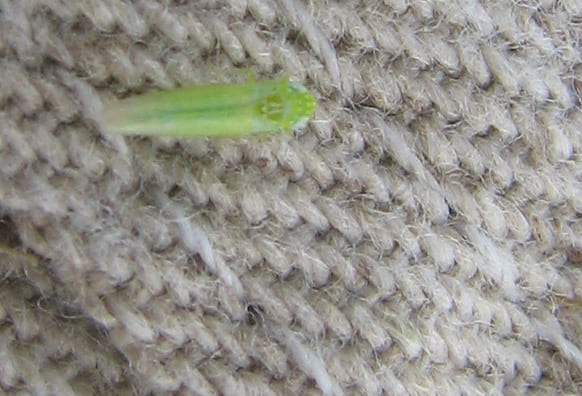
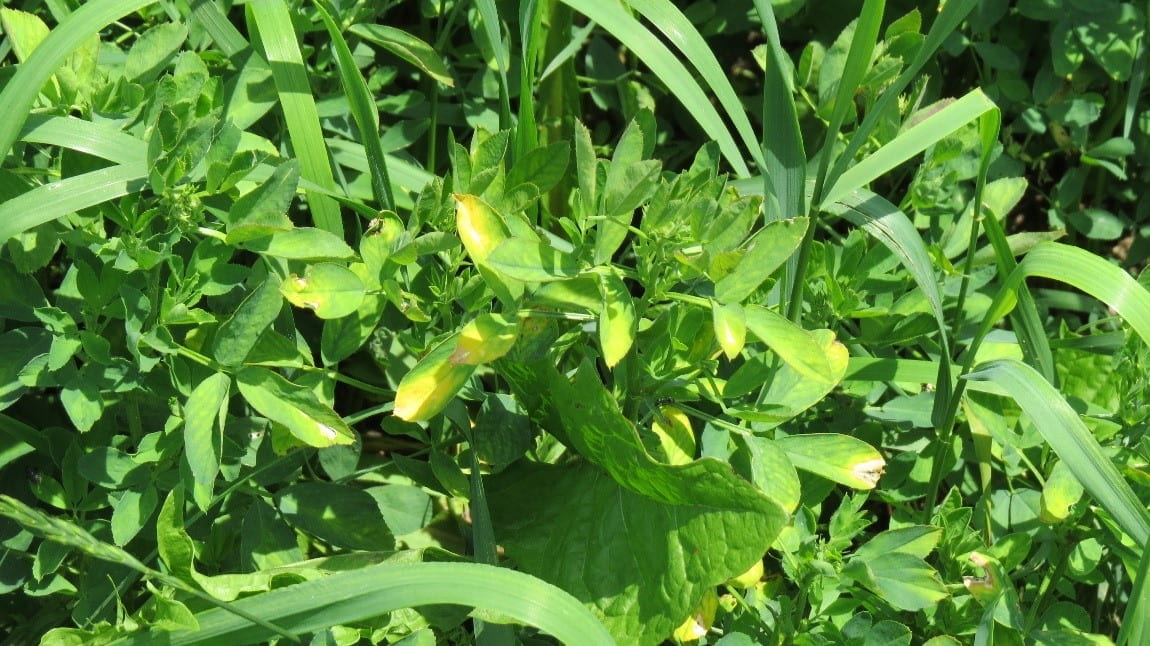
One of alfalfa’s most common pests in New York is potato leafhopper (Empoasca fabae) (PLH) (Fig. 1). Heavy PLH pressure can result in the reduction of stand quality and the loss of nutritional value, and it can impact the availability of successive cuttings. PLH is found across much of the eastern half of the United States and is a pest of many different crops, including clovers, potatoes, soybeans, and apples. At ¼  in, the small PLH can cause big problems. It feeds by using its straw-like mouthparts to extract sap from plants. While taking nutrients from the plant, the PLH also secretes a toxic saliva, which reduces the plant’s ability to photosynthesize. Leaves of infected plants will begin to yellow; this is known as “hopper burn” (Fig. 2).

Potato leaf hopper
Figure 1. A potato Leafhopper adult is about ¼ inches in length (Ken Wise)
hopper burn on alfalfa
Figure 2. Hopper burn, PLH-damaged alfalfa (NYSIPM)

Potato leafhopper management

PLH pressure in alfalfa fields is commonly addressed in two ways: spraying the field with a pesticide to reduce PLH numbers or harvesting the field early. Costs and benefits exist between both options, but often the decision relies on the timing of the upcoming harvest.

Advising between when to cut and when to spray pesticides can help the farmer reduce the cost of pesticides, fuel, and labor used while also maintaining the value of the alfalfa stand.

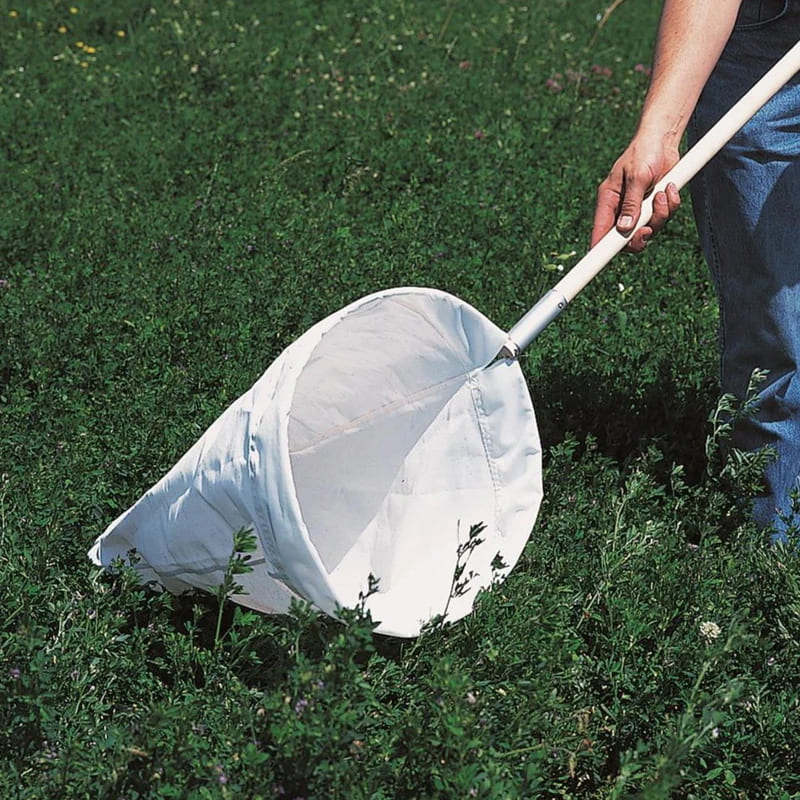
Farmers and pest scouts use large canvas sweep nets to sample PLH populations in alfalfa fields (Fig. 3). If the field has high PLH numbers, but the farmer is within one week of harvesting the field anyway, it would be more cost-effective to cut the field early. Cutting early allows the farmer to prevent further damage caused by PLH and maintain the quality of the alfalfa without unnecessarily expending time, fuel, and product by spraying with a pesticide. On the other hand, if the field is more than one week away from harvest and PLH numbers are high, it would make more economic sense to treat the field with an insecticide to provide the alfalfa more time to mature without PLH damage, since a low-yield harvest would have low economic value.

It is unclear whether PLH populations are predated upon by other insects or spiders to a degree that would affect alfalfa yield loss. Several species are reported to feed on PLH, but PLH are considered too fast to be captured by most predators. Still, insecticide applications intended to manage PLH would potentially affect other insects in the field, including those predating on pea aphid, another summertime insect pest of alfalfa that can cause yield loss in rare cases where populations get out of hand.

 What is considered a high PLH number?

Table 1. Economic thresholds of PLH in non-PLH-resistant alfalfa (adapted from Cornell Guide for Integrated Field Crop Management)

Height of Alfalfa (in) Max PLH/Sweep
<3 0.2
3-7 0.5
8-10 1
11-14 2
15+ 2*

* No action needed if within 1 week of cutting, and consider cutting early.

For Example…

If the stand of alfalfa is 21 in. tall and the average number of PLH per sweep was 2.5, then the action threshold has been reached, and it would make sense to cut the stand early to prevent further damage because it is likely within one week of harvest.

However, if the alfalfa in the field is only 10 in. tall and an average of 1.5 PLH were found per sweep, the field should instead be managed with an insecticide application to prevent further PLH damage, since the next cutting will not happen within the next week.

If the alfalfa height is 20 in., but the average number of PLH per sweep was only 1.2, then the action threshold was not reached, and no action would be warranted for the field.

Methods

To help our extension staff collect data and provide management recommendations to local farmers, nine area youth groups including seven FFA chapters were provided with sweep nets, insect identification guides, and a comprehensive insect identification textbook, all of which they could keep at the end of the project. In-person training sessions and data sheets were also provided by CCE staff.

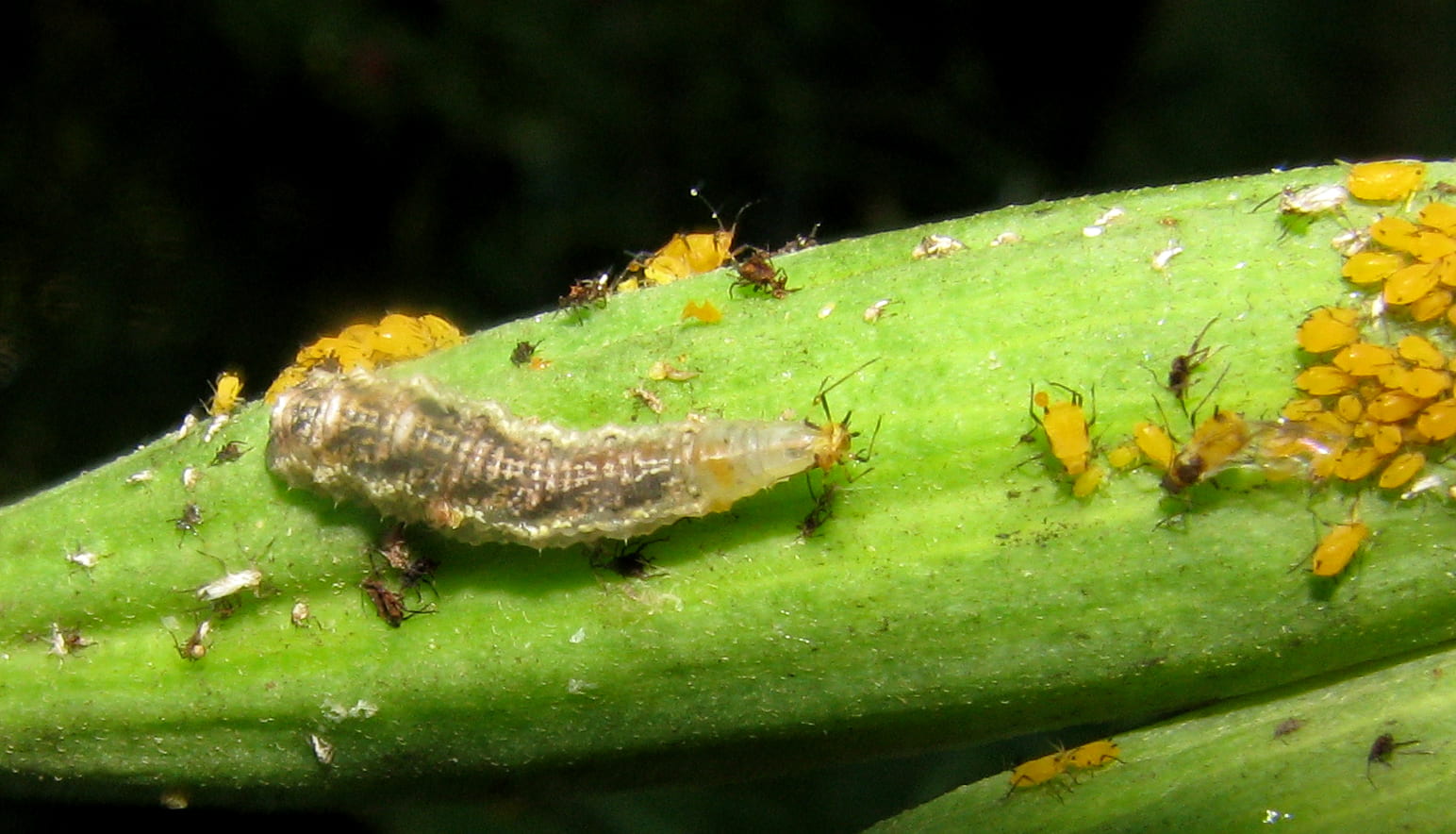
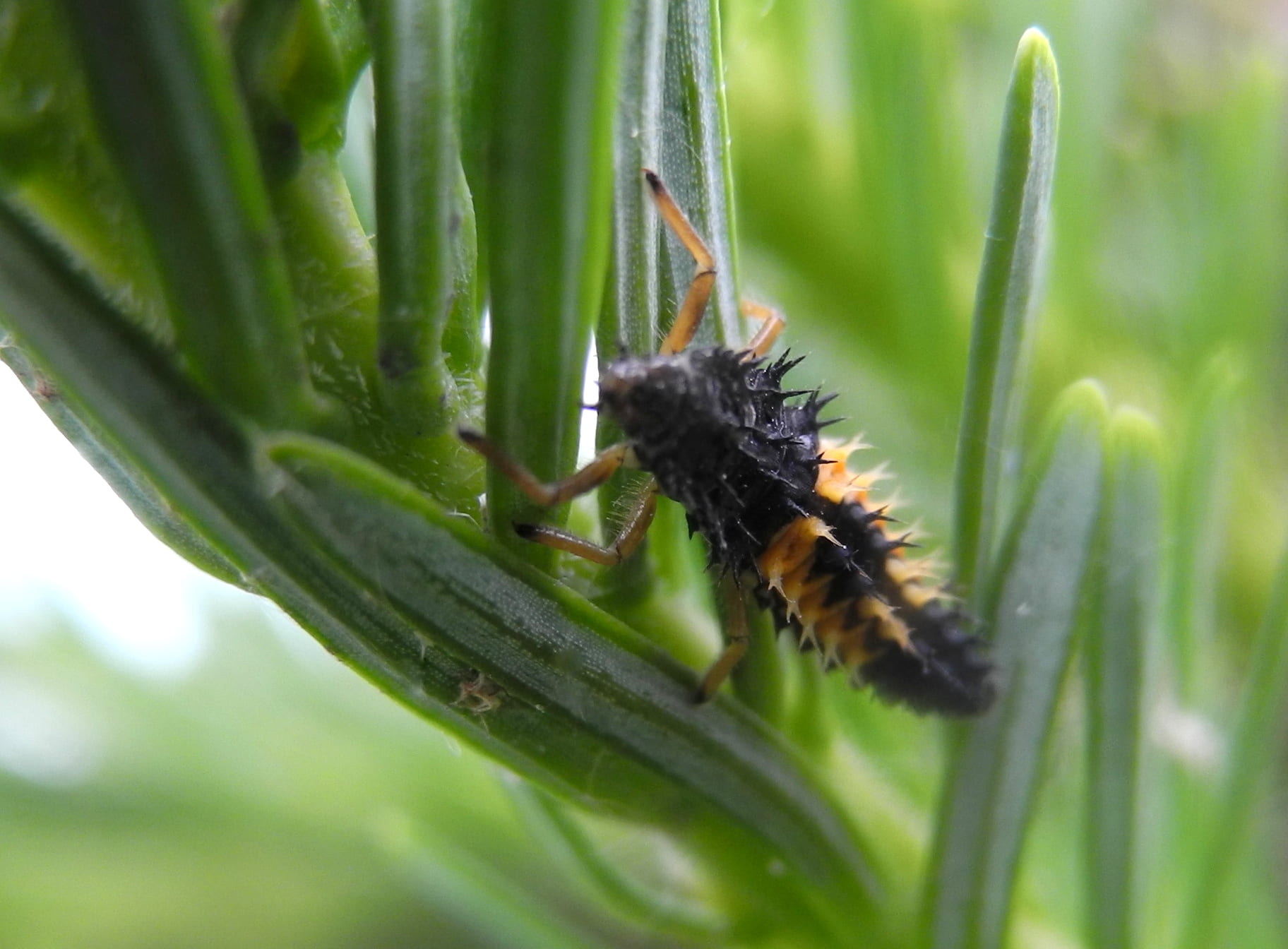
Data collection was performed with a standard 15-inch-diameter insect sweep net (Fig. 3). Participants swept the net a total of 10 times back and forth in a swinging motion while walking forward – each swing counting as one sweep – and at the end of the 10 sweeps, the number of insects in the net was recorded. In addition to PLH, participants also recorded seven types of predators that are known to feed on PLH and other insect pests. These included hoverfly larvae (Fig. 4), ladybugs and ladybug larvae (Fig. 5), lacewing larvae, damsel bugs, assassin bugs, minute pirate bugs, and spiders (including harvestmen, also known as daddy longlegs).

sweep net
Figure 3. Sweep net (Gemplers)
Hoverfly larva and aphids
Figure 4. Hoverfly larva feeding on an aphid (Kerri Wixted)
Ladybug larva
Figure 5. Ladybug larva (Cornell University)

This process was repeated for a total of three – five sets of sweeps, or 30-50 total sweeps per field. Fields were typically re-sampled weekly through the growing season, except immediately following harvest.

After counting the numbers of pests and predators and averaging those values across all sweeps, alfalfa height was recorded so that a determination could be made as to whether that field reached the threshold for management using the established economic thresholds (Table 1).

Results and Discussion

With four FFA chapters and one local youth group participating through the duration of the project, we were able to monitor PLH in 21 alfalfa fields on 13 farms in 5 counties over 12 weeks from June to August, when alfalfa crops are at highest risk of PLH and when producers are most likely to invest in insecticidal sprays to salvage yield.

Across all fields and sampling dates, 1,951 PLH and 1,291 insect predators were recorded (Table 2). This does not include many other insects that were also observed in our sweep nets, like horse flies, deer flies, bees, aphids, and parasitoid wasps. The two most common insects sampled were aphids and several species of parasitoid wasps. Aphid populations seldom reach damaging levels in alfalfa, and these species of wasp parasitize other insects, primarily aphids in this setting.

Table 2. Total PLH and selected predators observed across all fields and dates

table 2

Out of 126 sampling efforts, the action threshold was reached only 10 times (7.9%). Of those 10 times, applying a short-residual insecticide was the most economical management strategy in five cases, while early harvest was recommended the other five times. This meant that it was only economical to spray in 3.97% of cases. Only eight fields of the 21 monitored during the growing season reached threshold at least once (38% of fields). Five of those eight were fields where early harvest was recommended due to being within one week of planned harvest. Interestingly, of the three fields where sprays were recommended due to reaching threshold more than a week from harvest, two were in this situation more than once during the season (twice each). This means that only very few fields experienced consistently high PLH pressure. These fields will be monitored in 2024 to see if these trends continue, or whether 2023 was unique. Without question, PLH populations can vary wildly between growing seasons due to their migratory nature, so more observation will be needed to see how different fields experience PLH pressure over time.

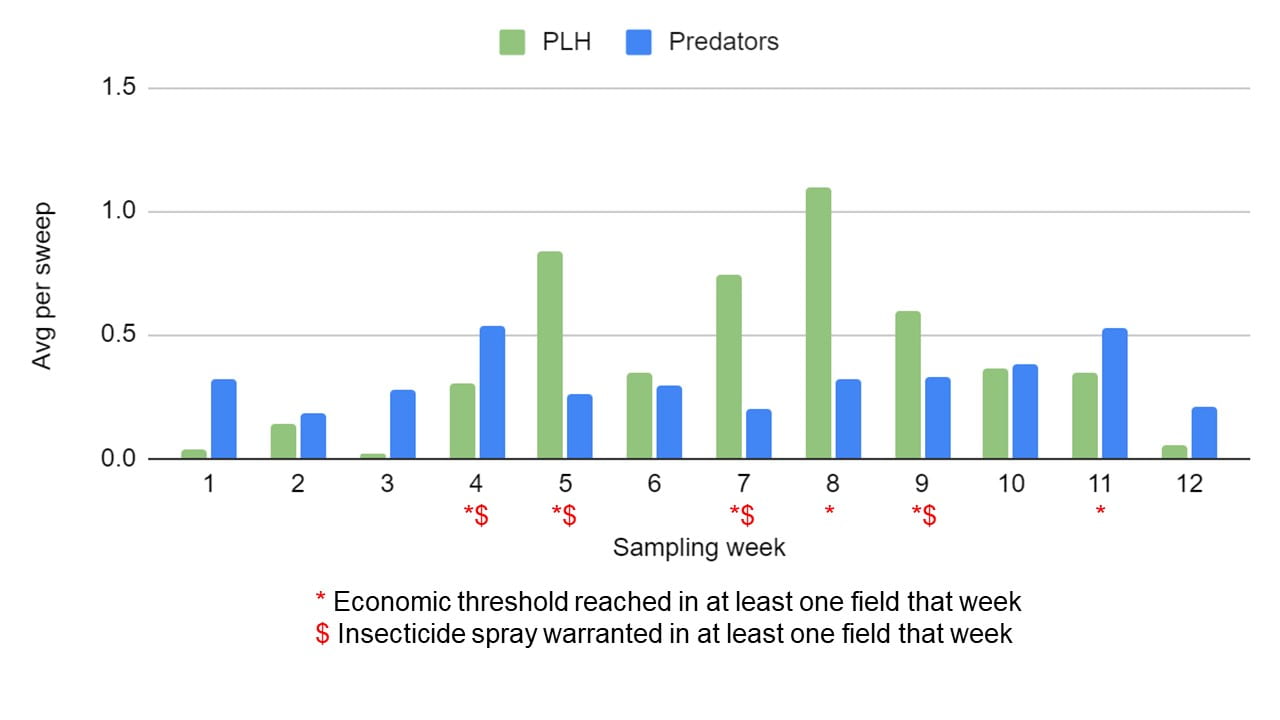
Predators outnumbered PLH in our sweeps until mid-July, and again after mid-August (Fig. 6). We know that the predators we recorded have been reported by others to feed on PLH, but we do not have a good understanding of how well they may be able to control PLH populations. But if they are, and if 2023 was a typical year for these species, there appears to be a period of about 5 weeks in the middle of summer that may be the highest risk for yield loss due to PLH infestation and potential yield loss. Alfalfa weevil is an important pest of alfalfa through late-June, and these predators may be exploiting this pest before PLH populations increase.

figure 6 bar graph
Figure 6. Insect population dynamics in Central NY alfalfa fields in 2023

Forage crops are unique because they are harvested multiple times per year, allowing for a partial reset of local pest populations with each harvest. But while the recommended short-residual sprays do not have extended activity directly, their effects can extend through the growing season if used incorrectly. Spraying without scouting to verify whether action thresholds have been reached, and spraying when pests are below economic thresholds not only wastes money in the short-term, but puts important insect diversity at risk. Not only non-target insects like pollinators, but also predators that may be feeding on PLH, alfalfa weevil, and aphids and preventing their populations from reducing forage yield and quality.

Potato leafhopper-resistant alfalfa varieties exist, and the economic thresholds of these varieties can be double, to nearly 10x the level of traditional alfalfa. If PLH-resistant varieties were used in this study, the economic threshold would have been reached no more than three times, all in different fields. For resistant varieties with economic thresholds higher than 3x the standard varieties, no fields in our study would have reached the economic threshold. However, farmers usually prioritize digestibility or other desired traits over pest resistance when choosing an alfalfa variety (these traits are not stackable with current varieties), so most alfalfa grown in NY is not PLH-resistant.

The partnership between CCE Chenango, the CNYDLFC regional team, and FFA chapters was instrumental to the project’s geographic reach and success. Through this partnership, young people in the community were able to aid farmers while learning about local agriculture, entomology, Integrated Pest Management, and the natural diversity that can be found on farms. While many of the young people involved with this project either lived on farms or were otherwise related to farmers, this was an enriching experience that gave them a better understanding of how crops are produced, and how farmers and CCE work together to make informed management decisions.

Additional Resources

Acknowledgments

This project was made possible by Chobani through the Chobani Community Impact Fund and relied on leadership and participation from the Central New York Dairy, Livestock, and Field Crops team; Cornell Cooperative Extension of Chenango County; high school members of the local Future Farmers of America chapters; and each landowner that generously allowed sweeping to occur on their fields. The authors thank Joe Lawrence (PRO-DAIRY) and Ken Wise (NYSIPM) for reviewing the article. For questions, contact Erik Smith, erik.smith@cornell.edu.