Looking good isn’t that easy — a short reflection on the tie workshop

Neckties and bowties are essential for a formal attire. People wear them on a wide variety of occasions, from social gatherings to professional events. The skill of tying a tie seems to be one of the necessary skills to master as an individual enters adulthood, but being able to tie well takes both time and efforts.

In the workshop last Thursday night, I learned to tie a tie with my GRF Ty. Learning to tie a necktie wasn’t that difficult, but I was surprised to see the numerous ways to do so. Some of the more complex methods produce a more symmetrical product with heightened aesthetics. Learning to tie a bowtie, on the other hand, was definitely a little more challenging. Although bowties are smaller, the steps involved in tying them are actually more than those for a necktie. The process of adjusting a bowtie after tied is also more difficult. However, I really liked the look of a bowtie. They give people a different feel and can make your formal attire more stylish. Many celebrities, including Adam Levine, Obama, and Cornell alum Bill Nye, love wearing bowtie. However, one thing to note about them is that, citing Business Insider, “bow ties don’t look nearly as cool loosened like regular ties.” So putting on a necktie might be a better option when you realized you only have 10 seconds to dress up before a formal party…

Matthew Morrison untied bow tie

A loose bowtie

Source:

https://www.businessinsider.com/when-to-wear-a-bow-tie-2014-8

A poignant Japanese coming-of-age story — A Spirited Away Review

I first watched Spirited Away when I was of Chihiro’s age about 10 years ago. My impression of it was nothing more than a fascinating story. But rewatching the animation yesterday had given me completely new perspectives and prompted me to reevaluate this animation.

I consider this animation a poignant Japanese coming-of-age story. Seeing Chihiro’s struggle to escape out of this unreal world and listening to the piano background music by Joe Hisaishi was full of bitterness. Overall, the plot of a 10-year-old girl, Chihiro, abandoning her childhood and growing up to face the reality in one day conveys to the audience some important coming-to-age messages.

Chihiro has to overcome the challenge of remembering her name at the bathhouse. Haku says to Chihiro in the beginning, “If she steals your name, you’ll never find your way home. I no longer remember mine. But it’s strange. I remembered yours.” Yubaba controls people by taking away their names, which are a symbolism of identity and childhood. In our real world, it is a struggle to maintain our identity too. Time is a one-way trip. Once you enter the adulthood or the next phase of your life, there is just no going back. That’s probably a major reason behind Haku’s warning to Chihiro at the very end in front of the tunnel. She said, “now go and don’t look back.” The world of spirits and the world of humans are distinct, just like our childhood and adulthood. Chihiro wants to escape the bathhouse at the beginning, but at the time of separation, leaving becomes a hard decision. Everything so close will become something so distant and out of reach — much like our fading memory of youth. When entering the tunnel for the first time, Chihiro’s mom says to her, “don’t cling like that, you’ll make me trip,” which is echoed by the exact same sentence as they are exiting the tunnel at the end. The first one is talking to a naughty kid, but the second one is more like talking to a much more mature teenager. Having to explore the world on her own turns Chihiro into a much more independent and sensitive individual.

Another coming-of-age aspect that I want to point out is the message regarding kindness. The film portrays greed as a bad human nature. Most employees at that the bathhouse are greedy — most evident by the frog’s desire for gold upon meeting No Face. Those greedy individuals were swallowed by No Face, and even Chihiro parents’ greed for food was punished by the metamorphosis into pigs. In contrast, Chihiro is kind. She is not lured by gold or food, she repays others’ kindness, and she values friendship. She chooses to save her parent amid impending danger and decides without any second thought to save Haku. The film chooses to reward Chihiro’s kindness with a happy ending, and Chihiro leaves the bathhouse as an upright person.

I wish I can say more about this film’s heavy influence by the Japanese Shinto religion and the period (economically and culturally), also Japanese cultural symbols such as the bathhouse, but I’ll leave that for other viewers of the film to consider due to the length of this post.

At last, I want to say to those who have only watched Spirited Away when they were a kid, “watch it again!” This animation’s depth of theme was far beyond what I thought.

I’d like to end this post with some excellent quotes from the animation thanks to My Anime List and Ranker.

“Play with me or I’ll break your arm.” – Boh
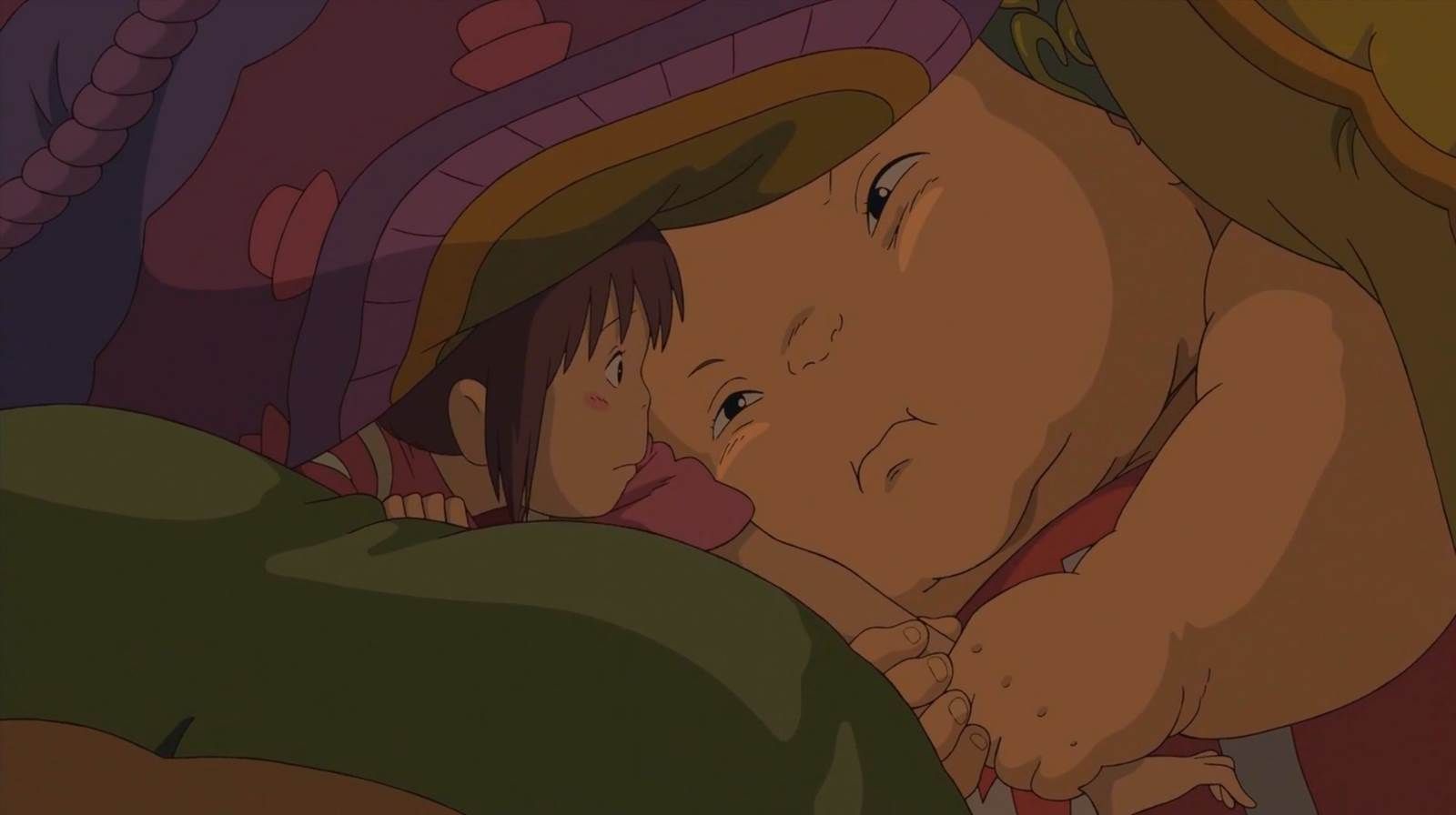
Sen to Chihiro no Kamikakushi, "Play with me or ill break your arm"


“Welcome the rich man, he’s hard for you to miss. His butt keeps getting bigger, so there’s plenty there to kiss!” – Aniyaku
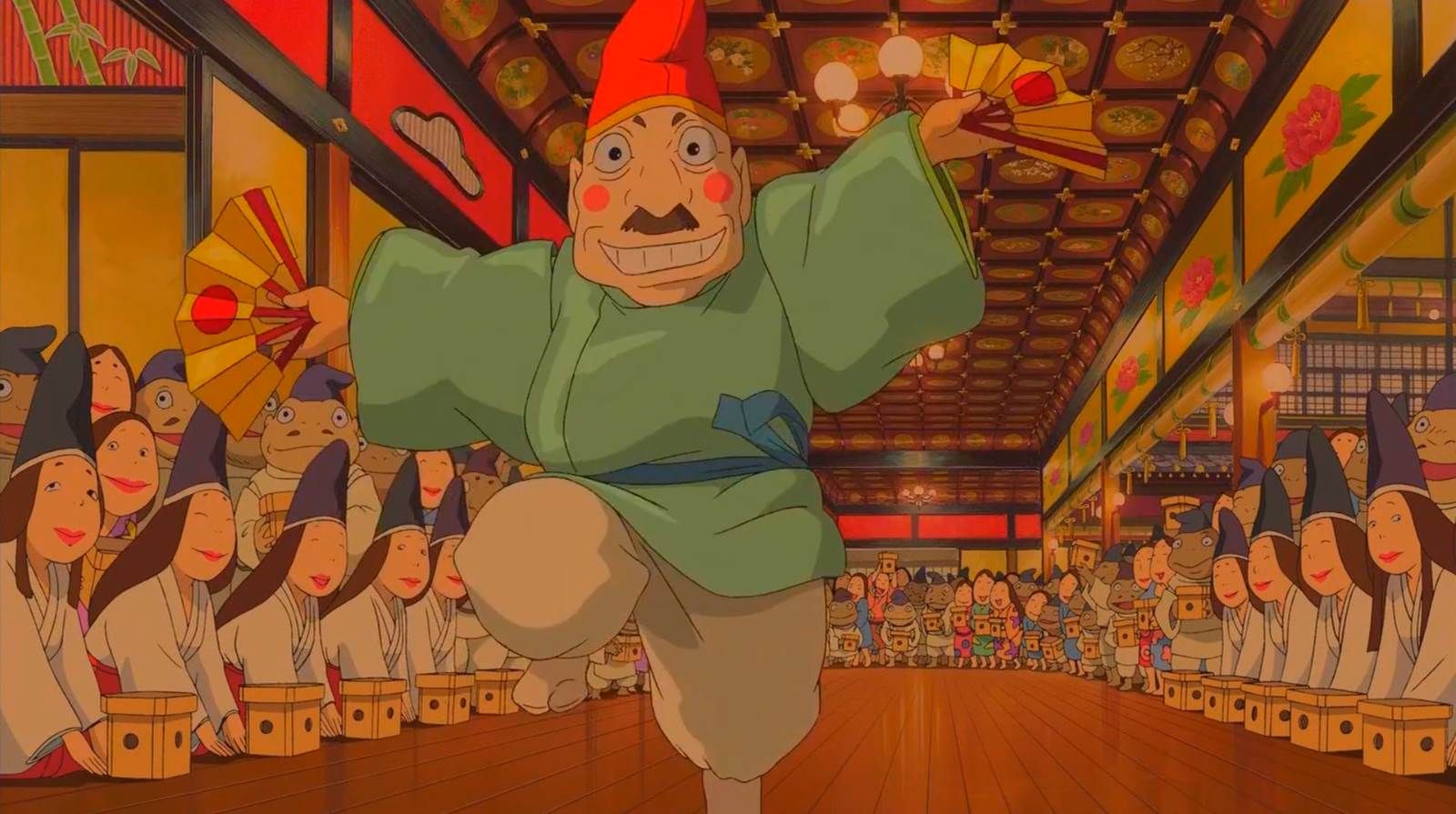
Sen to Chihiro no Kamikakushi, Rich man dance

“Chihiro, don’t cling like that, you’ll make me trip.” – Yuko Ogino

Sen to Chihiro no Kamikakushi, Chihiro clinging

“Once you’ve met someone you never really forget them. It just takes a while for your memories to return.” – Zeniba
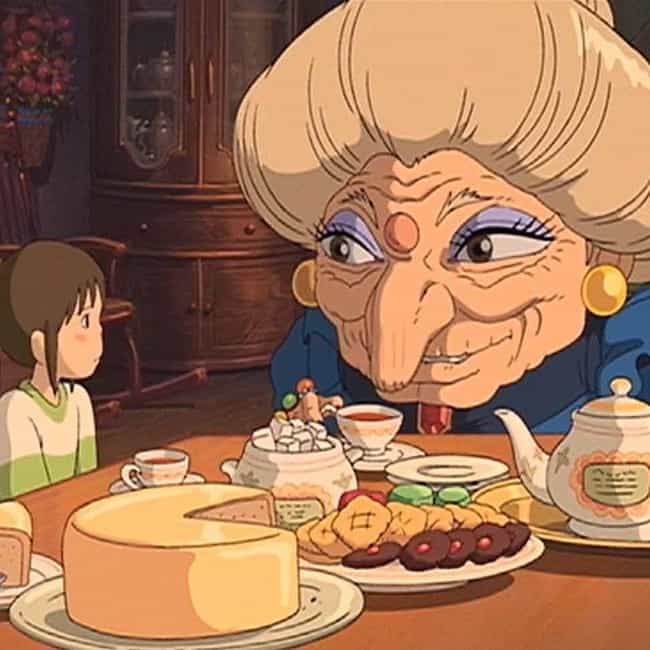
For Your Memories to Return is listed (or ranked) 1 on the list The Best Spirited Away Quotes

Pleasure, Virtue, and Expedience

You are lost in a forest. Mist surrounds you, and all you can see is two paths in front. They each have a sign besides it. One says pleasure, with small drawings underneath depicting extravagant material goods and unlimited wealth. The other only says virtue — the meaning of which is up to you to interpret. Which path would you choose?

Your conscience might be guiding you to choose virtue. We consider virtuous things to be morally correct, which means those things are for the greater good. Instead of solely benefiting an individual, they make the society better off. And rather than giving people short-term rewards, similar to planting a tree, they provide benefits in the long run.

Two thousand years ago, Roman philosopher Cicero explains good decision making with the term “expedience.” Expedient choices are the smart choices that actually benefit us. There are similarities in real expedient decisions. They are the choices that we won’t feel regretful when we look at ourselves in the mirror nor haunt us every day in bed. In one of Plato’s books there’s a story of the Ring of Gyges, a ring that empowers its owner to go invisible. Would you use the ring to conduct immoral behaviors? You can be invisible and steal wealth from anywhere you want, but it would not be an expedient choice if it makes you guilty for a lifetime. Expedient decisions are also those that focus on long-term benefits. In today’s society, we live in a global village. Any wrongful conducts can be broadcasted to the entire world through Facebook and Twitter. Doing things like bribery might give us momentary benefits, but they are not expedient at all because being tagged with those shameful labels are negatively life-changing.

It is pleasantly surprising how those ancient wisdoms are still applicable in today’s life. But although most virtuous conducts are still the expedient choice, the change in social values from a time period to the next one influences the meaning of virtue and expediency. Thus it is necessary for us to take into account of the time period when making decisions and analyzing choices.

A Billion Miles — One Telescope Away

Imagine hopping on the ultimate transportation vehicle — a space shuttle capable of carrying you at the speed of light. Everything zooms by you like a singular blur and the farthest place on earth is reachable at the blink of an eye. But traveling to Saturn would still take approximately one and a half hour. What if I tell you you can see Saturn — and its stunning ring and orbiting moons — right in front of your eyes without leaving Cornell? A telescope at Fuertes would be all you need.

Fuertes Observatory boasts a 12-inch refracting telescope that can easily magnify objects in the sky by 200 times. And more zooming can be achieved with a narrower lens at the cost of dimmer imaging. Perhaps the coolest part of this telescope is a spinning device located in the supporting structure. It is used for automatically rotating the telescope to match the rotation of the earth so that the telescope will always be aimed at the object of interest. From the telescope, Saturn looks like this: (this picture is from the internet, not the actual one I saw)

Image result for saturn from telescope

Now it’s time for some cool facts. Number 1, Saturn is massive! Both its volume and mass are 700 times of the earth’s! Number 2, Saturn’s ring is super thin! Believe it or not, it’s only 10 meters (32 feet) thick, meaning that you won’t even see the ring if you’re standing on one of Saturn’s moons! Number 3, Saturn’s ring is actually “dead” moons! Well, figuratively. When a moon gets too close to Saturn, it gets broken apart by Saturn’s gravity, becoming a part of the ring. Number 4, Mars might have a ring in the future! Mars might get a ring with its gravity just like its much-larger brother Saturn. But unfortunately, that would take 50 million years — nope, definitely not on my lifetime bucket list.

Looking Beyond Gorges

Ithaca is gorgeous. But did you know Ithaca is “historic” as well?

I went on a tour of Cascadilla Gorge today and was surprised by both the natural and historic transformations that have shaped the Cascadilla Gorge over the past centuries. A very long time ago, the entire Ithaca was underwater. Then platonic movements lifted the land up above sea level. The underwater period, together with erosion over time, has transformed the land into the one that we see today. The rock is actually a composition of hard sandstones and relatively softer materials like shale (that can be broken apart easily even by hand).

The the city of Ithaca began to form gradually thanks to its natural resources. People utilized the gorges for utilitarian reasons, building dams to generate power. The waterways also serve as important transportation paths before prior to the popularization of motorized vehicles. But later, as the main power source shifts to electricity, the gorges were transformed for recreation to become the beautiful park that we see today.

Picture vs You

Why do people take different pictures for different purposes? And what exactly do people want to convey with images?

According to Francis’ book The Focal Encyclopedia of Photography, portrait photography is a photograph that “captures the personality of the subject using effective lighting, backdrops, and poses.” (Francis 2007) But human’s personality is often too complex to be captured within a single picture: a lot of pictures just aim to capture what’s happening in an instant to convey something to the audience. Photographers might choose to just emphasize a specific aspect with a picture through the use of appropriate background and image composition. This Thursday, I got the opportunity to have a professional headshot taken at our mini-seminar and witnessed how professionalism can be conveyed.

Many elements are in play to make a portrait professional. First off, the use of a plain dark background. This background makes the subject stand out and gives the image a professional look. Secondly, the attire. Wearing a button-down shirt, or even better, a suit, enables the subject to impress the audience. Third, the camera distance and image composition. The headshot should only include the upper body and focus on the face of the subject. Last but not least, posture. The subject might choose to sit facing the camera or slightly sideways, but either way, the goal is to look elegant and pleasing to the eyes.

Pictures will never be the same as you. However, good pictures achieve their intended appeal to the target audience while giving an honest depiction of the subject.

Source:

Francis, Kathleen (2007). The Focal Encyclopedia of Photography. Focal Press. p. 341.

Change – A Sorry to Bother You Review

In today’s complicated society, humans are tempted to change themselves, or others, to achieve certain goals or meet social expectations. Sorry to Bother You (2018) implicitly explores this theme with a light-hearted touch of a comedy.

The main character, Cassius “Cash” Green, first changes himself when he is taught by a colleague that using a “white voice” would make his telemarketing much more effective. He starts using the fake voice to sound white to customers and very quickly makes his first success. This change of white voice brings him the vocal appeal of a professional white telemarketer and meets the telemarketing social expectations. Although this first change is mainly due to curiosity, little does he know that this change will bring more changes and get him addicted to changing like a first snort of cocaine.

He gets promoted to a Power Caller. It seems like everything is going well, but a change even bigger than the first one is taking place deep inside his heart. Required to wear a suit and use the white voice at all times during work, his personality and morals are changing. But changes do not always bring positive outcomes. Cannot resist the temptation of money and his richer-than-ever material life, he abandons his picketing friend and even lets the relationship with his girlfriend, Detroit, deteriorates. He begins to unconsciously talk in the white voice at home, to which Detroit strongly resists, and loses his temper with her. Feeling hopeless, Detroit angrily expresses that she does not like the change at all — she loves the old him. The change of personality and morals builds upon changes as small as individual behaviors, but as a whole is a much bigger deal. This reminds me of a song by Alec Benjamin called If I Killed Someone For You. “Would you love me more | If I killed someone for you?” Just as the song expresses, in some sense, changing your heart is like killing the old you. We might hope “that makes you (the one we change for) happy” But similar to killing a person, if we change ourselves so drastically, “there’s just no turning back.”

Approaching the end of the film, the biggest change is uncovered. The company WorryFree is changing humans to half-horses, referred to as “equisapiens,” to increase productivity. This change is a serious threat to human civilization and a fundamental betrayal to healthy morals. Here Cassius Green finally makes the right choice of refusing the astronomical sum of money and reporting the issue before he is changed into an equisapien himself. The movie comes to an end with him charging into the CEO’s residence accompanied by his peer equisapiens. The ending is open and a little unexpected, leaving the audience with endless imaginations…

The Art of Visual and Audio Storytelling —— Mini-Seminar & Movie Night

Books have existed for a long time. Parchment and scrolls might be considered some of the earliest forms of books, and paper can date back to Cai Lun’s invention in 105CE (ARRIETA-MERAZ). Since then, books had been the main medium of storytelling besides face-to-face ones. But the birth of camera, and afterwards, Hollywood, has revolutionized storytelling. Being able to watch and hear a story unfold right in front of you on screen has dramatically changed the way we perceive a story.


In a mini-seminar about writing a blog post, Mr. Godowski challenged us to delve into the subtleties of films (and videos in general). What makes visual storytelling appealing? The analysis of a car commercial has shown that mise-en-scene, soundtrack, cinematography, and edits contribute greatly to the power of videos. By depicting stories from well-chosen perspectives (cinematography and mise-en-scene) and using appropriate soundtracks, directors are able to connect with their audience and create strong emotional effects. This is especially important to commercials: persuading potential customers to make purchases in 15 seconds is not easy without impressive stories.  For movies, it can be even more important, one of the reasons is that movies usually have bigger themes.


At this Friday Movie Night, we watched a musical called Rent (2005). This musical is centered around several important topics, including sexuality, poverty, and the impact of AIDS and drugs. Musicals require truly ingenious designs as everything shall be conveyed through singing, acting, and very few lines of dialogue. In this particular movie, the lighting was very well chosen. Overhead and side lighting highlights the main characters’ facial expressions, while relatively dimly-lit background leaves out unimportant details. The actors’ performance was also great. Their singing conveyed emotion through pitch, volume and tempo, while their body gestures add on to the storytelling effect. It is indeed through the uniqueness of visual and audio storytelling — mise-en-scene and soundtrack — that Rent is able to tell such a deep story in a single musical.


Sources:

ARRIETA-MERAZ, JOSSELYN. “Cai Lun: The Chinese Inventor of Paper.” StMU History Media, 27 Oct. 2017, https://stmuhistorymedia.org/cai-lun-the-chinese-inventor-of-paper/.