
People in Cambodia use dance to show the divine power, celebrate the social events, and create laughter in daily life. Cambodian dance can be divided into three different categories: Khmer Classical Dance, Folk Dance, and Vernacular Dance.
Khmer Classical Dance:
This form of dance is also known by a name in English called “Royal Ballet of Cambodia”, and it is listed in UNESCO’s Masterpieces of the Oral and Intangible Heritage of Humanity in 2008. This dance was performed only for royalty meaning the “dances of royal wealth”.

Khmer classical dance is believed to derive from Indian court dance, which traces its origins to the apsaras(see pic1) of Hindu mythology, heavenly female nymphs who were born to dance for the gods. The traditions of Thailand and Java (in Indonesia) also influenced the music and dance of Cambodia.
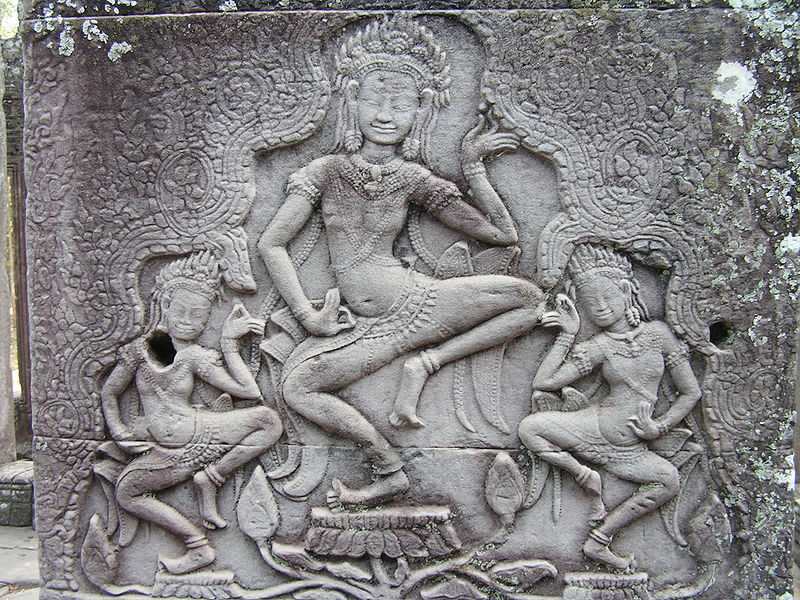
Pic1: Depiction of apsaras dancing, Temple Bayon, 12th century, in the city of Angkor Thom
Over the history of Cambodia, role of Royal Palace’s dancers have become symbols of the King’s prestige. After the signing of the 1863 Protectorate Treaty, the French, who among many other things controlled the country’s finances, tried to reduce the number of palace dancers in order to lessen the King’s prestige. In the 1930s, the French subsidized the private troupe of Princess Wongat Say Sangvann, which performed for tourists, calling it the “one and only true” troupe. But after King Norodom Sihanouk acceded to the throne in 1941, his mother Queen Sisowath Kossamak found ways to reestablish the royal troupe’s ascendancy. In support of her son, Queen Kossamak transformed performances so that the royal troupe could best serve Cambodia’s image nationally and abroad. She shortened the length of the dance programs, had pure dance pieces followed by dramatic or comic works, and added musical interludes.
However, the tradition of dance, last for over a millennium, was almost lost in the Cambodian genocide, when the Khmer Rouge targeted those involved in the dance and “imposed a massive cultural forgetting”. Khmer classical dance suffered a huge blow during the Khmer Rouge regime when many dancers were killed because classical dance was thought as of an aristocratic institution. Although 90 percent of all Cambodian classical artists perished between 1975 and 1979 after the fall of the Khmer Rouge, those who did survive wandered out from hiding, found one another, and formed “colonies” in order to revive their sacred traditions.*
*(Reference: Earth in Flower – The Divine Mystery of the Cambodian Dance Drama by Paul Cravath)
Khmer classical dancers use silent movements and gestures to tell a story. Dancers do not speak or sing; they dance with a slight smile and never open their mouths.(see pic2) Khmer classical dance can be compared to French ballet in that it requires years of practice and stretching at a young age so the limbs become very flexible.

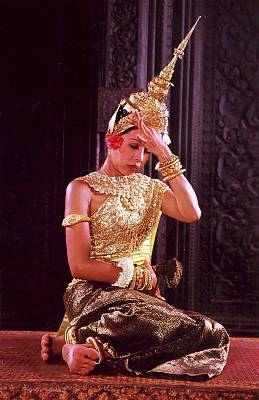
Pic 2:silent movement
In classical Cambodian dance, women, dressed in brightly colored costumes with elaborate headdresses (also see pic2), perform slow, graceful movements accompanied by a percussive ensemble known as the pinpeat. Pinpeat orchestras include drums, gongs, and bamboo xylophones. (see pic3)

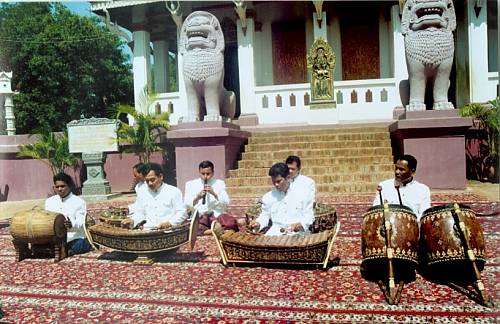
Pic3: Pinpeat orchestras
The way Khmer classical dance communicate with audience is very complicated. Different position of the arm and the position of the hand relative to the arm can also express different meaning. Besides hand gestures are gestures which are more specific to their meaning, such as that which is used to represent laughing or flying. These other gestures are performed in different manners depending on which type of character is played.

In addition to the renowned graceful hand gesture(see pic4) and stunning costumes, the Khmer Classical Dance, has been closely associated with the Khmer court for over one thousand years. Performances would traditionally accompany royal ceremonies and observances such as coronations, marriages, funerals or Khmer holidays. This art form is highly cherished by many Cambodians.
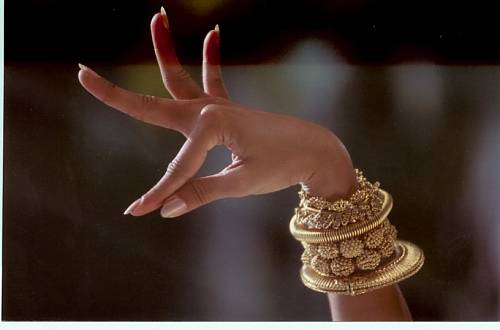
Pic4: hand gesture of Khmer Classical Dance
Infused with a sacred and symbolic role, the dance embodies the traditional values of refinement, respect and spirituality. Its repertory perpetuates the legends associated with the origins of the Khmer people. Consequently, Cambodians have long esteemed this tradition as the emblem of Khmer culture. Four distinct character types exist in the classical repertory: Neang (woman), Neayrong ( man), Yeak (giant), and Sva (monkey). Each possesses distinctive colours, costumes, makeup and masks. An orchestra accompanies the dance, and a female chorus provides a running commentary on the plot, highlighting the emotions mimed by the dancers, who were considered the kings’ messengers to the gods and to the ancestors.
Classical Cambodian Ballet: Apsara
Folk dance:
Folk dances play a role of performing art to entertain the audience. Khmer folk are fast-paced, and the movements and gestures are not as stylized as Khmer classical dance. Folk dances mostly are about love or the story about animals. The dancers wear costumes that portray ordinary people character, such as farmers, peasants, and tribe leaders. The elements of folk dance diversify profoundly by different area and local cultures. The most famous of all, Robam Trot, is mainly performed during the Cambodian New Year. The Dance got its history along a legend about a hunter and deer.
Vernacular dance:
In Cambodia, vernacular dance (or social dance) is the dance performed at social gatherings. Some of these dances are heavily influenced by the traditional dances of Laos. But rom kbach, for example, take heavily from the classical dance of the royal court. Rom kbach is a simple dance which uses hand gesture similar to that of classical dance and rom kbach song also utilize the melodies of classical dance songs and combine them with traditional Khmer and Western instruments.
Other social dances from around the world have had an impact on Cambodian social cultures include the Cha-Cha,Bolero, and the Madison. Such dances are often performed at Cambodian wedding receptions and banquets.
Yosuke and Tan-Chi
Ahaa, its nice dialogue on the topic of this paragraph at
this place at this webpage, I have read all that, so at this time me also commenting at this
place.
my website; FSH file recovery
This is a very interesting and informative article. The way Cambodian dance and culture are explained makes it easy to understand its importance and history. I enjoyed reading about the traditional expressions and cultural value behind the performances. Thank you for sharing such meaningful content.
Great insights shared here. I picked up a few new points that I hadn’t considered before.
1win প্রোমো কোড কি 2026
Mastering Fabric Expertise: Training, Skills, and the Future of Textile Professionals
In the world of fashion, design, and textiles, understanding fabric is far more than just recognizing a cloth by its colour or feel. A true fabric expert possesses deep knowledge of fibres, weave structures, fabric behaviour, production methods, and quality standards. This level of mastery not only elevates creativity, but is a cornerstone of innovation and success in apparel, home textiles, technical fabrics, and beyond.
Why Fabric Expertise Matters
Fabric is the foundation of every garment and textile product. Its properties influence comfort, durability, appearance, manufacturing efficiency, and sustainability. Choosing the right fabric for a design impacts not just aesthetics, but functionality — from moisture management in sportswear to drape and texture in couture fashion. Skilled professionals who can assess and select fabrics with confidence are indispensable in today’s competitive textile and fashion industries.
ScienceDirect
Additionally, the global textile industry is evolving with technological advancements. Smart fabrics, sustainable materials, and automated production are transforming how we think about textiles. Professionals trained in fabric science and technology are better positioned to contribute meaningfully to these innovations.
Garments Educations
Core Components of Fabric Expert Training
Becoming a fabric expert isn’t limited to feeling textiles in a store. Structured training programs bridge the gap between intuition and technical knowledge. Here are the core areas typically covered:
1. Fibre and Material Fundamentals
A foundation in identifying natural and synthetic fibres — such as cotton, wool, silk, polyester, and technical yarns — is essential. Learning fibre characteristics helps determine how a fabric will perform once manufactured.
Textile Institute
2. Fabric Construction Techniques
Understanding how fabrics are made — whether woven, knitted, or non-woven — deepens insight into properties like strength, elasticity, breathability, and appearance. Many training courses dive into weaving patterns, knitting styles, and finishing processes that define fabric behavior.
Textile Institute
3. Dyeing, Printing, and Finishing
Colour application and surface treatments dramatically change how fabrics look and feel. Practical knowledge of these processes enables experts to guide production decisions, ensure quality control, and anticipate how fabrics will react to processing and wear.
Netskill
4. Testing and Quality Assessment
Quality control is a key skill in professional fabric expertise. Trained specialists learn to apply standardized tests for strength, durability, shrinkage, colour fastness, and more — skills that are critical for manufacturers and designers alike.
GSDC India
Types of Fabric Expert Training
Training programs range from intensive short-form workshops to certification courses that provide industry credentials. For example, textile institutes offer focused “Fabric Knowledge Courses” that teach fabric construction, performance evaluation, and end-use suitability in a single day, ideal for designers and product developers.
Textile Institute
Longer professional programs such as Certified Textile Technologist or Textile Engineering courses dive deeper into production processes, quality systems, machinery, and advanced textiles technology — equipping learners with comprehensive industry competence.
GSDC India
How Training Shapes Your Career
Professionals with fabric expertise work in diverse roles:
Fashion Designers & Buyers — making informed material selections that enhance design quality.
Product Developers & Merchandisers — ensuring fabric choices meet performance and cost targets.
Textile Technologists & Lab Professionals — conducting tests to maintain quality and compliance.
Manufacturing & Sourcing Experts — managing supply chains and production workflows based on fabric properties.
Such skill sets not only increase employability but drive innovation and sustainability within the textile sector.
ccvte.org
A Final Thread
Like any art or craft, mastering textiles requires passion, curiosity, and structured learning. Whether you’re a fashion student, a manufacturing professional, or an entrepreneur aiming to start your own apparel brand, fabric expert training lays the groundwork for deeper understanding and greater industry impact. Investing in solid training today equips you to navigate tomorrow’s trends, technologies, and textile-centric challenges with confidence and clarity.
I appreciate the effort you put into researching this topic. It definitely shows in the quality.
promo code for 1win 2026
“This can be in addition a great article i genuinely liked looking at. It’s not at all every day i contain the probability to view a thing.
” سایت دنس بت
Very informative post. It answered some questions I’ve had for a while.
1win welcome bonus promo code
Thanks for sharing such useful information in a simple and easy-to-understand way.
1win apk promo code
This content is refreshing and practical. Looking forward to reading more posts like this.
1win promo code today
Nicely structured article. Each section connects well and keeps the reader engaged.
1xbet অফিসিয়াল প্রোমো কোড 2026
I learn some new stuff from it too, thanks for sharing your information. online casino game provider
Really enjoyed reading this! The way you explained the topic made it easy to understand and engaging from start to finish.
CryptoDaily101
this post just did a brain-dive into my thoughts and resurfaced with a glittering pearl of perspective! 🌟 I never looked at it that way, and now my coffee tastes smarter. Seriously, bookmarking this for when I need a little mental jazz. Keep these gems coming!
online sportsbook
Okay… I came for the info but stayed for the vibes. This post somehow feels like a high-five to my brain—unexpected, slightly messy, but totally satisfying. Can’t wait to see what mental rollercoaster you take us on next!”
crypto betting sites