ROAD TRIP IMPRESSIONS
Summer 2012
*

The ‘Sultanistic” authoritarian regimes and tyrants have fallen in Tunisia, Egypt, and Libya but the euphoria and revolutionary enthusiasm generated in the first few months are now almost obsolete. The political and security scene in the three countries is still in flux, often chaotic and more confusing than ever.

“We do not forgive … do not forget … expect us … ♥one love … one ‘shaab’♥ [people]” –-graffiti on a provincial school wall.
After the initial shock people are open to change, longing for social peace and stability—with whatever elements of society that are still functional, even if it’s the military or Islamists. There are major challenges: conceiving a new political and institutional framework; engineering new constitutions to formalize democratic governments; and holding parliamentary, presidential and local elections. These processes are underway in all three countries.
Islamists of both moderate and extremist persuasions are now vying for political power either at the ballot box or by other means—not necessarily peaceful ones. Some clearly hope to introduce Sharia religious law into the political system and enshrine it in the new constitutions. The rights of women, religious minorities, and all sorts of freedoms will accordingly suffer if there are not countervailing guarantees.
Only a few days after the overthrow of the Tunisian regime, self-appointed morality police turned up in the Tunis red-light district, where they threw Molotov cocktails into the brothels and threatened the women. In March 2012 a Salafist militant removed the Tunisian flag and raised the Jihadists’ black flag at the Manouba University near Tunis. A confrontation ensued that triggered the suspension of courses for weeks. A few weeks ago, a group of Salafists stormed an exhibition called “Spring of the Arts.” The rampage was triggered by a picture in which ants formed the words “Praise to God.”

A Salafist slogan on a mosque’s outer wall calling for restoration of the caliphate خلافة as system of government.
The Salafist groups have been emboldened by the passive reaction of the security services to stop them from intimidating and attacking anyone and anything they deem “un-Islamic.”

In Egypt, political Islam emerged strengthened from a revolution in which it played no part. The Muslim Brotherhood and the radical Salafists won the country’s first free parliamentary election. The Egyptian constitutional court, however, declared the parliamentary election to be invalid, and the military council curtailed the authority of the president even before the Muslim Brotherhood’s candidate came into office, ultimately rendering him a mostly powerless figure.
The real message behind the recent Egyptian election is that the old regime / establishment is alive and well, but that the country is also deeply polarized. The road ahead looks increasingly hazardous and the outcome of any future political dynamic seems unknown.

 In Libya, the legacy Gadhafi left behind doesn’t even resemble a workable state, with no political or civic institutions to speak of. The country’s July elections for a constitutional assembly, which will appoint a new interim government and a panel charged with drafting a new constitution surprisingly resulted in a resounding defeat for the political wing of Libya’s Muslim Brotherhood, bucking a trend of success for Islamist groups in other Arab Spring countries such as Egypt and Tunisia. A moderate National Forces Alliance scored a landslide victory over rival Islamist parties. (The quasi-parliament will convene for 18 months and will have two goals: to appoint a prime minister and a 60-member commission to draft a constitution).
However, the country remains very chaotic and the provisional central government has limited powers. In early June, an armed brigade occupied the airport in the capital Tripoli, and a few days later another militia arrested employees of the International Criminal Court. They had visited the former dictator’s son, Saif al-Islam Gadhafi, who has been jailed in the provincial city of Zintan since November — one of more than 4,000 Libyans being held prisoner by militias throughout the country.
*
Street art in Western Libya


Gadhafi asked his notorious “Who are you?” in one of his most frightening speeches in February 2011 addressed to his people. The Libyan’s responds, above, “we’ve been your tenants for the last 42 years.”
“Who are you?” [“Man antom?”] became a slogan during the Libyan Revolution; it’s equivalent to ‘Irhal’ which means “Go” or “Leave” chanted in other Arab Spring countries. Turned against Gadhafi by the people, “Who are you?” became a most famous revolutionary slogan along with “Jainag” which means “We are coming to get you.”
!“شبر شبر- بيت بيت- دار دار- زنقا زنقا- فرد فرد”
[Early in the uprising, Gaddafi threatened those who opposed him to pursue and fight them ‘inch by inch, house by house, alley by alley [zanga zanga] … A tautology that worked at his own expense in the end.]
*
The country consists of three regions: Tripolitania in the west, Cyrenaica in the east and Fezzan in the south. The politicians in the east feel underrepresented and are calling for a confederacy (a loose federal system with substantive independent decision powers for the three regions). Last week, a convoy of jeeps carrying anti-aircraft guns blocked the coastal road between Tripoli and Benghazi. In the absence of any kind of a national military or police force, local militias and armed gangs have run amok in Libya’s cities, towns and villages. Strong separatist forces are also at play. Libya risks being torn apart by longstanding regional and tribal rivalries and by those who oppose even a return to the loose federal arrangement of the 1950s before Gadhafi seized power.

Traditional dancers in the town of Nalut in the western Nafusa mountain region. Notice the Amazigh flag held by the top dancer and the absence of the Libyan national flag

The Amazigh (Berber) flag
*
In all three Arab Spring countries, halfway between first landmark elections and the next round of voting early next year, the political scene is fractured, security is far from normal, social dissatisfaction widespread and fear of Islamists domination overshadows many sectors of society.
————
FOOTNOTES
*‘Saved by Philosophy’
The event that triggered the cascading uprisings of the Arab Spring was when a street vendor persecuted for selling fruit without a license set himself on fire and died. More than a year and a half later little has changed in Tunisia’s law enforcement practices. In early July, a widely reported case captured the news headlines for its eerie similarities to the original event. The ‘perpetrator’ was accused of unauthorized street peddling of goods (“exposait sa marchandise d’une manière anarchique!”) Appearing before a judge he pleaded guilty, declaring that indeed he’s not licensed but his social condition did not leave him much choice; he was a third-year philosophy student from a poor family and had no other means to make a living. The judge, in an attempt to gauge his truthfulness, focused his questioning of the student on his putative study major and asked him many pointed questions about philosophy and major contemporary philosophers. The student answered brilliantly. At the end the judge inquired about the student’s current predicament and what philosophical context would it fit. Without hesitation came the answer: “Les misérables of Victor Hugo.” Verdict : a fine of five Dollars and 50 cents and return of all his marchandise to the student. After the Tunisian revolution, there’s little doubt that democratic practices and individual freedoms have changed the country beyond recognition. But much else is still the same : Civil, penal and criminal codes date back decades and so are law enforcement practices and ethics.
Sauvé par la philo / Journal Le temps [Archive Dimanche 15 juillet 2012]
Un jeune, la trentaine, a comparu devant le juge du tribunal cantonal de Tunis. Il est accusé d’avoir enfreint à la loi.
Etant marchand ambulant, il exposait sa marchandise d’une manière anarchique dans les artères de la capitale.
Interrogé par le juge, il a déclaré que ce n’est pas son métier mais ses conditions sociales l’ont obligé à l’exercer. Après le décès de son père, son frère aîné s’est marié et a quitté le domicile parental pour vivre avec son épouse. Il a déclaré qu’il est universitaire étudiant en 3ème année Philo et qu’il n’a aucun autre moyen pour continuer ses études et subvenir en même temps à ses besoins.
Le juge a fait preuve d’attention particulière aux déclarations de l’inculpé. Il lui a posé plusieurs questions concernant le domaine de la philosophie et les écrivains contemporains. L’étudiant a brillamment répondu à toutes les questions. La dernière question posée par le juge était sur sa situation actuelle et dans quel cadre philosophique peut-il la placer : l’étudiant a répondu sans aucune réflexion : Les misérables de Victor Hugo.
Dès la fin de l’interrogatoire le juge a annoncé le verdict : Une amende de 9 Dinars et restitution de toue la marchandise qui a été saisie à l’inculpé
A.A
Journal Le temps – – Sauvé par la philo.
FOLLOW-UP:
Man immolates himself in Arab Spring reprise
World A young cigarette vendor set himself on fire in Tunis yesterday, reviving memories of similar events two years ago that sparked an uprising which spread across the Arab world. [GRAPHIC!]
—————————————————–
*Judging People by Their License Plates
In post-Gadhafi Libya, total chaos rules all aspects of life; there’s of course no constitution and no laws governing the country to speak of. A typical example of lawlessness is a phenomenon you notice on Libyan car license plates. For decades during Gadhafi’s rule all plates read the same: “al-Jamahiriyah;” followed by a combination of numbers. (الجماهيرية, al-Jamahiriyah, or, the state of the masses, is a Gadhafi’s invention and a much controversial and hated term discussed in some detail in his Green Book.)

After the Revolution, you see now three kinds of plates: the old ones reading “al-Jamahiriyah” often identifying the owner as a Gadhafi (old system) supporter; the same “al-Jamahiriyah” but smudged, defaced, or painted over; and new ones reading simply Libya.

There’s no new law in the country regulating car or driver’s licensing. So, practically, you can write what you want on your car’s plate, often reflecting your regional, sectarian, political and ideological view point.





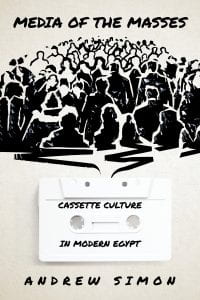 “Media of the Masses” investigates the social life of an everyday technology—the cassette tape—to offer a multisensory history of modern Egypt. Over the 1970s and 1980s, cassettes became a ubiquitous presence in Egyptian homes and stores. Audiocassette technology gave an opening to ordinary individuals, from singers to smugglers, to challenge state-controlled Egyptian media. Enabling an unprecedented number of people to participate in the creation of culture and circulation of content, cassette players and tapes soon informed broader cultural, political, and economic developments and defined “modern” Egyptian households.
 . He is Lecturer and Research Associate in Middle Eastern Studies at Dartmouth College.