


Watch out Big Apple and northern New Jersey. It looks like the viburnum leaf beetles (VLBs) are headed your way, if they’re not already in your neighborhood. Here’s what you can expect when larvae hatch in spring:
John Jordan, Natural Resources Supervisor at Prospect Park Alliance has found evidence of the beetle there, and says that there was a confirmed report on North Brother Island (between Manhattan and Queens) last year. VLBs are suspected to be in some of the larger parks in the Bronx, northern Manhattan and northern Queens. Native plant enthusiast William Wyman has recorded damage in Delaware Township Hunterdon County, N.J., 70 miles west, and they’ve also been spotted in Putnam County, N.Y., 60 miles north.
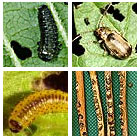 The viburnum leaf beetle, Pyrrhalta viburni (Paykull), is an invasive, non-native beetle that first appeared in New York along Lake Ontario in 1996, and has steadily spread across the state and down the Hudson Valley. It is a voracious eater that can defoliate viburnum shrubs entirely. Plants may die after two or three years of heavy infestation, particularly when larvae strip plants after hatching out in spring followed by heavy adult feeding later in summer.
For more information on identifying VLBs at all life stages, steps you can take to manage them and choosing resistant viburnums, visit the Cornell’s Viburnum Leaf Beetle website.
Metro area and New Jersey readers: If you spot VLBs in your area, please tell us where in the comments.
View more videos:
I sprayed my V.pragense and actually cut the plants in half. I hand picked what larvae I could find, and new growth is appearing on all 3. It is a wait and see. I live in Johnstown, Pa.
Prospect Park, Brooklyn, Kings Co. NY: On Sunday 6/8, I found skeletonized Viburnum leaves along path west of the East Drive between Nellie’s Lawn/Long Meadow. Pretty serious damage.
I live in Grey County, Ontario. this is the first year that I have had the viburnum leaf beetle on our highbush cranberry. I was out of town for work, and came home to find that they have all been completely defoliated in the span of 6 days. Not sure what to do now.
I live in northwestern Bergen County, N.J. I have severe VLB damage to my Arrowwood Viburnums. Total defoliation on 3 out of 5 shrubs and severe damage on the others. First noticed May 25, 2014, but damage was severe by then. No damage to my Witherod, Blackhaw, Doublefiles or Willowwood so far.By the way, I did notice some damage on the Arrowwood last spring but foolishly took no action. June 10, 2014 I had imidicloprid applied to the soil around the Arrowwoods. I will prune egg sacs off this fall. Spending the word through Facebook. Thanks for your helpful control info.
.
I have a viburnum bush and it has been infested with the viburnum leaf beetle. It started last summer
and is worse this year. It seems the birds have eaten the caterpillar stage. I will look for eggs.
What can I do to stop this.
I have two viburnums, V. dentatum and V. trilobum, in my yard in Essex county NJ that have been almost decimated by the Viburnum leaf beetle over the past 2 seasons.
Interestingly, I had another dentatum on another part of the property that was untouched.
Are you also interested in VLB south of NJ? We’ve an infestation of larvae on our Viburnum trilobum in New Market, MD 21774.
I live in Oyster Bay and have had V. B. For three or four years. I totally lost five arrow wood. Not pleased about the influx.
I have two viburnum dentatums in Maplewood, NJ, Essex County bordering Union County, that are infested with the larvae of the viburnum leaf beetle. Both were bought last spring from a nursery more than an hour south in central New Jersey.
I used Captain Jacks and so far it has worked. After a rain I reapply.
I live in Syracuse, NY and have 7 Viburnums on my property. Unfortunately they are ALL in the Most Susceptible Catagory to this bug. My Blue Muffin Arrowood is totally infested & I’m trying to solve that problem now.
🙁
Royal Oak, Michigan. (suburb of Detroit) Planted two viburnum in fall ’13. By this time both last year and this, leaves are totally laced. Did not know what to look for until Detroit News columnist posted about this problem and your website.
Address is 68 Southern Lane, Warwick, NY 10990-1915
I had three Maple Leaf Viburnum, now two, and three tomentosums – two of which are branch to branch with the surviving Maple Leafs. My father, James Lynn Hoard, late Professor Emeritus of Chemistry at Cornell and a stickler for correctness, suggested lantanu (sp, for sure, he never “spelled it out” for me) for the Maple Leaf.
An isolated ML on the south east corner of my house was destroyed by what I would guess as two or more years of attack by the MLVB {my shortening of the maple leaf viburnum beetle}. The two MLs [each is infected] on opposite ends of my east-west driveway are separated by two tomentosums {the 3rd t is remote from the other viburnums and, as yet [with the other 2 ts] seem(s) untouched}.
I’ve cut away the dead plant and sprayed the remaining two with Sevin. I’ve been too busy to hew away the obviously infected branches.
I am fighting it on my 2 arrowwoods at home (Chaplin, CT). I was disheartened to discover a tremendous amount of damage to numerous wild growing arrowwoods at a land preserve in South Windsor, CT that I take my students to. This is an area already under great pressure from invasive plant species. Losing the viburnums will be costly to this habitat.
Diane, I also used Captain Jacks and it seems to be working. Not sure how frequently to reapply.
May 20. 2015
I am finding Viburnum leaf beetle in my neighborhood, along Scofield Road, Pound Ridge, NY 10576. I noticed leaf damage last summer. During the winter I scouted for eggs and now I am seeing the larva on the leaves.
I HAVE AN ARROW WOOD VIBURNUN AND YESTERDAY MAY 19TH SAW THAT THE BEETLE IN ITS LARVAE STAGE HAS EATEN THROUGH MOST OF THE LEAVES. IT IS IN THE BACK OF MY YARD BEHIND A SWING AND I HAD NOT NOTICED THE EXTENT OF THE DAMAGE TILL NOW. I SAW AN ARTICLE ABOUT THE BEETLE ON A UNIVERSITY OF MICHIGAN EXTENSION SERVICE SITE. IN MY YARD ARE ALL NATIVE PLANTS. I LIVE IN NEW PROVIDENCE IN N.J. IT IS UNION COUNTY. A LITTLE CLOSER TO CENTRAL N.J THAN NORTHERN N.J.
I TRIED SPRAYING CAPTAIN JACKS DEADBUG YESTERDAY. IT HAS SPINOSAD. IF IT DID NOTHING I WILL TRY A SOAP PRODUCT. MY DAUGHTER WHO IS STUDYING ENTOMOLOGY AND EVOLUTIONARY BIOLOGY OFFERED THE SUGGESTION OF TAKING THEM OFF THE LEAF AND SUBMERGING THEM INTO A BUCKET OF SOAPY WATER. THERE ARE TWO TO THREE OF THESE INSECTS ON THE LEAVES REMAINING. THEY REALLY TOOK OFF THE LEAVES ON THE TOP AND SKELETONIZED THE ONES IN THE MIDDLE OF THE BUSH.
THERE ARE FAR TOO MANY TO START PLUCKING THEM OFF.
I JUST CHECKED AND IT DID SEEM TO HELP THERE ARE NOT AS MANY. I WILL TRY SPRAYING AGAIN , IF NOT I WILL TRY SAFER SOAP NEXT.
I HAVE AN AMERICAN ELDER NEXT TO THIS TREE, AND THEY ARE NOT GOING ON THAT AT ALL.
I live in Bergen County in Northern NJ. Just found my viburnam completely stripped of leaves. Must have happened very rapidly over the course of a few days. I found the larvae on the plant. I’m afraid that they have killed the plant.
Have seen it in several spots in Prospect Park, where it has devastated V. dentatum there.
Confirmed in my garden this year for the first time, on V. dentatum, though I’ve seen the leaf damage for years. I’m ~1/2 mile south of Prospect Lake in Prospect Park.
I’ve made NO efforts at control. I suspect the prevalence of natural predators in my garden have kept them in check the past few years. I specialize in gardening with native plants, and have lots of habitat in my smallish urban garden.
Last year some infestation, but this year snowball bush totally eaten by larvae in Akron, Ohio. Should we invest in lady bugs?
We had an infestation of the Viburnum Leaf Beetle on our Viburnum Bush at The Elisabeth Morrow School in Englewood, NJ. The bush has since been disposed of.
Lady Bugs offered for sale are gathered from the wild. Encourage the helpful bugs by planting native plants and not using pesticides which can kill the good bugs.
Commercially available lady bugs (ladybeetles) are the non-native multicolored lady beetle, Harmonia axyridis. They are commercially available because they aggregate in large numbers while they shelter in Winter, making it easy to collect them.
The introduction of non-native lady beetles is suspected to be a major contributor to the decline of nearly all our native lady beetle species.
There are likely many native predators existing in the landscape that can predate on VLB. By planting a wide variety of native plants, especially plants from the Asteraceae and Apiaceae, we can provide shelter and food for these insects, keeping them around for when VLB emerges.
I suspect this has what kept VLB at bay in my garden, despite the fact I’ve made no special efforts to control or contain it.
Our viburnum were first attacked 2 yrs ago. We cut everything back and burned brush but has not helped and we have too many to hand pick as the new larvae destroy the few new leaves. We live in Ann Arbor Michigan, west of Detroit.
The Viburnum beetle has been in central CT for about 5 years. It killed off all of my many Arrowwoods and I fear my high bush cranberries are next. We have tried pruning in the fall which has not helped a great deal. I don’t want to use chemicals, but I tried Neem and oil last year, but it did not help much. The Redwing, our favorite variety of highbush cranberry, seems super susceptible, and is quickly denuded. Even some of our Nannyberries were affected. So far Maple Leaf viburnums seem fine. I tried Tanglefoot this year, and have to see the effect this has on the beetles, as the larvae get caught when they descend the trunk to the soil. I noticed that wild Arrowwoods in the local woods are disappearing gradually each year after being denuded. Our favorite viburnum shrubs seem to be the latest native species on the way to extinction due to introduced pests.
I found a significant infestation of Viburnum Leaf Beetles in my backyard in Highland Park, NJ. An arrowwood plant had moderate leaf damage and almost all the leaves on a cranberrybush were skeletonized. This is the first year I noticed an infestation here.
I believe I saw today for the first time VLB damage in Montauk at Camp Hero State Park, on V. dentatum var. venosum.
We live in WNY East Arcade. I bought a virburnum from our local flea market in mid June. I haven’t planted it yet, and now we noticed leaves with tiny holes and a whole bunch of these bugs. So as good master gardeners, we researched and came up with this conclusion. Viburnum Leaf Beatles which we have never seen here before. I believe we may have brought it in with the viburnum. We do have Japanese Beatles The Viburnums are in their adult eating stage. When shaking off the leaves, they fall in multitudes.
Sincerely
Barbara Null
6841 Stinson Rd.
Arcade, NY 14009
We have a new infestation of the viburnum leaf beetle at the Braddock Bay Bird Observatory in Rochester, New York. This past spring and summer we observed extreme defoliation by the larvae of native Viburnum dentatum and non-native Viburnum opulus, and we have found adult beetles on both species. Will keep monitoring fruit production on these plants in the fall.
Hello-
I worked on a rain garden project in the CIty of Rahway in Union County, New Jersey where we installed 17 residential rain gardens. Many were planted with Viburnum dentatum. Upon inspection in mid-August I noticed quite a few sites had the characteristic oblong shaped holes in the leaves and the egg masses on the stems. There is a map here of the rain garden sites here- http://www.water.rutgers.edu/Projects/RobinsonsGreenInfrastructure/RobinsonsGI.html. We are notifying the homeowners to prune out the infected stems before the spring. I don’t want them to do it now though for fear of it being too close to the cold weather. If you need more information please let me know. Thank you,
Michele Bakacs
Michele Bakacs
Environmental Agent (Assistant Professor)
Union and Middlesex County
Rutgers Cooperative Extension of Union County
300 North Ave East.
Westfield, NJ 07090
p 732-398-5274
f 732-398-5276
Visit http://www.njaes.rutgers.edu/organiclandcare/ for updates
on the Rutgers Cooperative Extension Organic Land Care Program
Follow us on Facebook at
facebook.com/rutgersagriculturalandenvironmentalagents
I found a significant infestation of Viburnum Leaf Beetles in my backyard Yorktown Heights NY
My Cranberry bush/Viburnum is devastated. The leaves look like lace and the flowers are dying. Annette, Flint, MI
We live in Huntington NY Last year Nassau County ran a program where they sold bare rooted native shrubs. We bought a bunch of Arrow wood viburnum.A few months after planting we noticed the leaves being eaten by a bug we had never seen. It was viburnum leaf beetle.
Over the winter I pruned out all the egg clusters and in the spring sprayed with dormant oil. No luck. We still got lots of nymphs that ate the leaves. I hand removed and crushed all I could find on a daily basis but think we now have this pest permanently
My Cranberry bush was just beginning to be eaten (relatively speaking) and I was able to identify the pest thanks to your web-site. Sorry I didn’t take any photos but can report that I found the larva form munching on leaves. Also lots of ants on the upper branches. I’ve cut off all the lacey branches along with anything on them and disposed of them.
I’m in Summerside (actually North Bedeque) on Prince Edward Island in Canada (postal code C1N 4J9).
I’m on the island of Newfoundland and have an infestation. We get so much rain, I’m afraid nothing is going to work against them…
I just found a row of protected eggs on the new growth of what i think is a Blackhaw viburnum. Today is July 28th. I live in Princeton, NJ, 08540.